
 Join on WhatsApp
 Join on Telegram
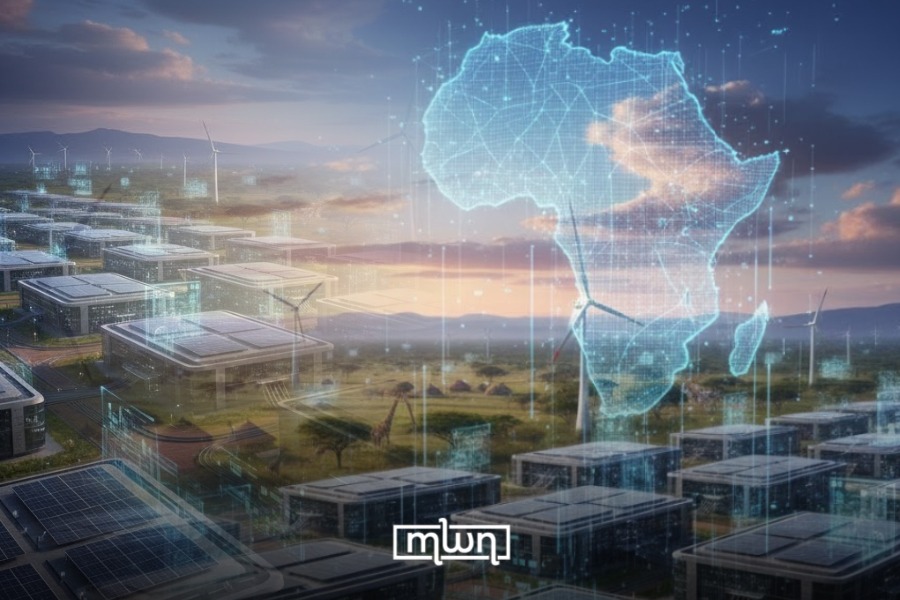
Mohammedia – Africa’s race to build the digital backbone needed for its fast-growing internet economy is accelerating, McKinsey has assessed in its latest report, projecting demand for data center capacity across the continent to triple or even quintuple by 2030 and rise from roughly 0.4 gigawatts today to between 1.5 and 2.2 gigawatts.
The shift marks one of the most significant infrastructure build-outs underway, and it could attract between $10 billion and $20 billion in fresh investment and generate up to $30 billion in revenue across the value chain.
But unlike other regions where large campuses dominate, Africa’s trajectory is defined by uneven demand as regulatory constraints and major infrastructure gaps continue to shape a distinctly local playbook, according to the new McKinsey & Company report, titled “Building Data Centers for Africa’s Unique Market Dynamics.”
Much of the momentum is tied to the continent’s accelerating digital adoption. Governments are rolling out ambitious digital services, from national ID systems to online public platforms, creating substantial demand for secure, local storage.
At the same time, companies are deepening their use of cloud services, with leading African firms expecting a significant rise in cloud workloads.
Consumer behavior is amplifying the curve: smartphone penetration is projected to reach 65 percent by decade’s end, and mobile money — already over 835 million accounts strong — continues to generate enormous flows of data that must be processed swiftly and kept within national borders.
Together, these factors position Africa to grow at a pace comparable with global markets, although the continent’s upside will depend heavily on how quickly AI adoption moves from pilots to full deployment.
A contest shaped by power, connectivity, and early anchors
The push to build, however, is challenged by realities that investors cannot ignore. Power reliability remains one of the sector’s toughest constraints, with some markets experiencing more than 30 outages a month.
To guarantee uptime, operators are increasingly blending grid connections with power-purchase agreements, independent power producers, and captive or shared generation.
Decarbonization pressures add another layer of complexity, as global cloud players push for low-carbon electricity across their footprints.
Connectivity is equally decisive. While Africa now benefits from more than 70 subsea cables, landings remain uneven, and terrestrial fiber infrastructure still lags behind demand.
Countries with stronger redundancy — such as South Africa — are naturally absorbing a larger share of hyperscaler interest. Markets with limited connectivity face a steeper path to attracting large-scale facilities.
Financing remains another hurdle. High capital requirements and uncertain early-stage demand make lenders cautious, especially in markets without strong anchor tenants.
Even so, activity is picking up, backed by major debt packages, development finance institutions, and emerging tools such as asset-backed lending tied to high-value GPUs.
Against this backdrop, the companies best positioned to lead are carrier-neutral co-location providers with the financial depth to build ahead of demand and the neutrality to host hyperscalers.
Leveraging existing enterprise relationships and government trust, Telcos are also advancing in markets where bundled connectivity and managed services give them an edge.
With coordinated investment, power reform, and smarter regional cooperation, Africa’s data center build-out has the potential to unlock a more resilient and competitive digital economy. This would make the continent perfectly capable of matching global innovation on its own terms, McKinsey concluded.
Read also: Orange Maroc Supercharges its B2B Strategy with New 1.5 MW Data Center