

 Join on WhatsApp
 Join on Telegram
Rabat – Cancer is one of humanity’s most formidable health challenges, claiming nearly 10 million lives each year, with global cases projected to rise to 27 million by 2040, according to the World Health Organization.
Surgery, chemotherapy, and radiotherapy have been the cornerstones of cancer treatment for decades. While these methods save lives, they also take a heavy toll on patients’ bodies, as they cause fatigue, hair loss, nausea, and sometimes lasting organ damage.
But a new generation of scientists is exploring gentler and more precise alternatives. Among them is the Optics & Photonics Center team/MAScIR at Mohammed VI Polytechnic University (UM6P), which includes Ms. Amina Badir and Dr. Siham Refki, working under the supervision of Prof. Zouheir Sekkat. Prof. Sekkat, who first introduced this idea in his laboratory, believes that light—quite literally—could transform the way we treat cancer, and he encouraged the team to pursue research in this promising field.
A new way to heal
In a conversation with Morocco World News, Dr. Refki, one of the team members, speaks about their recent research paper, co-authored with Ms. Amina Badir and Prof. Zouheir Sekkat, which explores the use of gold nanoparticles in plasmonic photothermal therapy (PPTT). The technique relies on a simple but powerful concept that combines nanotechnology and light physics to target and destroy cancer cells without harming healthy tissue.
“Traditional treatments are effective but often aggressive,” she explains. “With photothermal therapy, the aim is to treat cancer without attacking normal cells.”
The idea builds on advances in photonics, which is the study of light and its interactions with matter. When light interacts with certain materials at the nanoscale, it can be harnessed to generate heat in a controlled and localized way. “We use light, specifically infrared light, because it can penetrate deeply inside the body,” Refki says. She explains that when it meets the gold nanoparticles injected near cancer cells, it causes them to heat up and kill only the surrounding tumor while sparing the healthy tissues.
This localized heating, known as hyperthermia, raises the temperature of cancerous cells to about 42-45 °C, which is enough to destroy them. The process is minimally invasive, highly targeted, and potentially far less painful than traditional therapies.
Why gold?
Central to this approach are gold nanoparticles (AuNPs), which are tiny particles a thousand times smaller than a human hair. But why gold? “Because gold is stable and biocompatible,” Refki says. “It doesn’t oxidize like copper or silver and can safely enter the body.”
Gold also has unique optical properties, as its electrons resonate with certain wavelengths of light, a phenomenon called localized surface plasmon resonance. This makes it an excellent candidate for converting light into heat. In addition, gold’s chemical surface allows scientists to functionalize it, like attaching molecules, antibodies, or polymers that help the particles recognize and bind to cancer cells.
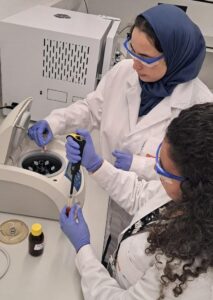
“This surface modification is very important,” Refki explains. “Without it, the nanoparticles wouldn’t know where to go. Functionalization allows them to target the cancer specifically.”
Researchers have experimented with various shapes of gold nanoparticles, including nanospheres, nanorods, nanoshells, nanostars, and nanocages, each with distinct absorption behaviors. “The shape is important,” Refki argues, explaining that spherical nanoparticles are easy to make, but they absorb light in the visible range, not in infrared. Nanorods and nanostars, however, absorb in the infrared, so they’re better suited for photothermal therapy.
Global progress
Though still in early stages, photothermal therapy using gold nanoparticles is not just theoretical. Clinical trials abroad have shown promising results. One company, Nanospectra Biosciences, developed a treatment using gold nanoshells that successfully ablated prostate tumors in 94% of patients during clinical testing.
“They used core-shell nanoparticles to treat prostate cancer, and they achieved good results,” Refki recalls.
Similar studies in Europe and the US have demonstrated the therapy’s safety and effectiveness in animal models and early human trials. Scientists are also exploring hybrid approaches that combine photothermal therapy with chemotherapy or immunotherapy for stronger results. For example, researchers at Rice University have tested nanoparticlebased “nano-bullets” that not only heat tumors but also deliver drugs at the same time.
However, despite these successes, the technology is far from being used routinely in hospitals. “We still need more research,” Refki concedes. “There are questions about long-term safety, like whether nanoparticles stay in the body or leave it, and about how to control the laser’s power so it’s effective but not harmful.”
Developing a safe and affordable treatment involves solving several scientific and practical challenges. The first is toxicity. Even though gold is considered safe, nanoparticles can behave unpredictably inside the body. Scientists must ensure they don’t accumulate in organs or cause unwanted immune reactions.
The second challenge is scalability. “We can synthesize nanoparticles in small quantities in the lab,” Refki says, “but there is no standard protocol for producing them in large amounts for clinical use.” Manufacturing consistency and quality control are essential before any medical technology reaches patients.
Then there’s the issue of cost: gold itself is expensive, and producing medical-grade nanoparticles adds to the price. Yet, as Refki points out, “the advantages of gold, its stability, safety, and ability to bind biological molecules, make it hard to replace.” Researchers are nonetheless exploring cheaper alternatives and even biodegradable nanomaterials for the future.
Finally, the therapy requires precise laser control. Too little energy, and it won’t destroy the tumor; too much, and it could harm surrounding tissue. “We usually work between one and ten milliwatts per square centimeter,” she details. “It’s all about optimization, of the nanoparticle, the light, and the cancer type.”
From lab to clinic
For now, photothermal therapy remains largely confined to research labs. But its potential extends beyond treatment. The same nanoparticles can be used for diagnosis to detect cancer cells before they grow into tumors. Prof. Sekkat’s lab at UM6P is already exploring this theranostic approach, combining therapy and diagnostics in a single system. “We can imagine a package that detects and treats at the same time,” she says. “It’s a step toward personalized, less painful cancer care.”
Globally, nanomedicine is moving in this direction. According to recent reviews, hundreds of clinical trials worldwide are now evaluating nanoparticle-based cancer therapies, including studies of gold-based nanoparticles. While most are still experimental, the results point to a future where such treatments could complement or even replace traditional methods.
Of Morocco’s position in this field, Refki is both realistic and optimistic. “We still need more research and collaboration,” she acknowledges, noting that diagnosis remains a big challenge and that early detection is important to make any treatment efficient. But the potential is there, the researcher believes, saying that “universities are investing in advanced research, and we are building expertise.”
The Optics & Photonics Laboratory at UM6P is among the first in Morocco to explore such advanced biomedical applications. Beyond healthcare, the lab also studies photonics for agriculture, renewable energy, and environmental sensing, showing how light can be a tool for multiple sustainable solutions.
Refki sees collaboration as the next step. “Photonics brings together people from biology, physics, chemistry, and Data science,” she says, highlighting the need to connect research with hospitals and medical centers to make these innovations reach patients. If photothermal therapy fulfills its promise, cancer treatment could become more personalized, targeted, and humane. “Maybe one day, instead of toxic chemicals or radiation, we’ll use light and nanoparticles,” Refki says with a smile. “It’s more precise and gentle.”