
 Join on WhatsApp
 Join on Telegram
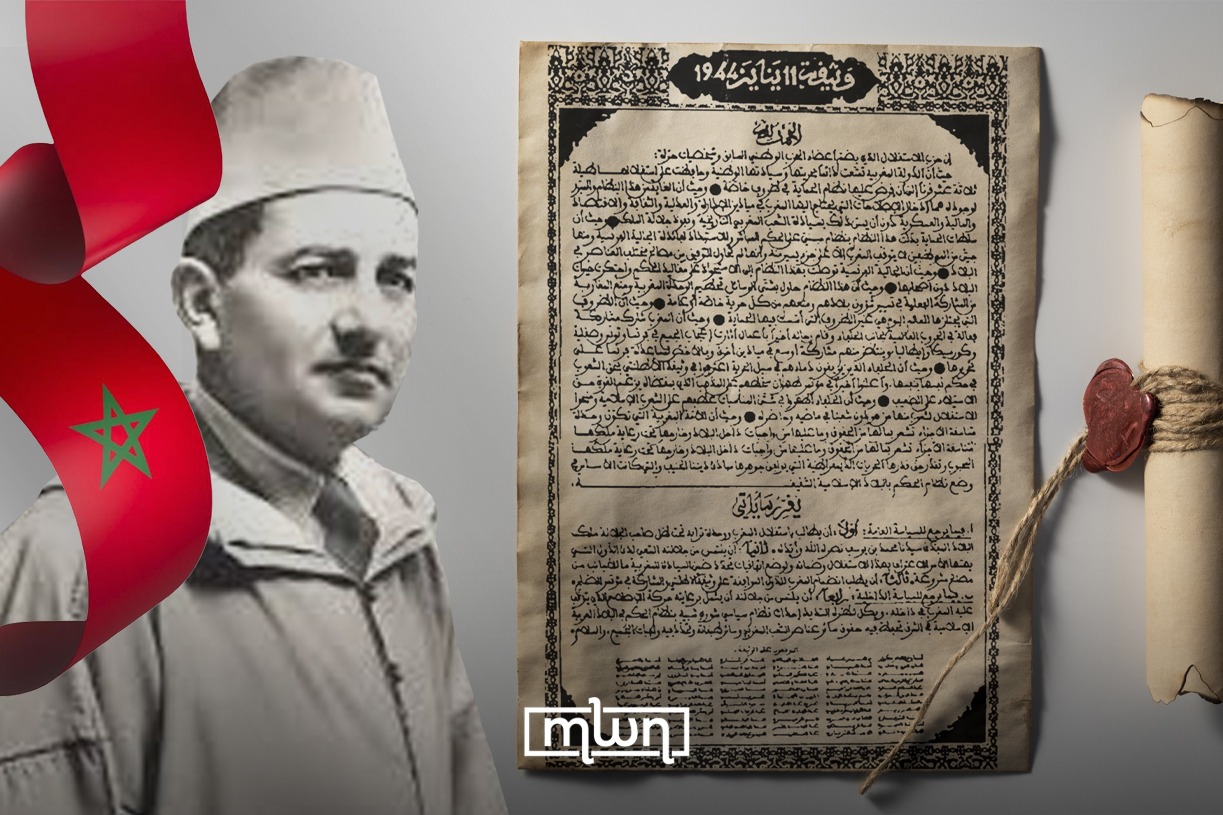
Mohammedia – Morocco will mark on Sunday the 82nd anniversary of the Independence Manifesto, the declaration submitted on January 11, 1944, that formally demanded the end of colonial rule and placed independence at the center of the country’s political struggle.
Presented during the French protectorate, the document is widely regarded as the moment when Moroccan nationalism moved decisively from reformist demands to a clear and public call for sovereignty.
The manifesto was addressed to Sultan Sidi Mohammed Ben Youssef, later King Mohammed V, and delivered to French authorities as well as foreign diplomatic missions.
By putting independence into writing and backing it with organized political leadership, Moroccan nationalists transformed long-standing aspirations into a concrete political position, one that colonial authorities could no longer ignore.
Morocco on the eve of January 11
In 1944, Morocco was still divided under multiple forms of foreign control. France administered the central regions under the 1912 Treaty of Fez, Spain governed parts of the north and south, and Tangier was placed under international administration.
This fragmented system limited Moroccan self-rule while allowing colonial powers to maintain political and economic dominance.
World War II reshaped this environment. Allied forces landed in Morocco on November 8, 1942, as part of Operation Torch, the Allied invasion of French North Africa, with troops arriving in Casablanca and other strategic locations to secure Vichy-controlled territories and open a new front against the Axis powers.
This development followed the fall of Paris to Nazi forces in June 1940, a defeat that led to the collapse of the French Third Republic and the establishment of the Vichy regime, significantly weakening France politically, economically, and militarily.
The consequences extended to its colonies, including Morocco, where wartime pressures disrupted food supply systems and contributed to severe shortages.
The period around 1944 and 1945 became known as the “Year of Rationing.” It was marked by famine and disease, as colonial resources were redirected to support the war effort, further intensifying social and political strain.
These developments created both pressure and opportunity, encouraging Moroccan nationalists to advance demands that had previously been framed in more cautious terms.
This shift was reinforced by the January 1943 Anfa Conference in Casablanca, which brought together US President Franklin D. Roosevelt, British Prime Minister Winston Churchill, and Free French Leader Charles de Gaulle.
The meeting underscored Morocco’s emergence as a strategic wartime space rather than a peripheral colony, and highlighted the limits of the French authority under the Vichy regime.
It also elevated Sultan Mohammed V’s international visibility, particularly through his exchanges with Roosevelt, strengthening nationalist confidence and contributing to the postwar push for independence.
From armed resistance to political nationalism
Throughout the 1930s, Moroccan political activism had focused largely on reform. Nationalist groups petitioned colonial authorities to protect local institutions and curb discriminatory policies.
This phase marked a transition from earlier forms of resistance that had been primarily military and locally rooted.
From 1910s onward, armed opposition to colonial penetration had been led in various regions by figures such as El-Hiba in the south, Moha ou Hammou Zayani in the Middle Atlas, and Assou Oubasslam, as Amazigh tribes and local leaders carried the burden of resistance on the battlefield.
These movements defended sovereignty long before organized political nationalism took shape in urban centers, laying the groundwork for a later shift toward coordinated political action as different components of Moroccan society gradually converged around a shared independence project.
But repeated bans on political organizations and the repression of activists convinced many that reform within the protectorate system would not lead to meaningful change.
By the early 1940s, independence had become a shared objective rather than a distant ambition.
Sultan Mohammed V played a central role in this shift. His growing alignment with nationalist leaders gave the movement a unifying reference point and reinforced the idea that independence was not a fringe demand but a national cause.
Historical accounts describe his efforts to assert Morocco’s sovereignty and cultural identity at a time when colonial authorities sought to reduce the monarchy’s political influence.
Inside the manifesto and its signatories
The Independence Manifesto was signed by 66 Moroccan nationalists from different regions and social backgrounds.
Teachers, judges, merchants, civil servants, and political activists were among those who placed their names on a document they knew could lead to arrest or exile.
It demanded full independence, territorial unity, and the establishment of political institutions capable of representing the Moroccan people.
The delivery of the manifesto was carefully planned. Copies were presented not only to the French Residency-General and the Sultan but also to the consulates of major Allied powers.
This diplomatic approach reflected the national movement’s awareness of international politics and its attempt to situate Morocco’s cause within the broader postwar conversation on self-determination.
One name stood out among the 66 signatures. Malika al-Fassi was the only woman to sign the manifesto.
Her presence reflected her personal involvement in nationalist and intellectual circles, particularly in Fez, and remains one of the clearest indications that women played active roles in Morocco’s independence movement.
While their contributions were often less visible in official records, women were involved in political organizing, education, and communication networks that supported the broader struggle.
The manifesto’s content and the unity it represented marked a turning point. It rejected the protectorate’s political framework and asserted Morocco’s right to decide its own future, under the authority of the Sultan and with institutions shaped by Moroccan society itself.
Public reaction and the road to independence
News of the manifesto spread quickly across the country. Contemporary accounts describe how its message circulated through cities and towns, reaching markets, mosques, and private gatherings.
For many Moroccans, it was the first time independence had been demanded so openly and collectively.
The colonial response was swift. French authorities launched arrests and repression in the days and weeks that followed.
This crackdown triggered protests in several cities, including Rabat, Salé, and Fez, deepening the confrontation between colonial administration and nationalist forces.
Rather than halting the movement, these measures reinforced the manifesto’s significance as a catalyst for broader mobilization.
The years that followed were marked by escalating tension. The exile of Sultan Mohammed V in 1953 intensified resistance and strengthened the bond between the monarchy and the population.
His return in 1955 opened the door to negotiations that ultimately led to the restoration of Morocco’s independence in 1956.
Looking back, January 11, 1944, is widely seen as the moment when Morocco’s independence movement gained irreversible momentum, transforming scattered political demands into a coordinated national project.
Sovereignty then and now
The Independence Manifesto placed sovereignty and territorial integrity at the heart of Morocco’s political vision, principles that continue to shape the country’s priorities today.
These themes remain central to Morocco’s position on the Sahara, which Moroccan authorities consistently frame as an extension of the independence struggle articulated in 1944 and a core element of national unity.
That continuity was reflected most recently at the UN Security Council, which on October 31, 2025, adopted Resolution 2797 extending the mandate of MINURSO until October 2026.
The resolution recognized Morocco’s Autonomy Plan as the genuine political process to end the dispute over Western Sahara.
11 members voted in favor of the resolution, including France, the United Kingdom, and the United States, with no votes against and three abstentions.
In parallel with UN-led efforts, Morocco has continued to consolidate international support for its position, including through expanded diplomatic presence in the southern provinces and sustained engagement with partners in Africa, Europe, and the Arab world.
As Moroccans commemorate January 11, the Independence Manifesto remains a key reference point in modern political life, not only as a historic declaration, but as a document whose principles continue to inform Morocco’s approach to sovereignty, diplomacy, and territorial integrity more than eight decades later.
Read also: Senegal Renews Support for Morocco’s Territorial Integrity