Join on WhatsApp
 Join on Telegram
Rabat – An overwhelming majority of Premier League fans are against the use of the Video Assistant Referee (VAR). A recent survey conducted by the Football Supporters’ Association of 8,000 fans found that 75% of fans are against the use of VAR and over 90% do not believe it has improved the matchday experience, with 91% claiming that it has not made watching the matches on TV more enjoyable.
Football Supporters’ Association network manager, Thomas Concannon, told BBC sport,“The results show that most fans want VAR removed.” He continued, “People are annoyed about the time that it takes, annoyed about the accuracy, and annoyed about the [reduced] spontaneity.”
The results of the survey show that fans are highly critical with 72% believing that it does not make refereeing more accurate and 74% believing that the reasoning behind decisions is not clear.
The Premier League has previously stated, “Premier League research indicates fans are largely in favour of keeping VAR, but improving the way it is used.”
It is highly unlikely that VAR is going away anytime soon. In a 2024 vote 19 out of the 20 Premier League clubs voted to keep VAR with only the Wolves voting against it. In order to remove VAR a club would have to propose its removal followed by 14 of the 20 clubs being in favor of its abolition.
Criticism of VAR is well-deserved, given the high number of mistakes; the Premier League Key Match Incidents panel reported a total of 54 errors by referees, up from 44 at this point last season. There have already been as many VAR mistakes this season (18) as the entirety of last season.
Professional Game Match Officials (PGMO) have claimed the general trend is positive citing the 23-24 season with 70 mistakes after 30 games. They have also indicated that stoppage time from VAR is down 25% from 63-48 seconds.
Recent VAR Controversy
Looking at recent decisions in the Premier League including decisions made earlier this month in Arsenal vs Everton and Manchester United vs Aston Villa the use of VAR has been heavily criticized
The Gunners were not awarded a penalty in the first half after striker Kai Havertz went down in the box after a challenge from Everton’s Michael Keane. Arsenal appealed for a penalty but after review the VAR upheld the referee’s initial no penalty decision.
Former referee Dermot Gallagher analyzed Arsenal’s penalty appeal against Everton on Sky Sports’ Ref Watch show. “I thought it was a penalty,” Gallagher said. “I was a forward and I alluded to this before, that’s what I was taught – push the ball there, step across (the defender), he’s out the game, clips his heel.”
“I wonder if they were looking at the upper body, and think ‘well, there’s not enough for a foul there’. But I think it’s a foul, because I think he steps on his heel.”
Former Arsenal striker and Sky Sports commentator, Alan Smith echoed the same sentiment, “It’s a foul all day long. I’m listening to the VAR trying to explain it to the referee.”

Michael Keane Challenges Kai Havertz in the Penalty Box. Photo by Justin Setterfield/Getty Images
VAR Explains Aston Villa Controversy
The matchup between Aston Villa and Manchester United sparked controversy early in the second half when Villa’s Ross Barkley shot an electric equalizer past the keeper. The controversy comes in whether offside midfielder Amadou Onana obstructed the keeper’s view or touched the ball before it sank into the back of the net.
The head referee awarded the goal triggering a VAR review; after review the goal stood. The Premier League Match Centre explained the decision on X stating, “The referee’s call of goal was checked and confirmed by VAR, with Onana in offside position, but not deemed to be in the goalkeeper’s line of vision or to have touched the ball”.
Under current rules, an offside player must interfere with the opponent or play to be penalized. This has most often been invoked when an offside player either touches the ball or interferes with the keeper’s line of sight. One such example is Manchester City’s defeat of Liverpool last November, when Virgil van Dijk’s header against Manchester City was overturned for offside. Andy Robertson was deemed to be blocking the keeper’s line of sight.
Gary Neville from Sky View commentary suggested that it may be difficult to say that Onana obstructed the keeper’s vision especially since he had no chance at the ball, “There’s a look at the offside, but that would be really harsh. Lammens would have had no chance.”
The analyst however did suggest that it is possible that the offside player touched the ball, “Has it hit his back, has it flicked him? How can you see? It’s impossible to tell whether that hits Onana or not really. It’s very close to him, that’s for sure.”
“That is where I got to with it, you can not be sure that the ball has hit Onana. Only he would know and he is unlikely to admit it. Oh, has he just said it did?”
Upset fans also took online to vent their frustration with the call one fan wrote: “Onana is in the way of the keeper whilst offside and the ball touched him.” another stated “Doesn’t touch Onana ‘No conclusive proof’ but in moving his body away or towards the ball, fools/tricks the keeper, therefore is interfering with play and is offside, surely?”
It is unlikely to know if this decision had any impact on the outcome of the game as Manchester City rallied after the conceded goal to score two more in the second half leading to a 3-1 victory.
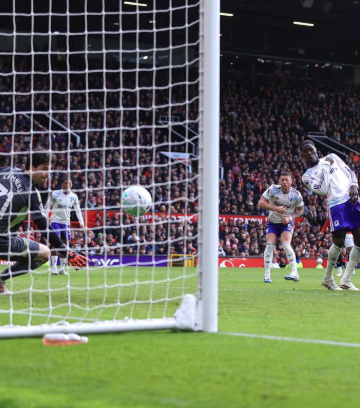
Aston Villa’s Ross Barkley scores against Manchester City to make the score 1-1 early in the second half. Source:Simon Stacpoole Getty Images
Egregious Decisions in Newcastle vs Aston Villa Show Why VAR Matters
Perhaps in one of worst refereed games in recent history, Newcastle defeated Aston Villa 3-1 in the fourth round of the FA cup. VAR was not being used during this game and led to three major missed calls including an offside opening goal, a missed penalty, and missed red card.
The first missed call was Tammy Abrahams opener from the free kic. The Villa striker was clearly offside when the free kick was played, however the flag from the assistant referee stayed down. The offside was a clear missed call and with VAR this goal would have been easily disallowed.
The most egregious missed call in this game was the unawarded penalty after fullback Lucas Digne handled the ball in the penalty area. The Aston Villa player was at least a full yard inside the penalty box when he handled the ball yet, Newcastle was only awarded a free kick.
In an interview with Match of the Day Live, former England striker Wayne Rooney stated, “That decision is one of the worst decisions I have ever seen in football because at no stage was Digne out of the penalty box”
Former Newcastle forward Alan Shearer told BBC, “There is no excuse whatsoever for the assistant, who is 10-15 yards away.” He continued stating, “I don’t think that is a difficult decision at all. In fact, it is easy. At this standard, that has to be given.”
Again another decision that should have been called but with VAR would have been easily overturned.
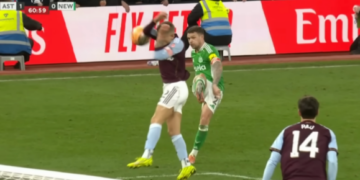
An incorrect free kick was awarded for a Lucas Digne handball in the box. Source ESPN
The next controversial decision involved a missed red card after a dangerous shin high tackle by Digne on Newcastle midfielder Jacob Murphy. Which while there is some speculation would have remained with the on-field decision even with VAR review; others like Sherear felt like the decision was clear cut, “Digne should have been sent off for a terrible tackle”
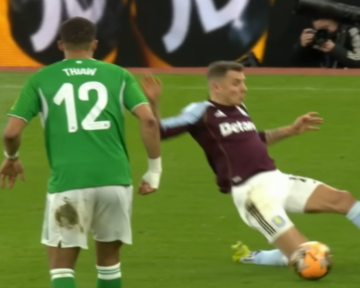
Aston Villa’s Lucas Digne awarded a yellow card after a dangerous shin high tackle source:ESPN
Shearer continued to slam the referees stating, “I would say out of five, maybe four, big decisions, simple decisions, I would say, they got one correct” . The one correct decision he might be referring to was to send off Aston Villa’s goalkeeper Marco Bizot after a foul that was initially claimed to be a serious foul play as his tackle was knee-high and nowhere near the ball but was later claimed to be denial of clear goal scoring opportunity.
Aston Villa keeper Marco Bizot sent off after a dangerous foul on Newcastle’s Jacob Murphy source: Alan Walter/Shutterstock
The referring in this game demonstrates the critical need for VAR in the premier League, however it also shows another dangerous trend: overeliance on VAR by officials. Alan Sherear commented on the potential damage of VAR on officiating, “If you ever needed any evidence of the damage that VAR has done to referees, I think today is a great example of that. These guys look petrified to make a decision today because they didn’t have a comfort blanket.”
Aston Villa boss spoke out after the match reinforcing the need for VAR to help referees, “Today it makes sense understanding that VAR is necessary. It’s necessary to help the referees.”
One thing is clear, VAR in the premier League is not going anywhere anytime soon, however, with the new expanded powers of VAR to review second yellow cards and corner kicks the efficacy and accuracy of VAR will be under increased scrutiny as the 2026 World Cup approaches and mistakes continue to pile up.