
Rabat – Foodborne illnesses represent a major public health challenge worldwide, and contaminated poultry products are among the most common sources of bacterial infection. Salmonella, one of the leading causes of food poisoning, remains a serious concern for both consumers and food producers because detecting it quickly is often difficult.
Traditional testing methods can take up to two days to confirm contamination, which slows down food safety decisions and adds pressure on producers. To address this problem, researchers at University Mohammed VI Polytechnic developed a faster and simpler detection method that can identify Salmonella in chicken in less than an hour using a color-based molecular test.
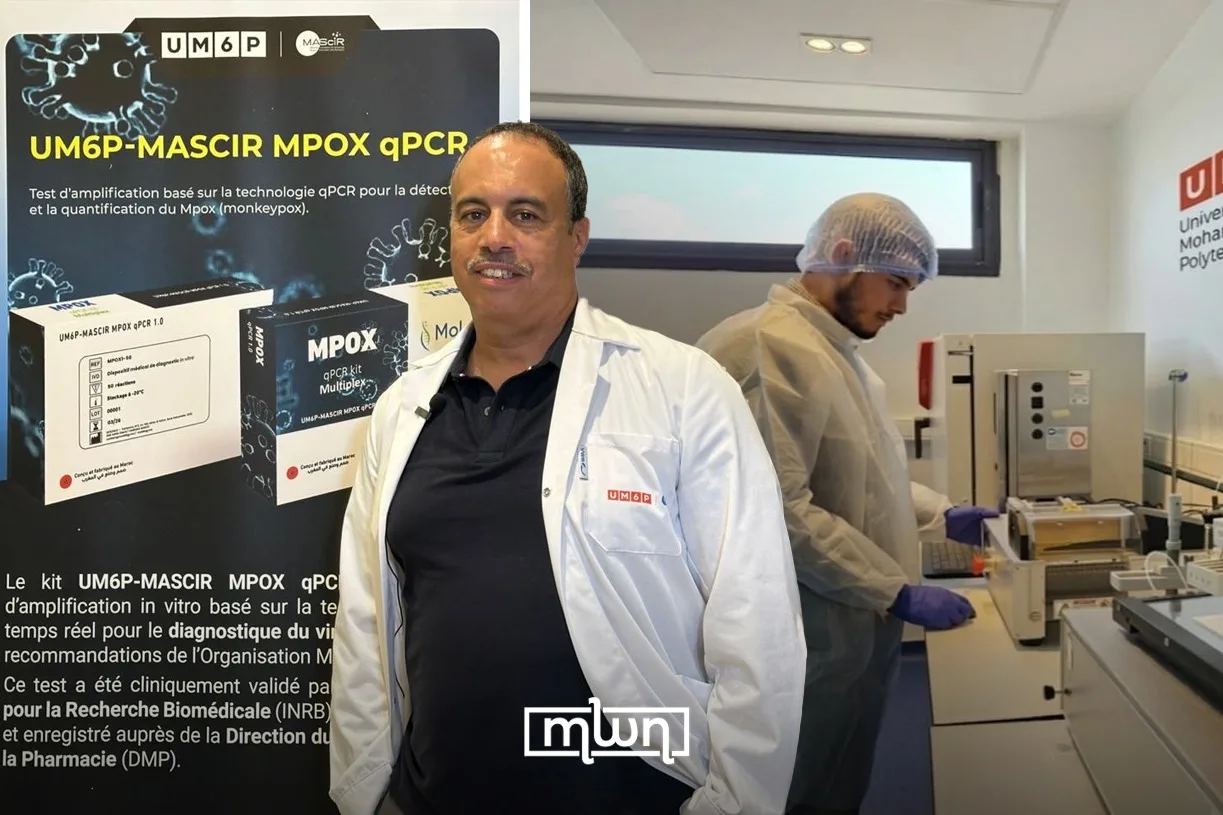
Morocco World News (MWN) spoke with Abdeladim Moumen, Director of the Diagnostic Kits and Medical Devices Development Laboratory at UM6P, to better understand how the method works and why the team believes it could improve food safety screening.
Moumen explained that conventional methods are reliable but slow and costly because they often depend on enrichment and DNA extraction. The UM6P team instead developed a cLAMP method using an in-house Phenol Red buffer that detects Salmonella directly, without pre-enrichment or DNA extraction, an approach the researchers say has not previously been reported in the literature for this application. The aim, he said, was to build a complete solution “from A to Z” that would be “quick, specific, performant.”
“We wanted to develop tests which are produced in Morocco, developed in Morocco, and the main objective is to reduce the price,” Moumen said.
That challenge is especially relevant because Salmonella remains a major food safety issue. Foodborne illness affects one in 10 people worldwide each year and causes 420,000 deaths, with Salmonella among the main causes. In Morocco, no Salmonella is allowed in 25 g of chicken products, which makes rapid and accurate testing essential for inspectors and producers alike.
‘100% Moroccan brain, 100% Moroccan hands’
The team’s solution is a colorimetric LAMP test, or cLAMP. LAMP is a DNA amplification method that works at one constant temperature instead of cycling through multiple temperatures like PCR. Unlike PCR, which requires more complex equipment, LAMP only needs a steady temperature of 65 degrees, and the result is visible through a color change.
Moumen also said the broader objective was to develop tests that are “100% Moroccan brain, 100% Moroccan hands,” so the country can produce more of its own diagnostic tools instead of relying on imports. He noted that most of these reagents are produced in countries such as the United States, China, and across Europe, adding that dependence on imported materials significantly increases the cost of diagnostic tests.
“To develop these tests, we still need reagents that are not produced in Morocco and must be imported,” Moumen said. “Sometimes we face delays because importing health-related materials requires authorization from the Ministry of Health, and that process can take time. In research and development, time is critical.”
The visual part is what makes the test easy to read. The assay uses Phenol Red, a pH indicator that changes from pink to yellow when amplification occurs. The researchers designed the buffer in-house and targeted the hilA gene, which is conserved across Salmonella strains and helps improve specificity. The gene was selected because it remains relatively stable across different Salmonella serotypes, making it a strong marker for assay design.
The team had to solve a practical problem to make the method work directly on chicken meat. Chicken naturally has an acidic pH, which could interfere with the color reaction. They therefore tested different NaOH levels and settled on 12.5 mM as the best pretreatment. The researchers treated 50 chicken breast samples and found that the pH values were mostly stable and clustered around the target range. Moumen explained that the goal was to know quickly whether the meat was clear of Salmonella before it reached the consumer, so that a decision could be made without delay.
The study produced promising results. The method detected Salmonella at concentrations as low as 3.9 CFU/µL in laboratory testing, showing a high level of sensitivity. The paper said the performance was comparable to real-time PCR. In artificially contaminated chicken samples, the version that used DNA extraction detected Salmonella down to 10 CFU/µL in one sample and 1 CFU/µL in another.
The heat-treatment version was slightly less sensitive, but it still detected the original solution and some dilutions, suggesting the assay could be useful even when full extraction is not practical. Moumen affirmed that the method is highly effective for detecting Salmonella at the concentrations that matter for food safety screening.
The test was also specific. The researchers checked it against Salmonella and non-Salmonella strains, and only the Salmonella samples turned positive. That level of selectivity is important in food testing, where a false positive can be costly and a false negative can be dangerous. Moumen said the team also tested the method against several bacteria, including E. coli, Listeria monocytogenes, Proteus, and Staphylococcus, with no color change in the negative controls.
From lab to market
What makes the study especially interesting is that it is not limited to one bacterial test. Moumen said the same approach can be adapted to other DNA-containing pathogens. He told MWN that the lab is also expanding its work into animal and plant diseases, reflecting broader needs in food safety and agriculture. He cited ongoing research on chicken, tomato viruses, tuberculosis, breast cancer, leukemia, and hepatitis across the lab’s wider research and development pipeline.
“This is the idea behind UM6P. Our main objective is to do research and convert it into economic value,” Moumen said.
Moumen noted that the team is already close to bringing the technology to market, as the Salmonella assay is currently in its final stage of validation. UM6P has previously commercialized diagnostic tools developed using the same approach.
A key element in this transition from laboratory to market is Moldiag, the UM6P spin-off responsible for manufacturing and commercializing diagnostic tests developed by the research team. Built on experience gained during the COVID-19 pandemic, the company was created to bridge the gap between academic research and industrial production.
“Through the creation of a startup called Moldiag, we were able to manufacture, produce, and commercialize our COVID-19 test during the pandemic. It was the first diagnostic test fully developed and produced in Morocco,” Moumen told MWN.
Through Moldiag, several laboratory-developed tests, including those targeting infectious diseases and certain cancers, have already moved beyond validation into practical use. This structure ensures that scientific developments are not limited to publications, but are transformed into locally produced diagnostic tools that can be deployed in real-world settings, Moumen said.
The team is now preparing for the next stage of validation, which will include larger sample sizes to ensure compliance with regulatory standards and to better evaluate performance under mixed or uneven contamination conditions.
For Morocco and similar contexts, the method could offer significant practical value. A fast, visible, and lower-cost test would allow inspectors, laboratories, and food producers to respond more quickly and reduce potential losses. It could also reduce reliance on imported diagnostic kits and reinforce the broader push toward locally developed, cost-effective solutions.