
 Join on WhatsApp
 Join on Telegram
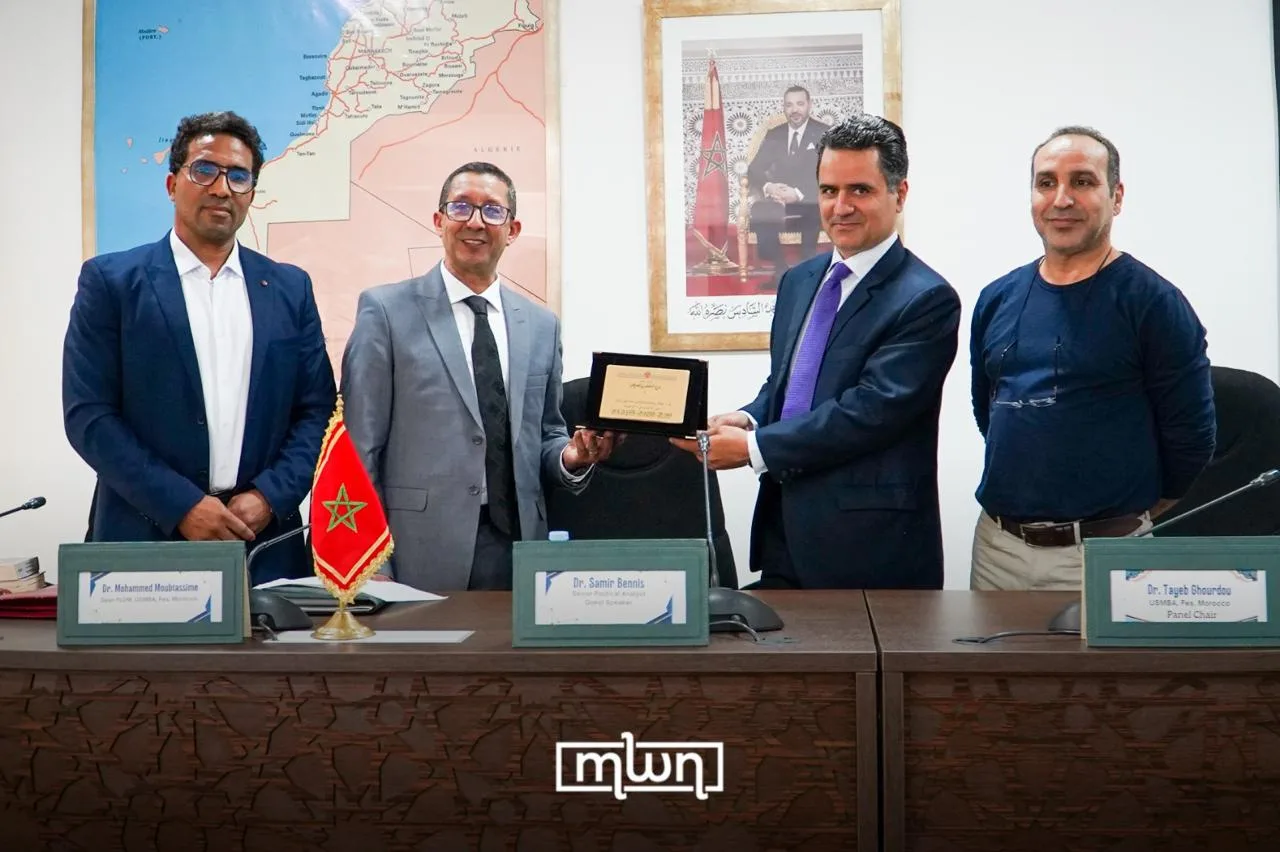
Fez – At a book reading session in Fez, Moroccan political analyst and CEO of Morocco World News Samir Bennis discussed the role of historical archives, international narratives and geopolitical strategy in the Moroccan Sahara issue.
The discussion was hosted at Sidi Mohamed Ben Abdellah University’s Faculty of Letters and Human Sciences, bringing together students, researchers and academics for an exchange on the historical and diplomatic dimensions of the Sahara question through the themes explored in Bennis’s book, “The Unholy Alliance: The Hidden Conspiracy Behind the Spanish-Algerian Plot Over Morocco’s Sahara (1965–1979).”
The event formed part of a wider academic conversation around the importance of archives, political communication and historical interpretation in understanding long-standing geopolitical conflicts.
Throughout the session, attendees discussed the relationship between diplomacy, media narratives and international influence in shaping perceptions of territorial disputes.
During the session, Bennis reflected on the research process behind the book, explaining that his work relied primarily on original archival material rather than depending only on previously published interpretations of the conflict.
According to the author, revisiting historical records was central to understanding how diplomatic narratives surrounding the Moroccan Sahara evolved over time and how they continue to influence international perceptions today.
He noted that his research included access to United Nations archives dating back to 1957, in addition to documents from the CIA and the United States Department of State.
The book also references international media coverage from publications including The New York Times and Le Monde, which Bennis used to trace how the Sahara issue was presented and debated internationally during key political periods between 1965 and 1979.
Speaking before attendees, Bennis also referred to his professional experience within the United Nations system, particularly his work connected to the Fourth Committee.
He explained that this experience gave him direct exposure to diplomatic discussions related to Morocco’s territorial integrity and allowed him to better understand the mechanisms through which international positions and narratives are formed inside multilateral institutions.
A significant part of the conversation focused on the relationship between politics, diplomacy and narrative-building.
Bennis argued that geopolitical conflicts are not shaped exclusively through historical facts or official negotiations, but also through the ability of states, institutions and media actors to influence international discourse and public opinion.
He added that archives and diplomatic records remain essential tools for revisiting contested historical events, particularly in cases where political narratives have developed over decades through international institutions, foreign policy debates and media representation.
A book built around historical reconstruction
Beyond its historical documentation, the book presents an extensive political and diplomatic analysis of one of the most sensitive periods in modern Moroccan history.
Spanning more than 500 pages, the work examines the years leading to the Green March and reconstructs the diplomatic tensions between Morocco, Spain, Algeria and other international actors between 1965 and 1979.
Rather than treating the Sahara issue as an isolated territorial conflict, Bennis engages with it as a broader geopolitical struggle shaped by colonial legacies, regional rivalries and competing international interests during the Cold War era.
A major focus of the book centers on Spain’s political strategy during the final years of its colonial presence in the Sahara.
Through archival documents and diplomatic records, Bennis argues that Spanish authorities attempted to preserve influence in the region by encouraging political structures capable of supporting the idea of a separate Sahrawi identity aligned with Spanish interests.
The book also examines the deterioration of relations between Morocco and Algeria during the same period.
According to Bennis’s analysis, Algeria increasingly approached the Sahara issue not only through ideological arguments linked to self-determination, but also through broader regional and strategic calculations connected to influence in North Africa and access to the Atlantic.
One of his central arguments d is that the conflict evolved through a combination of diplomacy, media influence and international lobbying rather than through military confrontation alone.
Bennis analyzes how international narratives surrounding the Sahara issue were constructed inside diplomatic institutions, newspapers and academic circles, arguing that political communication played a major role in shaping global perceptions of the conflict.
The book also places strong emphasis on Morocco’s diplomatic strategy during the 1970s, particularly under the leadership of the late King Hassan II.
According to the analysis presented in the book, the Green March represented both a symbolic and strategic turning point.
Bennis describes it as a carefully calculated political initiative designed to pressure Spain diplomatically while strengthening Morocco’s position internationally without direct military escalation.
The author further examines how divisions inside the Spanish political establishment during the final years of General Franco’s rule influenced negotiations over the Sahara question.
Drawing from intelligence reports and diplomatic correspondence, the book explores how uncertainty inside Spain created opportunities for Morocco to strengthen its diplomatic position internationally.
Another important dimension of the work concerns the role of international powers, particularly the United States, during the crisis.
Bennis uses declassified American intelligence assessments and diplomatic records to analyze how Washington viewed the conflict and the potential consequences of instability in the region during the Cold War period.
Throughout the book, Bennis repeatedly returns to the importance of archives and documentation in understanding modern political conflicts.
He argues that many contemporary interpretations of the Sahara issue overlook important diplomatic and historical details that can only be understood through direct access to official records and international archives.
The analysis also extends beyond governments and diplomacy to examine the role of media narratives and academic discourse.
According to Bennis, the international debate surrounding the Sahara was shaped over decades by selective interpretations that often influenced public understanding of the conflict outside the region.
In this sense, the book positions itself not only as a historical study, but also as a reflection on narrative-building, political influence and the relationship between history and international communication.
Throughout the discussion in Fez, students and researchers engaged with these themes by raising questions about the relationship between archives, sovereignty, media framing and political legitimacy in international conflicts.
The session opened broader conversations on the role of academic research in revisiting politically sensitive historical issues, particularly in societies where questions of memory, identity and territorial integrity remain deeply connected to contemporary public debate.
Beyond the book itself, the event reflected the growing presence of intellectual and cultural discussions taking place in academic spaces in Fez, where history, politics, diplomacy and media studies increasingly intersect.
The session also highlighted the growing interest among younger audiences in discussions that connect historical research with present-day geopolitical realities and international relations.
By revisiting archival documents and diplomatic narratives tied to the Moroccan Sahara issue, the discussion offered attendees an opportunity to reflect on how historical interpretation, political communication and international discourse continue to shape public understanding of regional conflicts decades after the events explored in the book.