Marrakech – The Polisario Front’s carefully curated veneer and meticulously manufactured mythos of national liberation is hemorrhaging credibility at terminal velocity.
Its decades-old masquerade as a bona fide emancipatory movement is collapsing in real time, its geopolitical scaffolding buckling under an avalanche of counterterrorism scrutiny, its threadbare pretense of anticolonial legitimacy disintegrating under the weight of its own contradictions, and its painstakingly constructed facade of revolutionary politics fracturing beyond salvage.
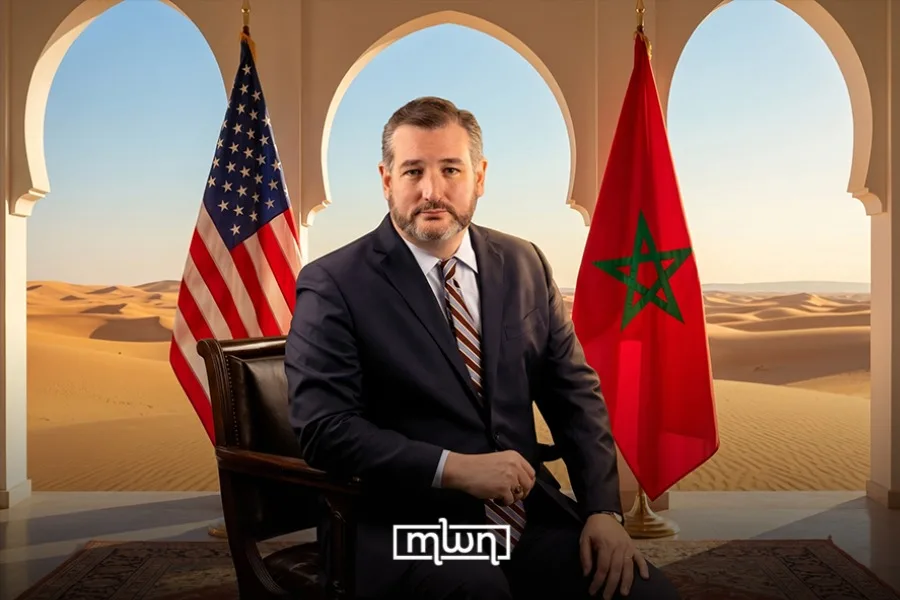
And no figure on Capitol Hill is dismantling that crumbling edifice with more prosecutorial tenacity, accelerating its ideological decomposition with sharper jurisdictional precision, or architecting its institutional ruin with more prosecutorial tenacity or unrelenting legislative lethality and counterterrorism gravitas than US Senator Ted Cruz.
In a pointed intervention to Medi1 TV, the Texas Republican dispensed with diplomatic euphemism and drove straight into the marrow of the matter. The Polisario, Cruz declared, is not “simply a regional separatist group” but an armed appendage of the Iranian regime – “being supported very directly by Iran,” “funded by Iran,” and embedded within “a global network of proxies that Iran is using to wage terror.”
The remarks land barely a month after the Polisario’s brazen projectile attack on the Moroccan city of Es-Smara on May 5, in which three munitions struck the vicinity of a civilian prison and a cemetery, injuring a woman who was evacuated to a provincial hospital with wounds to the leg and shoulders.
The militia, with characteristic cynicism, claimed through its propaganda mouthpiece SPS that it had conducted a “targeted bombardment against enemy rear bases” and inflicted “significant losses” – assertions so grotesquely divorced from ground realities they would be farcical were they not so demonstrably criminal.
Such fabrications – confections of such hallucinatory mendacity, a tapestry of disinformation so ludicrously at variance with operational reality, phantasmagoric distortions so spectacularly untethered from empirical fact that they disintegrated on contact with the most rudimentary battlefield verification – indicate a militia desperate to resuscitate its own relevance, only to author, with each delusional communiqué, the most damning paragraphs of its own obituary.
Cruz referenced the Es-Smara strike explicitly, noting that the Polisario’s resort to indiscriminate ordnance renders it “a more violent terrorist organization than ever before.” He observed, with palpable satisfaction, that the international response this time was categorically different: “It was striking that we saw our European allies call it out for what it was.”
What followed was a diplomatic conflagration of unprecedented proportions, and the geopolitical aftershock reverberated with a ferocity the Polisario’s handlers in Algiers could scarcely have anticipated. The United States, France, the United Kingdom, the European Union, Spain, Belgium, the Czech Republic, Saudi Arabia, Qatar, the UAE, Liberia, Bahrain, and Jordan all issued condemnations – a cascade of opprobrium that constitutes the broadest multilateral rebuke the Polisario has ever absorbed.
The US Mission to the United Nations declared unambiguously that such violence “threatens regional stability and the progress made towards peace.” The US Embassy in Algiers – in a calculatedly surgical move – amplified the message directly into Algeria’s capital, posting that “the status quo serves no one’s interest and cannot continue.”
Read also: In Despreate Bid to Revive Sahara File, Polisario Committed Political Suicide
For Cruz, the Es-Smara attack merely corroborated what he has been prosecuting on the Senate floor for months. At a February hearing of the Senate Foreign Relations Subcommittee on Africa and Global Health Policy, the senator confronted State Department officials over what he branded a “willful blind spot,” accusing the administration of deliberately omitting the Polisario from counterterrorism discussions.
“Iran is trying to turn the Polisario Front into the Houthis for West Africa,” he repeatedly warned, alleging the militia had taken “drones from the IRGC” and facilitated weapons transfers “on behalf of the Iranian regime.”
That rhetorical offensive crystallized into legislative architecture in March, when Cruz, alongside Senators Tom Cotton and Rick Scott, introduced S. 4063 – the Polisario Front Terrorist Designation Act of 2026. The bill compels the Secretary of State to designate the Polisario as a Foreign Terrorist Organization and Specially Designated Global Terrorist if cooperation with Iranian-affiliated entities is substantiated.
Senator David McCormick subsequently co-signed the initiative, while a companion bill, H.R. 4119, introduced in the House in June 2025 by Representative Joe Wilson with bipartisan Democratic co-sponsorship from Jimmy Panetta, continues accruing endorsements.
The latter has swelled to twelve co-sponsors – an ever-widening legislative phalanx that signals not fleeting congressional curiosity but entrenched institutional momentum, a groundswell that betrays unmistakable bipartisan appetite for reclassification.
In his Medi1 TV intervention, Cruz also laid bare the procedural mechanics of designation with uncommon legislative candor, delineating two distinct pathways toward the Polisario’s formal reclassification.
The first, he acknowledged, runs through Congress – a terrain encumbered by the Senate’s filibuster architecture, which demands “at least 60 votes” in a chamber where Republicans command only 53 seats, meaning “a minimum of seven Democrats, maybe more” must be conscripted into the coalition.
That route, he conceded, “will take time” and “is not imminent,” though he predicted that continued Polisario belligerence would steadily erode partisan resistance, noting that if the militia “continues to engage in acts of terrorism,” bipartisan support will inevitably “grow.”
The second – and, in Cruz’s calculus, “the most likely path” – bypasses the legislative labyrinth entirely: an executive designation by the administration, whereby the president, Treasury, and State can “move quite swiftly” to brand the Polisario a terrorist entity.
Cruz framed his own legislative offensive not as an end in itself but as a deliberate instrument of institutional pressure, declaring that he had “introduced this legislation in part to build momentum” and “chaired multiple hearings” to impress upon Washington that the Polisario constitutes a threat “not just to Morocco, but also to the United States.”
Cruz situated the Polisario within Iran’s broader geostrategic calculus with disarming clarity. Tehran, he argued, views Morocco’s stability as an obstacle: “Iran doesn’t want America to have allies in Africa or in the Middle East.”
The Polisario’s utility, in Cruz’s reading, extends beyond the Western Sahara dossier – it is a lever for Iranian influence projection toward the Strait of Gibraltar and, by extension, the European littoral.
Tehran, he argued, is deliberately “fomenting uncertainty, fomenting unrest” because the regime “perceives” destabilization “as in their own interest,” while actively “looking for outposts that are close” to “a handful of global choke points in terms of trade and commerce across the world.”
Morocco, with “its proximity to Europe, its proximity to Gibraltar,” represents precisely such a strategic perch – “one of the reasons that I think Iran cares and is investing in the Polisario Front is to exert power not just in Morocco, but more broadly.”
The senator’s closing formulation left no residual ambiguity: “United States government and United States policy should reflect that reality.” With bipartisan legislative machinery now grinding forward in both chambers, the noose of formal terrorist designation tightens around the Polisario with each passing week – and with it, the diplomatic oxygen available to its Algerian patrons contracts ever further.
Read also: Polisario’s Terrorist Reckoning: Why Morocco Should Escalate Its Washington Lobbying