 Join on WhatsApp
 Join on Telegram
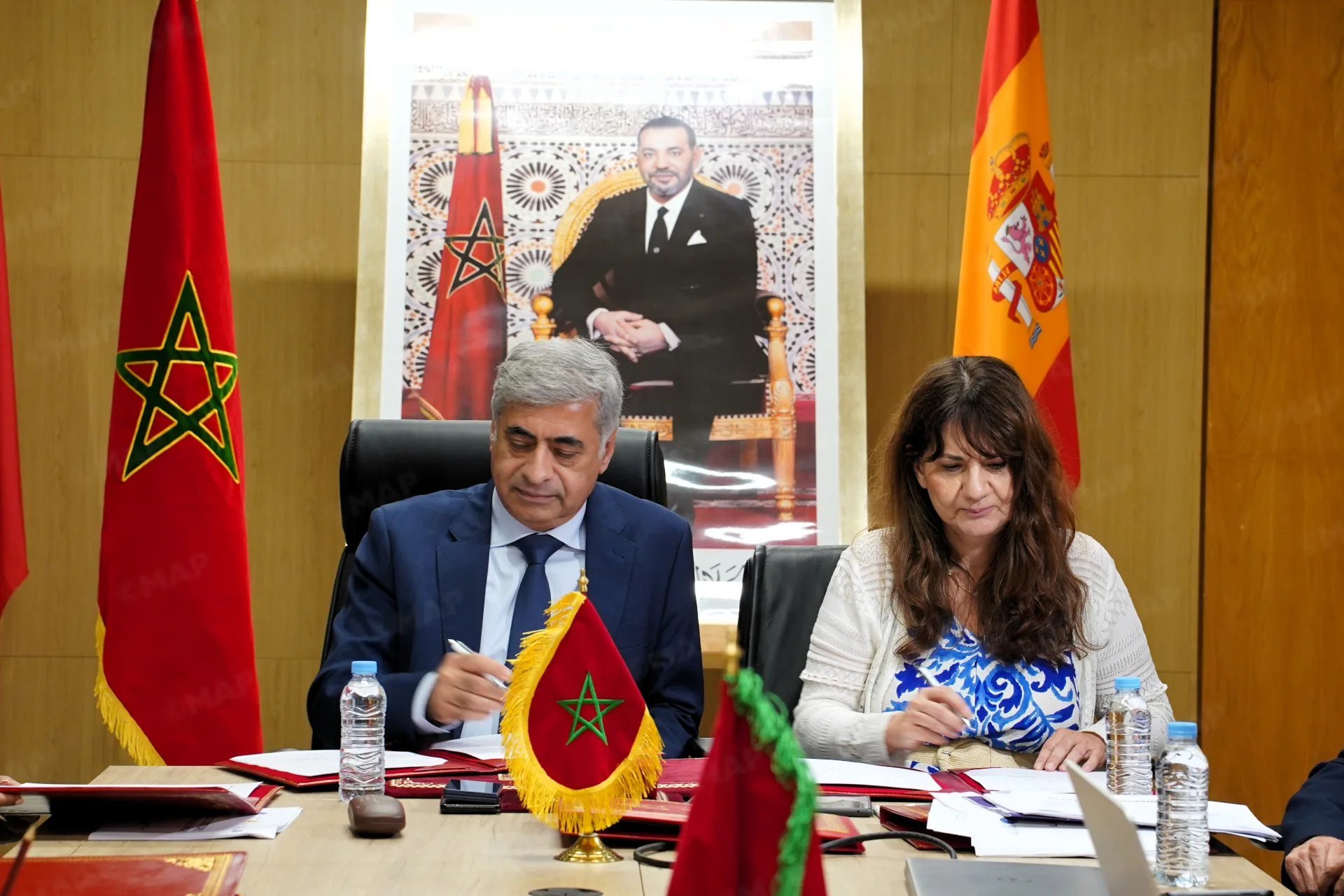
Marrakech – Ibn Zohr University concluded two partnership agreements with major Canary Islands universities in Laayoune on Tuesday, extending Morocco-Spain academic cooperation firmly into the Western Sahara.
The first convention was signed by Ibn Zohr University President Nabil Hmina and the Dean of Laayoune’s Faculty of Medicine and Pharmacy, Fatima Zahra Alaoui Hafidi, with María del Mar Tavío Pérez, Dean of the Faculty of Health Sciences at the University of Las Palmas de Gran Canaria. It targets cooperation in applied research, clinical research, and technological innovation.
The second was signed with Francisco García Rodríguez, President of the University of La Laguna. It covers interdisciplinary scientific cooperation in medical humanities, narrative medicine, clinical ethics, and anthropology.
The agreement also provides for researcher and student mobility, joint research projects, and the creation of an inter-university structure dedicated to medical humanities – designed to strengthen ties between Moroccan and EU higher education institutions.
Hmina told state-owned news agency MAP that the Spanish delegation’s visit builds on cooperation launched since the beginning of the year with both La Laguna and Las Palmas de Gran Canaria.
He noted that several partnership conventions have already been concluded, including with a Canary Islands technological institute, spanning blue economy, climate change, water resource management, tourism, artificial intelligence, and sports sciences.
García Rodríguez, for his part, described the partnership as opening “new perspectives for cooperation” between institutions on both sides. He pointed out that the two Canary Islands public universities already collaborate on climate change, tourism management, energy, and water scarcity.
The Laayoune-Sakia El Hamra and Dakhla-Oued Eddahab regions, he added, face “similar challenges and opportunities” to the Canaries due to their geographic proximity – making this academic cooperation “particularly valuable.” He expressed confidence that the partnership will deliver “joint projects serving the development” of both regions.
The delegations visited the Faculty of Medicine and Pharmacy and the Higher School of Technology in Laayoune. The wali of the Laayoune-Sakia El Hamra region received the Spanish rectors to discuss expanding cooperation between the country’s southern provinces and the Canary Islands institutions.
Separatist influence in Spanish universities reaches a dead end
García Rodríguez’s presence is more than symbolic; it gives the event real political weight. The La Laguna rector was formerly a known sympathizer of Polisario positions.
His visit to Laayoune and Dakhla – and his signing of binding institutional agreements there – amounts to a political defection from the separatist orbit. The agreements shatter the Polisario’s last illusion of relevance in Spanish academic circles, exposing the separatist front as an exhausted political relic abandoned by its own former sympathizers.
They amount to a diplomatic humiliation – a death certificate for the Polisario’s collapsing influence in the very academic spaces it once colonized, and a point-blank institutional burial of decades of separatist infiltration. It is a stark indicator that the Polisario’s ideological stranglehold over segments of Spanish academia is fracturing beyond repair.
That disintegration has been accelerating despite increasingly desperate attempts by the secessionist camp and its dwindling network of Spanish enablers to stem the tide.
In December 2025, El Independiente – a Spanish outlet that has long served as a mouthpiece for Polisario propaganda narratives – published an alarmist report accusing Morocco of launching what it called an “assault on Spanish universities.”
The publication alleged that Rabat was “infiltrating through chairs, academic agreements, cultural events, and funding” with the goal of “improving its image with Spanish public opinion and shaping the discourse on Western Sahara.”
The piece paraded Polisario representatives who branded Morocco’s legitimate academic engagement a political operation designed to “whitewash the occupation” and “obstruct the Sahrawi people’s right to self-determination.”
The rhetoric is textbook separatist disinformation – framing normal institutional cooperation as subversion while the Polisario itself has spent decades weaponizing Spanish universities as platforms for its own irredentist agenda.
That El Independiente’s frantic warning produced no effect whatsoever speaks volumes. Morocco secured academic footholds in Córdoba and at the Universitat Rovira i Virgili in Tarragona. Now, Canary Islands rectors are traveling to the very territories the Polisario claims – to formalize cooperation with Moroccan institutions operating there.
Stripped of political leverage and abandoned by former allies, the front has resorted to crude obstruction. In April, Polisario partisans at the University of Zaragoza attempted to shut down a conference on UN Security Council Resolution 2797, organized by the Moroccan Consulate in Aragon and featuring Bahi Larbi Ennass, a former Polisario member who rallied to Morocco.
Their effort collapsed. The event proceeded, and Morocco’s position reached the student audience regardless.
The Laayoune agreements confirm a trajectory the Polisario can no longer reverse. Spanish universities are engaging with the Western Sahara on institutional terms, through Morocco. The breakaway project is hemorrhaging support in the very spaces it once dominated.