 Join on WhatsApp
 Join on Telegram
The organization of mega-sporting events has established itself as a privileged instrument of soft power, allowing states to exert influence through attraction and persuasion rather than coercion. States now see it as much more than a one-off showcase: a strategic lever to shape international perceptions, build legitimacy and project lasting influence.
Successful bids are no longer judged solely on their ambition or technical capacity, but on their credibility, sustainability and alignment with the broader development strategies of the candidate countries. This requirement has transformed the nature of the application files, which now include objectives of social and economic transformation.
Morocco is a perfect example of this approach. For the Kingdom, the co-organization of the 2030 World Cup with Spain and Portugal is much more than a sporting event: it is a “lever and driver of development” to accelerate the country’s strategic transformation and realize the royal vision of a dynamic, inclusive and modern Morocco.
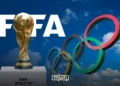
“Sport and politics have nothing to do with each other.” FIFA, the IOC and the BIE repeat this phrase as a credo; yet it is profoundly misleading. From the seminal work of Pierre Bourdieu (see “Choses dits”, 1987, and his “theory of the sports field”), who saw sport as a space for the struggle for the legitimate definition of athletic practice, to Norbert Elias’ analyses of sport as a “process of civilisation” (in “Sport et civilisation”, in collaboration with Eric Dunning, 1994), Sociologists have consistently shown that sport is not a protected enclosure. On the contrary, it magnifies the power relations, the strategies of influence and the struggles for legitimacy that shape the wider world.
The purpose of this essay is to decode how countries win the organization of these major events by going beyond the written law (law in books), the official criteria – stadiums, budgets, legal guarantees – but the “effective” criteria (law in practice), those that emerge from data, testimonies and archives. To do this, I built up a database and then sifted through 28 countries (FIFA), 20 countries (IOC) and 22 countries (BIE), covering five decades of bids (1974-2034). We have built original indicators – the TFP (Proximity to FIFA), the NIC (National Influence) and the FBII (Diplomatic Influence) – to measure from the outside what is really happening behind the scenes because we are unable to carry out investigative work with these organizations.
The results are clear: three organizations, three distinct logics, three implicit rules. And a conclusion that applies to all events: the most careful technical files often lose. The decisive factors lie elsewhere.
The awarding of World Cups by FIFA
Founded in 1904, with 211 member federations, FIFA is a unique private association under Swiss law but very active at international level; One of its particularities is that the president has an exceptional signing power.
As matter of fact all countries hope is to win world cup or at least host one of its edition due to the economic, diplomatic and symbolic soft power impacts; nevertheless organizing or winning the cup is not an easy task. In order to organize a World Cup, it would first of all be necessary to meet the prerequisites, the requirements of a strict set of specifications including a technical file evaluated according to nine criteria, including in particular stadiums, financial guarantees, legal guarantees, not to mention the famous rule of continental rotation between the different continental federations to ensure the universality of the World Cup.
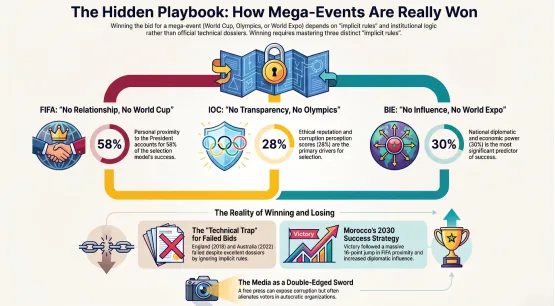
Nonetheless, compliance with these strict technical rules is necessary but not sufficient. Many observers and analysts including the current identifies three preponderant factors: the first, and by far the most important, is the individual relationships with FIFA technostructure measured through a composite indicator the TFP (Proximity to FIFA), which aggregates the meetings and interactions between the FIFA staff and the high dignitaries of the applicant country, institutional anchoring (regional offices, seats on the Council), and symbolic capital (honorary distinctions, praising speeches etc.). The PTF score alone explains 52% of the award results. A country with a PTF score of 100 (the United States) is statistically predicted to host 2.0 World Cups. A country with a score of 0 (the Netherlands) for 0.5. This factor weighs 58% in our model. The correlation between TFP and the number of World Championships organized is 0.72 (p < 0.001). No other variable comes close to this level of prediction.
The second factor is communication restraint at least during the selection process in order to prevent any press interference that could jeopardize the final results of votes and the chances of the candidature ; the analysis suggests that countries where press freedom is controlled (RSF high) are systematically over-represented among recent hosts. The 2026 RSF ranking speaks for itself: Qatar 173rd, Saudi Arabia 173rd, Russia 172nd have all organized or will organise major events. Countries with free media (Norway 1st, Netherlands 2nd, Germany 10th) have hosted few World Cups, in proportion to their national influence. The correlation between RSF and the number of World Championships organized is 0.45 (p = 0.012). J Blatter predicted it the failure of British candidature to host world cup before the 2018 vote: he said the “bad British media” would hurt the English bid; It should be remembered that British journalists have investigated, revealed scandals and exposed bribery. In return, the voters sanctioned England
The third factor is national influence (NIC), a composite indicator that aggregates economic power (GDP, trade), diplomatic power (embassies, UN votes), military power (spending, alliances) and cultural power (soft power, tourism). It weighs 22% in our model. China (NCI = 88.5) has never hosted a World Cup due to a lack of sufficient TFP (6.8). Qatar (NCI = 32.0) organized with a high TFP (46.8). National influence is therefore not a sufficient condition.
It’s worth mentioning that FIFA witnessed a paradigm shift under the leadership of President Gianni Infantino and is moving closer and closer to the more transparent IOC model where organizational capacity and football tradition and performance matter more and more, as demonstrated by the awarding of the 2030 World Cup to Morocco (with Spain and Portugal), which demonstrated its organizational capacity and the competitiveness of its national A team, which reached the semi-finals and the quarter-finals in the last two editions, not to mention the titles of the other categories, including the U20s who won the World Cup under the enlightened leadership of King Mohammed VI.
The IOC “No transparency, no Olympic Games”
After going through a major crisis of legitimacy after the Salt Lake City scandal in 2002, when four members were expelled and ten were sanctioned, the International Olympic Committee carried out a major reform, including banning IOC members from visiting candidate cities – a common practice that allowed for direct lobbying and the exchange of favours. Agenda 2020 (2014) and then the “New Norm” (2018) deepened the reforms: an 80% reduction in bid budgets, the imposition of the use of 93% of existing or temporary venues (Milano Cortina 2026), and the joint allocation of two editions (Paris 2024 and Los Angeles 2028).
Our analysis identifies three overriding factors for hosting the IOC Olympics: the first in importance is transparency, as measured by Transparency International’s Corruption Perceptions Index (CPI), which explains 28% of the variations in our model; countries with a high IPC (Scandinavian democracies, Canada, Germany) are favoured; countries with low CPIs are penalised. The correlation between CPI and obtaining the Games is 0.48 (p = 0.015). What is remarkable is that this factor is much less important in the FIFA model (not significant) and in the BIE model (only 8%). The IOC is therefore the organization where ethical reputation matters most.
The second factor is national influence (NCI), which accounts for 25% of the model. The major powers (the United States, China, France) remain over-represented among the hosts, but this effect is tempered by the demand for transparency. The difference with FIFA is instructive: for the IOC, national influence counts almost as much as transparency (25% compared to 28%); for FIFA, national influence weighs only 22%, far behind the TFP (58%).
The third factor is previous sporting success, as measured by the number of gold medals at previous Games. It weighs 22% in the model. It is a signal of organizational capacity and sporting tradition. Countries that excel in organizing sports competitions are more credible to organize the Olympic Games. Environmental performance (Green Games score) weighs 15%, previous reception experience 10%.
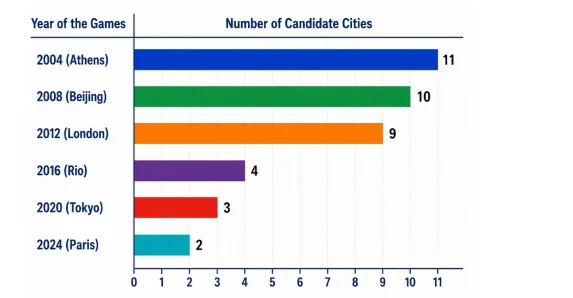
However, it has been observed that, unlike the football World Cup, countries are not rushing to host the Olympics, the number of candidate cities has dropped from 11 to 2 in twenty years, forcing the IOC to reform. The causes of this decline are multiple: excessive costs (Montreal 1976 was reimbursed only in 2006; Athens 2004 left stadiums abandoned), popular opposition (Boston, Budapest, Hamburg withdrew their candidacy after unfavorable referendums), and mistrust of the selection process. The IOC had to reform in order to survive. But the damage is done: cities no longer want to pay the price.
The IOC’s implicit rule is: “No transparency, no Olympic Games.” (No transparency, no Olympics.)
The BIE “No influence, no World Expo”
The Bureau International des Expositions is fundamentally different from the other two organizations; it is an intergovernmental organization, founded in 1928, which has 179 member states, its delegates are diplomats, representatives of member states, and not co-opted natural persons. Unlike FIFA and the IOC, which are associations under private law, the BIE is an organization under public international law. Its delegates receive instructions from their capitals. Lobbying is carried out through traditional diplomatic channels: embassies, state visits, bilateral agreements.
Our analysis identifies three predominant factors of World Expo host countries: the first in importance is national influence (NCI), which weighs 30% in our model (the highest of the three organizations for this factor). The BIE functions as a mirror of the balance of power between states. A country with a high NCI (United States, China, Germany) is statistically more likely to get the organization. The correlation between NIC and obtaining the Expo is 0.52 (p = 0.008).
The second factor is the previous onboarding experience, which weighs 25% in the model. Countries that have already organized a World Expo are favoured, because they have proven infrastructure and know-how. Japan (Osaka 1970 and 2025), Canada (Montreal 1967, Vancouver 1986) and Spain (Seville 1992) benefit from this cumulative advantage.
The third factor is diplomacy at the summit, particularly visits by the head of state, which weighs 22% in the model. The personal presence of the Head of State during the BIE voting sessions is a signal of credibility and political commitment. Crown Prince Mohammed bin Salman made the trip to Paris in June 2023 to defend Riyadh’s candidacy. He obtained 119 votes in the first round (72%). President Yoon (South Korea) and President Meloni (Italy) also made the trip, but their lobbying was less effective. It should be remembered in passing that Nelson Mandela would have weighed relatively well during the FIFA votes in Zurich, a kind of reward for his management of the cohabitation between the Boers and the natives in South Africa after Apartheid.
Comparative synthesis: three organizations, three logics, three rules
The results suggest that the large organizations responsible for awarding international mega-events do not all seem to follow the same logic. In the case of FIFA, winning bids appear to be more associated with relational variables, which could reflect the importance of networks and political dynamics surrounding decision-making processes keeping in mind that applicant shall meet the FIFA’s official criteria, which focus on the infrastructure, governance and organizational capacity.
The IOC has a different profile. The successful bids seem to be more correlated with indicators of governance, transparency, sports performance and sustainability. This configuration is broadly consistent with the image of an institution seeking to strengthen its credibility and reduce the reputational risks associated with the organization of the Olympic Games.
Finally, the BIE seems to give a more important place to the attributes of state power. Winning hosts are more frequently associated with the countries’ international influence, organizational experience, and diplomatic activity. Taken together, these results suggest that, behind broadly similar official criteria, successful bids mobilise different forms of influence: more relational in the FIFA world, more institutional in the IOC and more diplomatic in the BIE.
National strategies to win the organization of mega-events
Beyond the implicit rules specific to each institution, countries that succeed in obtaining the organization of mega-events deploy coherent and multidimensional national strategies. The analysis of the winning bids reveals several common pillars which, combined with the specific logics of each organization, form a foundation for sustainable success.
The race to host mega-events is not just about a country’s economic power or prestige. Analysis suggests that the States seem to follow different strategies, combining international influence with the quality of relations maintained with the decision-makers of the major mega events organizations. The United States, China and Germany appear to be the best placed, benefiting from both significant geopolitical weight and a strong proximity to the governing bodies.
The other countries occupy more intermediate positions. France, Japan and the United Kingdom seem to rely above all on their institutional credibility, their experience and their reputation to remain competitive. Conversely, Global South countries such as Morocco, Mexico and Argentina have a hybrid strategy combining hard and soft assets. Overall, these results suggest that there is no single recipe for organizing a mega-event: depending on the country, success seems to result from a different mix of national influence, relational networks and the ability to convince international bodies.
The Kingdom of Morocco: a daring journey to Host the World Cup
Morocco’s history with the World Cup perfectly illustrates how a country can, by transforming its real power, five disappointments between 1994 and 2026 (1994, 1998, 2006, 2010, 2026) then, success in 2030.
Between 1994 and 2024, Morocco has undergone a profound transformation, measurable by three indicators. The NCI rose from 18.5 to 25.5 (+7 points). The Kingdom has climbed 13 places in the global ranking of influence, from 65th to 52nd place. This increase can be explained by an economic take-off (GDP multiplied by 3.5), the opening of 32 new embassies, and the return to the African Union in 2017 after 33 years of absence.
The FBII (Formal Bilateral Influence Index) jumped from 34.2 to 48.6 (+14.4 points). This increase, one of the fastest among emerging countries, reflects the signing of 78 new bilateral agreements and a growing alignment of votes at the UN with those of the major powers.
The PTF (Proximity to FIFA) has increased from 2.1 to 18.4 (+16.3 points). The most spectacular progression took place after the semi-final of the 2022 World Cup in Qatar, where the score jumped from 3.5 to 8.4 in a few months. The reason? Morocco won because it changed its paradigm on the ground under the enlightened leadership of King Mohammed VI; with a better technical record, economically, and diplomatically.
Besides Gianni Infantino witnessed, at the Al Beit stadium and at the Prince Moulay Abdallah complex and Tangier stadium, not only the popular fervour for football in Morocco but also the organizational capacity, the collective strength, the management of Football and world class infrastructure crowned by the election of Faouzi Lekjaa, the Minister of Budget and head of FRMF, at the FIFA Council and CAF finance committee.
In conclusion, any candidate country would benefit from adapting it’s strategy to these distinct logics. To apply for the World Cup, you have to invest in personal relationships with FIFA. To apply for the Olympic Games, you have to improve your transparency score, win medals, and demonstrate your environmental capacity. To apply for a World Expo, you have to develop your national influence, open embassies, sign bilateral agreements, lobby and diplomacy at the Summit.
The official rules – the technical files, the evaluations, the legal guarantees – are largely unrelated from the actual rules. It’s this discrepancy that explains why the best technical files so often lose. “Wanting is not enough. We must understand the real implicit rules of the political game within these organizations. »