
 Join on WhatsApp
 Join on Telegram
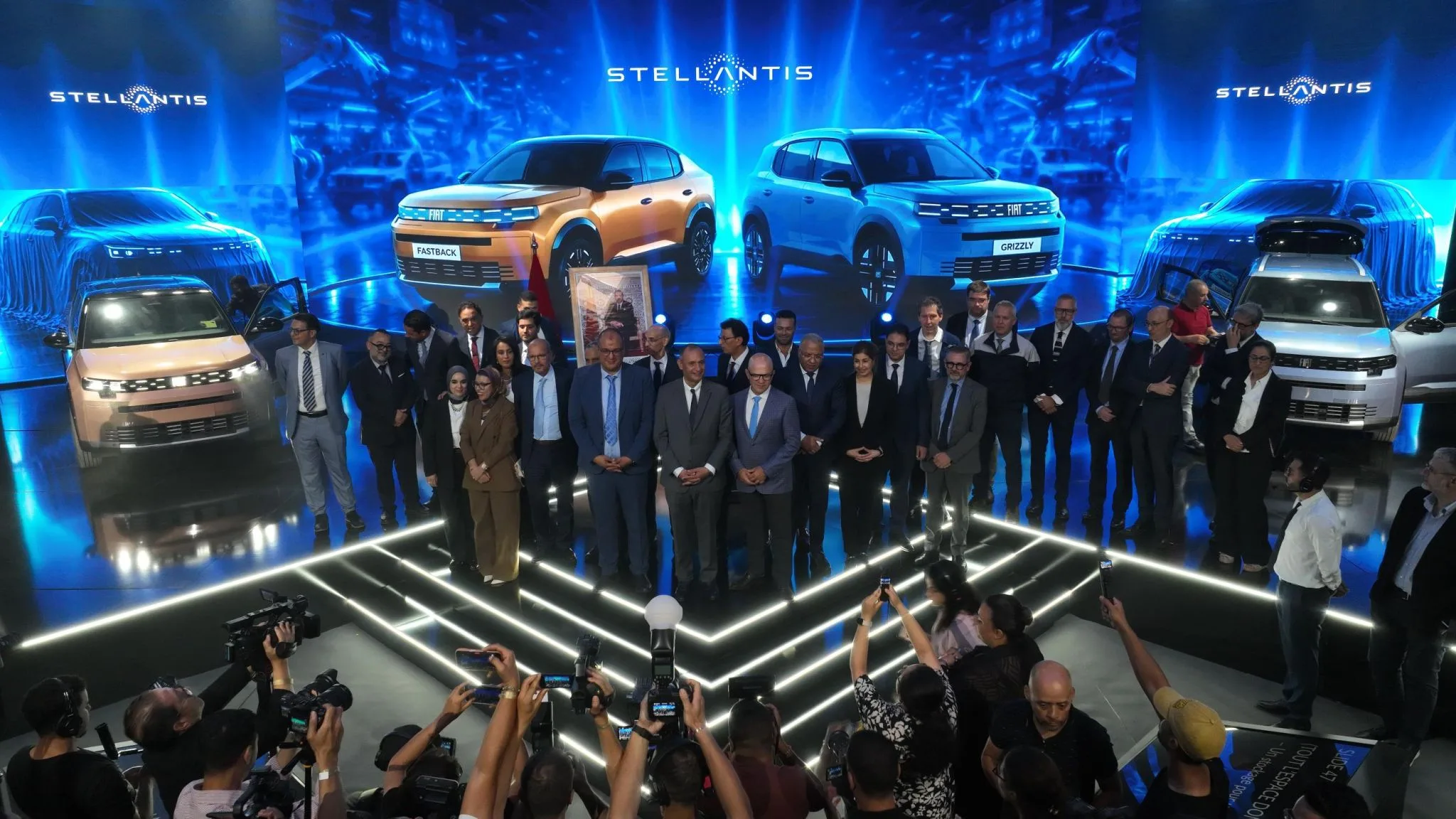
Marrakech – Stellantis officially began production of the Fiat Grizzly and Fiat Fastback at its Kénitra complex on Wednesday. The two SUVs are built on the new Smart Car platform, expanding the automaker’s manufacturing footprint in Morocco and its product portfolio across Africa, the Middle East, and the Mediterranean.
The launch event, attended by Ryad Mezzour, Morocco’s Minister of Industry and Commerce, took place at the plant King Mohammed VI inaugurated in 2019.
Both vehicles share a common platform but target different segments. The Fiat Fastback is positioned as a SUV coupé with a dynamic, lifestyle-oriented profile. The Fiat Grizzly takes a more robust approach, designed as a spacious family SUV built for comfort and versatility.
Both will be available in thermal, hybrid, and electric variants. Commercial launch is planned for the final quarter of 2026.
Samir Cherfan, Stellantis’s Chief Operating Officer for Middle East and Africa, described the launch as “a key pillar” of the company’s FastLane 2030 strategy.
The platform demonstrates the ability to combine “scale, competitiveness, local integration and customer relevance,” Cherfan noted. He also pointed to a broader shift at the site, from “an essentially manual industrial organization to a more digitalized, automated and connected model.”
The numbers reflect that transformation. Since 2019, the Kenitra workforce has grown from 1,700 to 7,200 employees, with a target of 9,300 by the end of 2026. Annual installed capacity now stands at 535,000 units – 400,000 passenger vehicles and 135,000 micromobility vehicles – alongside 350,000 engines per year.
The body shop operates two lines, each assembling 30 vehicles per hour for a combined output of 60 per hour. One line is dedicated entirely to the Smart Car platform. The other maintains a flexible setup, handling both the Peugeot 208 and the new Fiat models.
Mounir Kharbouche, the complex’s director general, explained that this configuration allows Stellantis “to manage several industrial programs within a single site while maintaining quality and performance standards.”
Cutting production costs while building local expertise
Quality control relies on the Perceptron system, equipped with approximately 80 cameras. It inspects 100% of all bodies produced in real time, detecting dimensional deviations without interrupting production flow. Collaborative robots also assist operators in screwing operations, improving precision and reducing physical strain.
Internal logistics run on roughly 250 automated guided vehicles out of 340 produced on site. Manufacturing these AGVs in-house cuts costs by approximately 30% compared to external suppliers, according to Stellantis, while building local expertise in electronics, programming, and maintenance. Stock levels for some stamped parts sit at around 1.8 days, reflecting tightly optimized flows.
The new paint facility introduces a fully electric baking process and RoDip technology, making Kenitra the second Stellantis plant globally to adopt the system. Bodies undergo a full 360-degree rotation during immersion in treatment baths, improving surface preparation and anti-corrosion protection.
Local integration currently reaches 69%. Stellantis is targeting 75% by 2030 through an expanded supplier network and proximity sourcing strategies. Seats for the new models are now assembled on site and delivered directly to the line in vehicle sequence order. Door handling follows a fully automated circuit capable of feeding 180 vehicles.
Roberto Giolito, head of exterior design for Fiat and Abarth, noted that both models draw on design references to Fiat’s historic Lingotto factory in Turin, with oval shapes in the cabin and a wraparound dashboard. Interior storage reaches 25 liters.
Minister Mezzour characterized the launch as “the result of industrial work built brick by brick” on a site that has “profoundly transformed itself.” He added that the vehicles will strengthen Stellantis’s competitiveness in an environment defined by intensifying international pressure, where production costs and development speed are becoming decisive.
For Stellantis and Morocco’s automotive ecosystem, the task now is converting this industrial buildup into sustained export volumes, added value, and lasting competitiveness.
Read also: Stellantis Invests €1.6 Million in Morocco’s First Vehicle Dismantling Center