Marrakech – There is a particular brand of political theater – perfected by autocrats who mistake podiums for pulpits – in which the actor delivers lines so divorced from reality that even his own audience winces.
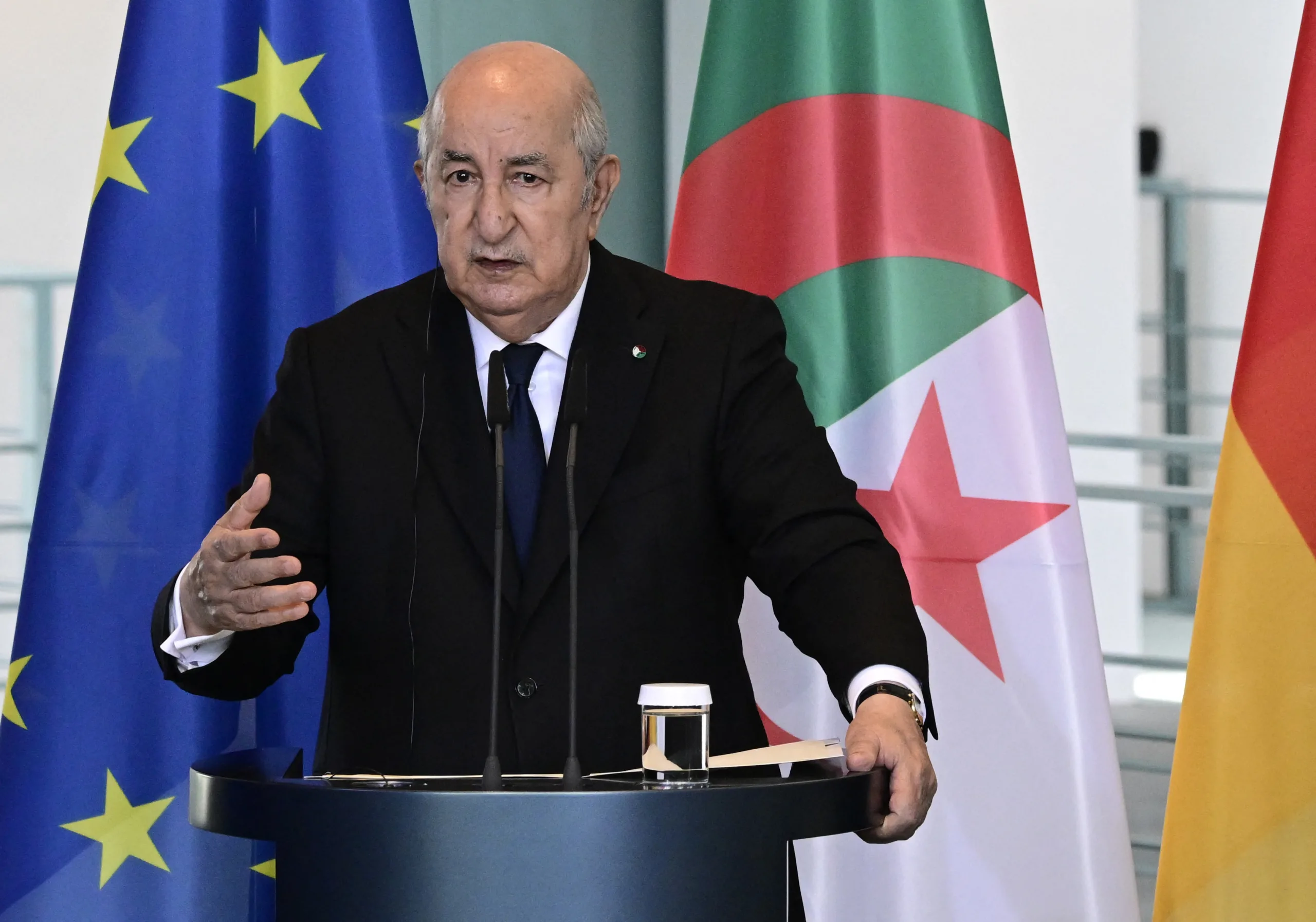
Abdelmadjid Tebboune’s two-day sojourn in Berlin this week furnished precisely such a spectacle: a head of state who, from the manicured corridors of the German Chancellery, beckoned his country’s exiled dissidents home with one hand while swatting away questions about a jailed French journalist with the other.
The dissonance between gesture and record was not a mere misalignment; it was structural, embedded in the very scaffolding of the visit itself.
Standing before members of the Algerian diaspora on the evening of July 15, Tebboune unfurled what he branded as an olive branch to the opposition abroad, urging those who had fled his government’s dragnet to return and engage in what he termed “civilized dissent.”
Criticism, he conceded, does not contradict patriotism – provided it remains constructive, decorous, and, one presumes, sufficiently deferential to the generals who underwrite his tenure. The performance had all the hallmarks of a carefully choreographed charm offensive: the measured cadence, the appeal to Western democratic norms, the invocation of dialogue as a national virtue.
الرئاسة الجزائرية: السيد رئيس الجمهورية: “أعيدها أمامكم في برلين..مرحبا بالمعارضين في الجزائر” pic.twitter.com/dfop3ghLjr
— AL24news – قناة الجزائر الدولية (@AL24newschannel) July 15, 2026
‘It’s a trap, George’
The only problem was the audience. Algerians, it turns out, have functioning memories.
Within hours, social media platforms detonated with the kind of mordant ridicule that authoritarian regimes spend billions trying to suppress. The cinematic catchphrase “It’s a trap, George” – borrowed from popular culture and repurposed as a political warning – became the unofficial tagline of Tebboune’s Berlin overture.
One commenter wrote with acid precision: “Welcome to them – at El-Harrach Prison.” Another distilled the absurdity further: “Welcome to the opposition, but the show trials and El-Harrach are waiting for them.” A third offered the sort of verdict no presidential communications team can spin away: “We live in reality, and it is the opposite of what you declare.”
The mockery was not gratuitous. What poured across social media in the hours that followed was not the reflexive cynicism of an idle public; it was derision grounded in lived experience and documented fact.
A ledger that speaks for itself
SHOAA for Human Rights, the London-based watchdog that has become one of the most meticulous chroniclers of Algeria’s civic asphyxiation, issued a forensic communiqué that functioned less as a press release and more as an autopsy report on Tebboune’s credibility.
The organization said its database documents the continued detention of more than 200 prisoners of conscience – activists, journalists, elected officials, and ordinary citizens prosecuted under the regime’s elastic interpretation of national security statutes and the notoriously weaponized Article 87 bis.
Rachid Aouine, SHOAA’s director, put it in unvarnished terms: Tebboune’s declarations “completely lack credibility given the continued operation of the repressive machinery and the restriction of fundamental freedoms.”
The organization went further, dismantling the regime’s so-called “Lam El-Chamel” reconciliation initiative and the regularization measures adopted by the Council of Ministers in January 2026.
Far from constituting a genuine amnesty, these mechanisms conditioned the return of exiled Algerians – and even their access to consular services and passports – on written pledges not to repeat the acts that triggered their prosecution.
In plain language: sign away your right to dissent, or remain stateless. SHOAA characterized this as a framework built not on the rule of law but on the instrumentalization of administrative documents as tools of coercion and blackmail.
The timing of Tebboune’s Berlin pantomime compounded its hollowness. Algeria’s Independence Day, July 5, passed without the customary presidential pardon that traditionally accompanies national celebrations – a conspicuous omission that reverberated through political and human rights circles as a deliberate signal of continuity rather than clemency.
Days earlier, the regime’s July 2 legislative elections recorded a historically dismal 20.79% turnout – the lowest participation rate ever registered in an Algerian parliamentary vote – with nearly 80% of the electorate refusing to validate a process widely denounced as stage-managed and foreclosed.
Rather than reckon with its own democratic bankruptcy, Algiers reflexively blamed the Kabylie-based MAK movement, announcing the arrest of six alleged operatives in Tizi Ouzou – four of whom it conveniently identified as Moroccan nationals – a fabrication consistent with the regime’s well-documented habit of externalizing every domestic failure onto its eastern neighbor.
The question Berlin could not extract
And then there was Christophe Gleizes.
The 37-year-old French sports journalist, a contributor to So Foot and Society, has been imprisoned in Algeria since his conviction in June 2025 on charges of “apology for terrorism” – a sentence of seven years handed down by the Tizi Ouzou tribunal for the crime of reporting on a Kabyle football club.
As Thibaut Bruttin, the director general of Reporters Without Borders, observed: “This kind of incident – a journalist detained on Algerian soil during a reporting assignment – is most often resolved by expulsion. What is astonishing here is that it was judicialized and that the sentence was so severe. The decision clearly came from the summit of power.”
Gleizes withdrew his cassation appeal in March, deliberately clearing the legal pathway for a presidential pardon. The Algerian judiciary itself rejected a prosecution appeal in May, closing the procedural file entirely.
FIFA President Gianni Infantino personally accredited the journalist for the 2026 World Cup and publicly called for his release – an intervention Bruttin described as “unprecedented in the history of FIFA on an individual case.” Every conceivable obstacle had been removed. Every diplomatic signal had been transmitted.
Tebboune’s response, when a German reporter pressed him at the joint press conference with Chancellor Friedrich Merz, was a masterwork of performative indignation. The question had to be repeated twice before the Algerian president deigned to acknowledge it.
Visibly irritated, he replied in Arabic: “I will not comment on this subject out of respect for my country’s judiciary, and even less so abroad.” It was the verbal equivalent of slamming a door – not because the room contained nothing worth discussing, but because the discussion itself was inconvenient.
View this post on Instagram
The journalist’s family had written to both President Frank-Walter Steinmeier and Chancellor Merz on July 15, hoping Berlin might reprise the mediating role it played in securing the November 2025 pardon of Franco-Algerian writer Boualem Sansal.
Gleizes’s attorney, Emmanuel Daoud, articulated the family’s plea with quiet gravity: “We hope the German authorities will obtain from President Tebboune this gesture of humanity that Christophe’s family has awaited for months.” No gesture materialized. Tebboune departed the German capital without uttering another syllable on the matter.
Algerian political activist Chawki Benzehra captured the visit’s cumulative trajectory with characteristic bluntness, calling it “a catastrophic and humiliating spectacle” that exposed a president “who wagered heavily on this trip to escape the profound isolation engulfing Algeria.”
The Gleizes affair, Benzehra argued, is not an isolated judicial matter but a deliberate hostage-taking strategy – a pressure card in the deteriorating Algerian-French relationship, mirroring the Sansal precedent and entangled with the separate case of an Algerian diplomat imprisoned in France.
View this post on Instagram
George Orwell once wrote that political language “is designed to make lies sound truthful and murder respectable, and to give an appearance of solidity to pure wind.” In Berlin this week, Tebboune gave the aphorism a live demonstration.
He invited dissidents home to a country that jails citizens for pressing a “like” button. He wrapped repression in the lexicon of pluralism. And when confronted with the most elementary test of his proclaimed openness – a single question about a single imprisoned journalist – he retreated behind the very judiciary he wields as a bludgeon.
The wind, as Orwell warned, was pure.
Read also: Heatwave, Technical Fault Trigger Widespread Power Outage Across Algeria