 Join on WhatsApp
 Join on Telegram
Rabat – Islamophobia, verbal and mental abuse, physical violence, restrictions, and killings… The ellipsis reflects tens of thousands of other incidents that indicate the many challenges migrants, whether undocumented or documented, face in many parts of the world, including Europe.
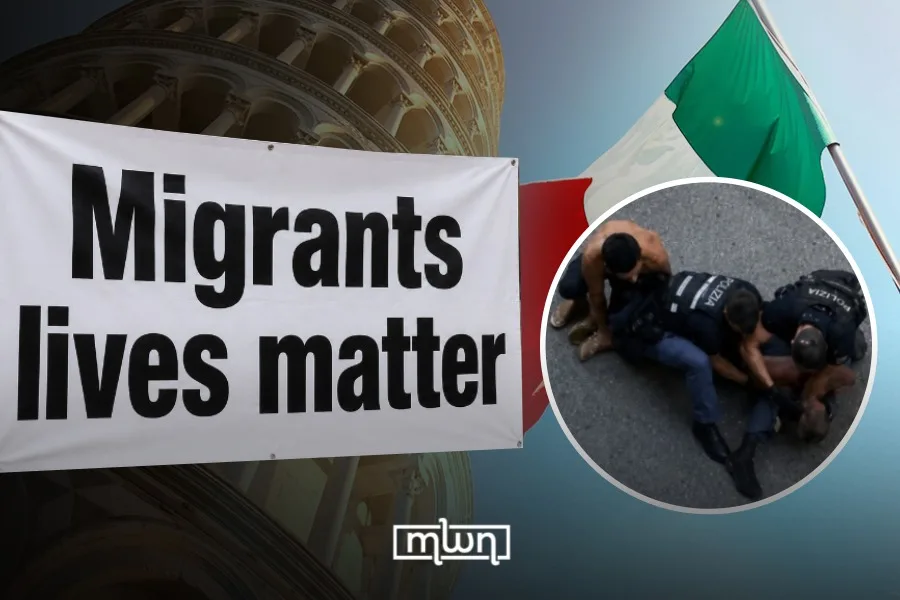
The latest case reflecting this situation is the disturbing tragedy in which a violent police intervention killed a 43-year-old Moroccan man, Abderrahim Fakir, on the outskirts of Bologna.
In Bologna’s Pilastro district, a police intervention on Sunday turned fatal after officers physically restrained him and bound his wrists with plastic zip ties.
View this post on Instagram
Fakir suffered a fatal medical crisis after he begged police to stop, asking for help. Preliminary reports said a local resident alerted police after hearing a man behaving “erratically” near the building’s parking lot.
Medical personnel and police came to intervene, with police allegedly striking Fakir with a vehicle.
Pepper spray was also used on him before he was physically restrained and killed.
Bologna Mayor Matteo Lepore called on residents to join a demonstration demanding “truth and justice” over Fakir’s death.
Do migrants’ lives matter?
The incident has drawn comparisons to the case of George Floyd, who was killed by a police officer during an arrest in Minneapolis, Minnesota, in the United States in 2020.
Floyd’s death sparked millions of people to protest around the world under the “Black Lives Matter” movement. Researchers recorded 7,750 to 10,600 Black Lives Matter-linked demonstrations across the US, with analysis revealing that 93% of the events were entirely peaceful.
The protests spanned more than 2,440 locations nationwide, drawing an estimated 15 million to 26 million participants. The campaign marked the largest protest movement in American history.
The case has also reignited discussions about discrimination and prejudice faced by migrants, whether documented or undocumented, including bias linked to their background or religion. At its core, the case raises a simple question: Do migrants’ lives matter?
Anti-migrant politics
Beyond the seemingly endless timeline of cases involving violence and alleged human rights violations against migrants, the issue is also deeply political. The growing influence of far-right parties across parts of Europe, including in Spain, France, the Netherlands, Germany, and Italy, continues to draw scrutiny.
While governments and institutions repeatedly pledge to combat discrimination and hate, analysts argue that concrete action often falls short. Parties such as Spain’s Vox and France’s National Rally have frequently weaponized anti-migrant sentiment as an electoral tool, portraying migrants as a threat to national identity, security, social cohesion, and economic stability.
Critics warn that this ultra-nationalist rhetoric does more than deepen political divisions; it can also contribute to an environment in which Islamophobia, xenophobia, and other forms of extremism become increasingly normalized, leaving migrants from different backgrounds more vulnerable to hostility.
France remains at the center of debates over religious expression and integration. Under its assimilationist policies, the country bans conspicuous religious symbols, including the Islamic headscarf, in public schools, while restrictions on garments such as the burkini have repeatedly sparked legal and political controversies. For many Muslims, these debates have translated into feelings of exclusion, prejudice, and, at times, verbal or physical abuse.
The Netherlands has also witnessed years of anti-Islam rhetoric from far-right politician Geert Wilders, who has repeatedly targeted migrants and the Moroccan community. Just before Morocco’s opening World Cup match on June 13, Wilders posted a message on X insulting Allah and Islam, sparking widespread backlash.
Human rights organizations, anti-racism groups, and civil society organizations regularly condemn such statements and warn about their consequences. Yet observers argue that public condemnation alone is insufficient. They question whether enough concrete measures are being taken to deter repeated hate speech and prevent the normalization of rhetoric that, they believe, fuels discrimination and hostility toward migrants and Muslim communities.
A lot of pledges alongside repeated violations
Whether at the European Parliament or the UN, governments in the EU and beyond continue to make claims and pledges, as well as efforts to tackle the situation.
The reality on the ground differs, however, as many reports show how police violence is judged differently depending on who is affected.
“When people with an immigrant background are targeted, abusive police actions are perceived as less serious,” the University of Zurich said, quoting a new international study in March.
The study, conducted by two researchers from the University of Zurich and Aalborg University in Denmark, examined cases of police violence, noting that there have repeatedly been cases in both the US and Europe in which “police officers used disproportionate physical force against individuals without sufficient justification based on an actual threat.”
The findings of the research show how police violence is judged differently by people, suggesting that many tend to judge identical cases of police abuse less severely when the victim has an immigrant background and indicating that public reactions may differ depending on who the victim is.
According to a UN report, significant attention “has been given to the horrors” that many people in the process of migrating have been enduring.
“Reports of deaths are increasingly common around the world, with the numbers of people victimized en route rising as organized criminals realize the profit to be made from exploiting human hope and separation,” the UN said.
While the sea and drowning are among the causes of death, police violence perpetrated against migrants is also among the contributing factors.
“Many people become stranded en route, rendered more vulnerable to violence… Repressive policies aimed at curtailing migration mean that migrants may turn to smuggling services for lack of alternatives to migrate,” the report elaborated.
In 2024, Italian police came under scrutiny after Italian prosecutors opened an investigation into a shipwreck that killed 94 migrants in 2023, accusing two members of the coastguard and four police officers of involuntary manslaughter.
The situation sparked outrage, with critics arguing that authorities had failed to respond quickly to reports of an “overloaded vessel in the area.”
And that was only one chapter in a much longer record. Violent police interventions have long sparked uproar in Italy and many parts of Europe. In 2023, investigators in Verona also reported police using pepper spray in migrants’ eyes and kicking them until they passed out.
The case prompted the arrest of five police officers on charges of torture and bodily harm against migrants and homeless people, with two suspects accused of racist hate crimes against Black people and African migrants.
A more expanded timeline documents police violence that prompted protests across Italy.
In November 2024, violent protests broke out in Milan, Italy, for two consecutive nights following the death of a young man.
The cause of death? He was killed in a traffic accident while being pursued by police. Two men of migrant origin on a motorcycle failed to stop at a police checkpoint, prompting a police chase.
One of the migrants, 20, died in the crash.
An Amnesty International report in 2025 said the number of deaths in custody remains high, acknowledging that migrants continued to be held in bare cells without meaningful activities in repatriation centers.
“In July, the Constitutional Court found that the detention of migrants violated constitutional principles, citing parliament’s persistent failure to establish regulatory frameworks,” the report observed, recalling the torture and ill-treatment of 33 boys at a juvenile prison in Milan between 2021 and 2024.
All of these cases—and countless others that appear with a simple search—have made headlines once, twice, or repeatedly over the years. But has anything truly changed? Have the statements, condemnations, and promises translated into meaningful action that demonstrates migrants’ lives matter?