
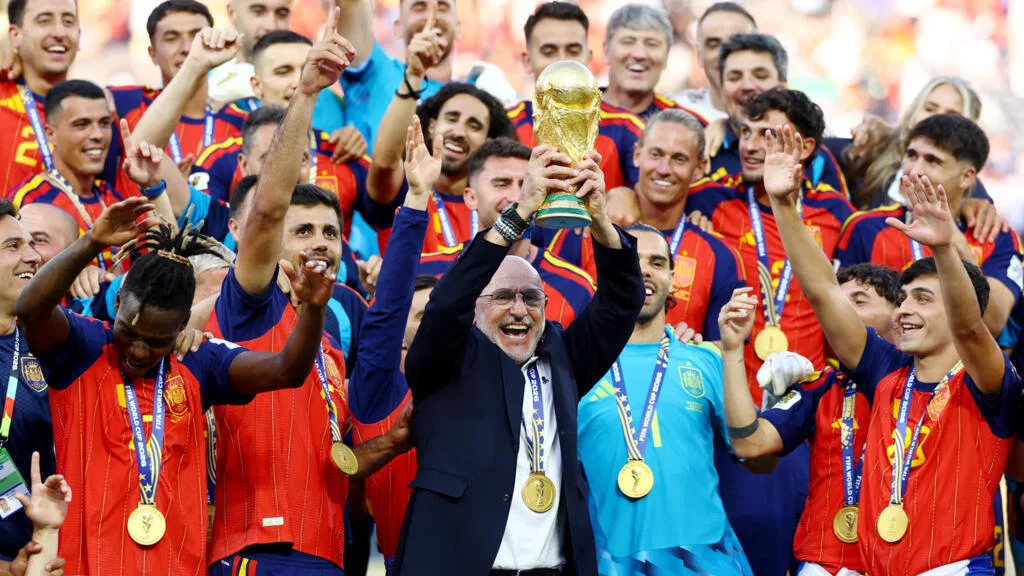
Every nation tells a story about belonging. Some tell it through constitutions. Others through language. Others through ancestry. Modern Spain has long told its using all three.
On the eve of Spain’s World Cup semi-final against France during the 2026 FIFA World Cup, Spain’s former Prime Minister Mariano Rajoy offered what appeared to be an ordinary piece of football commentary. France, he observed, possessed one of the strongest teams in the tournament. Then came the sentence that travelled instantly across the world.
France, he wrote, had an excellent team, but “without French players.”
The reaction was immediate. France’s Foreign Minister, Jean-Noël Barrot, replied that France has no skin color. The French embassy in Madrid patiently reminded readers that every member of the squad was French, most born in France, the others French citizens by law. Spain’s Prime Minister, Pedro Sánchez, condemned Rajoy’s remark as xenophobic, concluding in a social media post: “May the best team win, and may racism lose.” Newspapers across Europe treated the controversy as another episode in the familiar story of racism in football. Within hours, the debate had become a diplomatic incident.
The controversy was striking not because politicians occasionally make inflammatory remarks about football, but because Rajoy’s words seemed to question something modern democracies take for granted: that citizenship is sufficient to define who belongs to the nation.
Rajoy had not questioned anyone’s passport. He knew perfectly well that Kylian Mbappé, Ousmane Dembélé and Aurélien Tchouaméni were French citizens; nor had he questioned their footballing ability. France had reached yet another World Cup semi-final. His remark pointed elsewhere. It implied that citizenship had failed to settle a deeper question:
If these players were legally French, what exactly was missing for Rajoy?
That question interests me more than Rajo’s commentary itself.
It invites us to ask why, in modern democratic societies founded upon civic citizenship, ancestry continues to possess such remarkable symbolic authority. Why do public conversations about national teams so often drift away from passports towards parents, from birthplace towards origin, from citizenship towards genealogy?
Rajoy’s remark became possible because football asks nations to do something few other institutions require. It asks them to imagine themselves as a body.
Most of the time, nations remain abstractions. They exist in passports, censuses, constitutions, and maps. Their citizens will never know more than a tiny fraction of the people with whom they supposedly share a common identity. National belonging is therefore largely an act of imagination. It requires millions of strangers to recognize themselves as participants in the same collective story.
International football briefly alters that condition.
For ninety minutes, the nation acquires faces. Millions of citizens who have never met one another agree that eleven players will stand in their place before the world. The national team condenses an entire political community into a handful of bodies. Flags become shirts. Anthems become breathing voices. Victory and defeat become shared emotional experiences.
That is why football repeatedly provokes questions that extend far beyond sport.
Who speaks for us?
Who represents us?
Who belongs?
These questions are rarely asked in ordinary political life because modern democracies presume they have already been answered. Constitutions define citizens through law rather than lineage. Passports certify membership. Elections recognize political equality. The legal language of the modern state appears remarkably clear.
Public imagination is often less certain. Anthropologists have long observed that societies imagine belonging in different ways, through residence, religion, language, or descent. Modern nation-states insist that citizenship should settle the matter, yet everyday conversation instinctively reaches for another vocabulary. People ask about parents, origins, and family histories. Ancestry quietly reappears where citizenship was expected to end the discussion.
I think of this as a genealogical imagination: the persistent tendency to treat ancestry as revealing a deeper truth about national belonging than citizenship itself.
Modern democracies govern through citizenship.
They often continue to imagine themselves through ancestry.
Football makes this tension unusually visible because international competition transforms legal membership into public representation. The question is no longer simply whether someone is a citizen, but whether he appears to embody the nation itself.
Benedict Anderson famously described nations as imagined communities whose members will never know most of one another, yet nevertheless imagine themselves as belonging together. Michael Billig later showed how nationalism persists through the quiet rituals of everyday life: flags hanging unnoticed outside public buildings, weather maps, newspaper headlines, and sporting competitions. Football intensifies those ordinary rituals into moments of extraordinary visibility. For the duration of the match, the imagined community becomes visible, embodied, and emotionally charged.
At precisely such moments, the question quietly changes. It is no longer simply Who are we? but Where do our origins lie?
Rajoy did not invent that question.
His statement merely revealed that, beneath the constitutional language of citizenship, another language of belonging continues to speak.
To understand why ancestry continues to exert such symbolic force in contemporary Europe, one must leave the football stadium and travel several centuries back.
Growing up in the Middle Ziz Valley of southeastern Morocco, Spain never felt entirely foreign. It existed in village and family conversations, migration stories, football broadcasts, and the geography of everyday imagination. Across the Strait of Gibraltar lay a country that was at once a neighbor, a former colonial power, a destination for migrants and, further back in history, the land that had once been al-Andalus, Muslim-ruled Iberia, whose history remains deeply woven into Moroccan historical memory. The distance separating us was measured not only in kilometers but in centuries of shared history. From Morocco, debates about Spanish identity have always sounded different. They echo conversations that have crossed the Mediterranean for generations.
For much of the Middle Ages, the principal language of belonging in Iberia was religion. Christians, Muslims, and Jews occupied different legal and political positions, but the boundaries separating them were, in principle, permeable. Conversion held out the promise of crossing them. Whatever its motives or however sincere,, baptism altered legal identity.
The conquest of Granada in 1492 transformed that world.
The Christian kingdoms had recovered political sovereignty over the peninsula. Yet military victory created an unexpected problem. As Muslims and Jews converted to Christianity, some willingly, many under overwhelming pressure– the old religious boundaries began to dissolve. If converts now professed the same faith as everyone else, how could difference continue to be recognized?
The answer increasingly became not another theology but genealogy. As religious conversion blurred older boundaries, descent increasingly became the decisive criterion of belonging. Faith could be professed, loyalty demonstrated and language learned, but ancestry appeared immutable. Genealogy became a form of evidence, transforming not simply administrative practice but the very anthropology of belonging.
This shift found institutional expression in the doctrine of limpieza de sangre, literally, “purity of blood,” which distinguished Old Christians from converts and, increasingly, from their descendants. Conversion could alter religious status; it could not erase ancestry. Lineage became a social credential that shaped access to universities, religious orders, public office, and positions across Spain’s expanding empire.
For centuries, religion had provided the primary language through which difference was recognized. After Granada, descent increasingly assumed that role. Conversion no longer settled the question. It merely displaced it. Behind every profession of faith lay another inquiry, one directed not toward belief but toward lineage.
Historians have shown how this genealogical logic spread far beyond the Iberian Peninsula. Throughout Spain’s Atlantic empire, officials examined family histories, scrutinized lineages, and demanded proof of ancestry from people whose religious identity was already beyond question. Belonging was no longer established solely through public conduct or legal status. Increasingly, it required inherited origin.
Contemporary Spain is founded upon constitutional equality, and no serious observer would claim that Mariano Rajoy consciously invoked limpieza de sangre. Historical persistence rarely works that way. Ideas seldom survive as quotations; they survive as habits.
No one today asks whether a footballer descends from an Old Christian family. Instead, different questions emerge: Where are his parents from? What are his real origins? The vocabulary has changed. The instinct to seek ancestry beneath citizenship has not.
Ancestry continues to be imagined as revealing a deeper truth than citizenship itself.
This, I think, is one of the enduring paradoxes of modern democratic societies.
Citizenship defines who belongs by law.
Genealogy continues to tell the imagination who should feel as though they belong.
The point is not that modern Spain secretly remains governed by limpieza de sangre.
It plainly does not.
The point is more anthropological. Ways of imagining society often outlive the institutions that first produced them. They become part of ordinary common sense, detached from their historical origins yet quietly shaping how new questions are asked.
Imagine, for a moment, placing two documents side by side on a table. One is a sixteenth-century certificado de limpieza de sangre, attesting that its bearer descended from Old Christians. The other is a twenty-first-century Spanish passport. They belong to entirely different political worlds. One certifies ancestry; the other certifies citizenship. Yet the questions that sometimes accompany the passport can sound curiously familiar: Where are his parents from? What are his real origins? The document has changed. The instinct to look beyond it has not.
The Moor matters here not because contemporary Spaniards still think in medieval categories, nor because modern debates simply repeat the past. Rather, “the Moor” became one of the enduring historical figures through which Spain learned to imagine ancestry, otherness and belonging. Over the centuries, the figure acquired new meanings. What endured was not the figure itself but the habit of looking beyond citizenship toward ancestry.
It is here that Spain’s relationship with Morocco becomes especially revealing. The Moor did not disappear from Spanish history after Granada. He merely crossed the Strait after the Reconquista
Morocco never ceased to be Spain’s nearest historical other. What changed over five centuries was not the relationship itself but the forms through which it was lived: coexistence, conquest, empire, migration and, eventually, citizenship.
For the next four centuries, Morocco remained one of Spain’s closest neighbors and one of its most persistent historical reference points. The Mediterranean did not separate two unrelated worlds so much as connect societies that had spent centuries shaping one another. Trade continued. Diplomacy continued. Captivity, piracy, and migration continued. So did the circulation of stories through which each society imagined the other.
In 1912, Spain established a protectorate over northern Morocco. The medieval frontier gave way to a colonial one. The Moor was no longer imagined primarily as the defeated Muslim of the Reconquista but as the colonial subject of a European empire. Yet the transformation was never complete. Colonialism did not erase older memories. It reorganized them. Morocco remained the place against which Spain continued to define itself as European, Christian and modern, even as the two societies became increasingly entangled.
Empire has a curious way of binding together those it seeks to separate.
Spanish officials administered northern Morocco. Moroccan laborers crossed into Spanish territories. Soldiers served under Spanish officers. Merchants moved between Tangier, Tétouan, Ceuta, Melilla, and Andalusia. Families formed relationships that ignored the neat boundaries imagined by maps. The Strait of Gibraltar remained less a barrier than a corridor, carrying people and histories in both directions.
The contradictions of this relationship became unmistakable during the Spanish Civil War.
Francisco Franco launched his military uprising not from Madrid or Seville but from Spanish Morocco. His Army of Africa, composed largely of Moroccan soldiers alongside Spanish officers, crossed the Strait in 1936 to fight on the Nationalist side. Tens of thousands of Moroccans became indispensable participants in a conflict that would determine Spain’s political future.
History rarely accommodates simple categories.
For centuries, the Moor had figured in Spanish historical memory as conqueror, religious rival and civilizational other. During the Civil War, he became something else: the soldier whose military experience and discipline proved crucial to Franco’s campaign. The figure who had long marked Spain’s historical difference now helped shape the modern Spanish state.
The irony is striking. The same historical imagination that repeatedly distinguished Spain from Morocco depended, at critical moments, upon Moroccan lives. The relationship did not end with decolonization.
When Morocco regained its independence in 1956, the two countries remained connected by geography, commerce, and migration. Over the following decades, hundreds of thousands of Moroccans crossed the Strait seeking work, education, and new opportunities. Today they form one of Spain’s largest immigrant communities. Their children attend Spanish schools, speak Spanish with local accents, play for, and cheer on Spanish football clubs and increasingly occupy visible places in Spanish public life.
The direction of movement has changed. For centuries Spain looked south toward Morocco as a frontier, a colony, or a military zone. Increasingly, Morocco has become part of Spain’s own social landscape. The old distinction between “here” and “there” has grown more difficult to sustain. The history that once unfolded across the Mediterranean now unfolds within Spanish cities, classrooms, and football stadiums.
This longer history complicates contemporary debates about national belonging.
Questions about ancestry do not emerge in a historical vacuum. They are shaped by centuries of contact in which Morocco has occupied multiple and often contradictory positions within Spain’s imagination: neighbor and rival; colony and partner; source of labor and source of anxiety; object of fascination and marker of difference. The Moor has never been a fixed historical figure. He has been continually reinvented as Spain’s understanding of difference has changed.
The historical figure once imagined as the Moor no longer stands outside Spain’s imagined community. Many of those once cast in that role are now ordinary Spanish citizens.
That transformation comes into sharp focus in the figure of Lamine Yamal, whose presence on the Spanish national team reveals how the nation’s historical relationship with Morocco has moved from the frontier to the family, from the colony to the citizen, and from the Strait of Gibraltar to the football pitch.
Seen against this longer history, Lamine Yamal becomes less a footballer than an ethnographic puzzle. There is remarkably little ambiguity about his citizenship. Born in Esplugues de Llobregat, outside Barcelona, he grew up in Catalonia, entered FC Barcelona’s famed La Masia academy as a child, and emerged as one of the most gifted footballers of his generation. He speaks the languages of the country in which he was raised, represents Spain in international competition and has become, while still a teenager, one of the principal faces of Spanish football.
Constitutionally, politically, and biographically, the matter appears settled. Yet public conversation rarely leaves it there. Sooner or later another observation emerges: his father is Moroccan. The observation is not, in itself, racist. It simply reveals how quickly public discussion shifts from citizenship to lineage.
Citizenship establishes membership.
Ancestry seeks authenticity.
Modern democracies promise that citizenship settles the question of belonging. Public imagination often continues searching for another answer. It asks whether ancestry reveals something that passports cannot, whether inherited origins disclose a truth deeper than legal membership.
Lamine Yamal does not create this tension; he makes it visible. When asked about the controversy surrounding Rajoy’s remarks, he refused to answer in the language of ancestry. Instead, he offered a strikingly different vocabulary: “If football can make a difference, it is through integration. France and we [Spain] are both examples of integration.” His response quietly redirected the conversation away from inherited origins and toward a shared civic future. In doing so, he answered the controversy without accepting its underlying premise.
Drawing on Michèle Lamont’s work on symbolic boundaries, we can see how societies distinguish those recognized as fully belonging from those whose membership remains, however quietly, subject to qualification. These boundaries are rarely fixed. They shift over time, responding to political circumstances, economic anxieties, and cultural change. Football offers an unusually vivid setting in which to observe them because national teams transform symbolic membership into public performance.
The question is never simply who can play.
It is who can embody the nation.
Spain is hardly unique in confronting this dilemma. Across Europe, football has become one of the principal arenas through which migration, citizenship, and national identity are negotiated. Yet Spain’s possesses a distinctive historical depth because the language of ancestry echoes centuries of earlier attempts to distinguish inherited belonging from legal membership.
This is why Rajoy’s remark resonates so powerfully.
He was not denying the citizenship of France’s players.
He was simply privileging genealogy..
Whether consciously or not, he implied that descent revealed something more fundamental than law.
France responded in the language of republican citizenship. Spain officially embraces that same civic principle, yet Rajoy’s remark reminds us of how easily public discourse slips into another register in which ancestry quietly assumes the authority citizenship was meant to replace.
Older ways of imagining belonging rarely disappear when new ones emerge. They remain beneath the surface, like older foundations beneath a rebuilt city. Constitutional citizenship overlays inherited ideas of ancestry without entirely erasing them. Most of the time those older foundations remain invisible. International football has an uncanny habit of exposing them.
For ninety minutes the abstract language of constitutions gives way to faces and bodies. It is in those moments that older historical imaginations unexpectedly return.
For centuries, Spain imagined the Moor as someone standing beyond the frontier: first as religious rival, later as colonial subject, and often as the figure against whom Spanish identity was defined. Today, one of the nation’s most celebrated athletes carries Moroccan ancestry not as a mark of foreignness but as an ordinary part of contemporary Spain.
The historical figure has changed. More importantly, its place within Spain’s imagination has changed.
The historical figure once imagined as the Moor no longer stands outside the nation asking to enter. Many of those once cast in that role are already ordinary Spanish citizens.
The question is no longer whether Spain can accommodate him.
It is whether Spain’s imagination of belonging has fully caught up with Spain’s own history.
Football did not create the questions that surfaced during the World Cup.
It merely asked them in public.
Spain’s history reminds us that belonging has never been imagined in only one way. Older understandings of religion and ancestry continue to shape a nation that now defines itself through constitutional citizenship.
That is why the figure of Lamine Yamal matters beyond football.
He is not historically significant because his father is Moroccan and his mother is from Equatorial Guinea. Millions of Europeans carry family histories that extend across borders, empires, and migrations. Nor does his presence reveal that Spain has somehow failed to become a modern democracy. On the contrary, his emergence as one of the country’s brightest sporting talents testifies to a Spain that is increasingly confident in its civic understanding of nationhood.
The deeper significance lies elsewhere in such questions as:
Why does public conversation return so readily to ancestry when citizenship appears to have settled the matter?
Why do family origins continue to seem more revealing than birthplace?
Why does genealogy retain such symbolic authority in societies that officially define themselves through equal citizenship?
These are not uniquely Spanish questions.
They are increasingly European ones.
Yet Spain confronts them with unusual historical intensity because no other European country has lived quite so long with the intertwined legacies of Al-Andalus, the Reconquista, limpieza de sangre, colonial Morocco, and contemporary migration across the Strait of Gibraltar. The conversation that surfaced during a football tournament belongs to a history measured not in decades but in centuries.
There is an irony here that history alone could have produced.
For centuries Spain imagined the Moor as someone approaching from across the Mediterranean. He occupied many historical roles, but he almost always appeared as someone against whom Spain defined itself.
Today that geography has quietly disappeared.
The child is born in Catalonia.
He enters La Masia before he enters adulthood.
He dreams in Spanish, Catalan, and the ordinary rhythms of contemporary Spain.
He wears the national jersey.
He becomes, for millions of supporters, the future of Spanish football.
The frontier has moved.
It no longer lies at the Strait of Gibraltar.
It lies within the stories nations continue to tell themselves about who belongs.
Perhaps that is football’s deepest anthropological lesson.
The game does not simply reveal athletic talent. Every so often it reveals the categories through which societies imagine themselves. During the match , the nation becomes visible, not only in the players who wear its colors but also in the conversations their presence makes possible.
The old Spanish saying no hay moros en la costa, literally, “there are no Moors on the coast,” a way of saying that the danger has passed, preserves an older map of Spanish historical imagination. The Moor belonged somewhere beyond the horizon, across the Strait of Gibraltar. Five centuries later, that geography no longer describes Spain. The frontier has moved inward. The figure once imagined as the Moor is no longer located beyond the horizon but within the nation itself.
Football did not prove that the French players whose Frenchness Rajoy questioned belong, nor did it validate Lamine Yamal’s place in Spain. The law of their nations had already done that. What football does is make the nation visible. For ninety minutes, eleven players become the public face of that nation. The deeper test comes after the final whistle. Will these societies continue to define belonging through inherited origins, or will they listen to a nineteen-year-old Spanish footballer who points toward a different possibility: a nation grounded not in ancestry but in a shared civic future?