
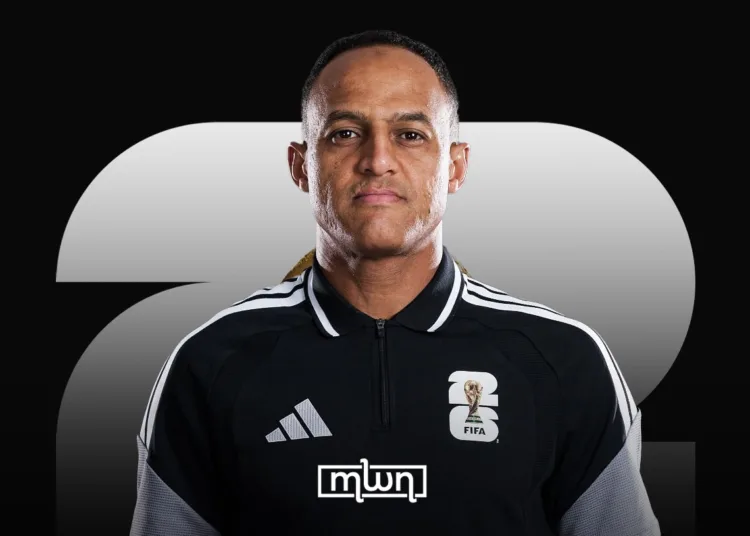
Rabat – Moroccan-born American referee Ismail Elfath has backed Morocco to emerge as a serious contender for the 2030 FIFA World Cup, arguing that the national team’s recent achievements can no longer be described as surprising.
Speaking in an interview with Saudi newsoutlet Arriyadiyah, Elfath said Morocco’s progress was the outcome of a long-term football strategy based on infrastructure development and investment in young players.
“The results achieved by the Moroccan national team have become expected and are no longer surprising,” Elfath said. “They are the result of work that began more than 10 years ago, through a clear vision of investing in infrastructure and developing talent.”
Morocco reached the quarter-finals of the 2026 World Cup before being eliminated by France, continuing the country’s strong performances on the international stage.
The Atlas Lions had previously made history by reaching the semi-finals of the 2022 tournament in Qatar, becoming the first African and Arab team to reach the last four of a men’s World Cup. Morocco’s latest run has strengthened expectations ahead of the 2030 edition.
“I am confident that Morocco will have a strong presence at the 2030 World Cup,” Elfath added. “Why should it not compete for the title?”
Morocco’s rise built over time
Morocco has invested heavily in football academies, training facilities and stadium infrastructure in recent years.
The Mohammed VI Football Complex near Rabat has become a central part of the country’s strategy, providing national teams with modern preparation facilities while supporting the development of young players.
The country is also preparing to co-host the 2030 World Cup with Spain and Portugal. Argentina, Paraguay and Uruguay will stage the tournament’s three centenary matches in recognition of the first World Cup, held in Uruguay in 1930.
FIFA formally confirmed Morocco, Portugal and Spain as the main hosts in December 2024.
Morocco’s preparations include the construction and renovation of stadiums, transport networks and other infrastructure.
The country is also seeking to host the 2030 final at the planned 115,000-capacity Grand Stade Hassan II near Casablanca, although FIFA has not yet confirmed the venue for the decisive match.
Elfath, who was born in Casablanca before moving to the United States, has become one of North America’s most prominent referees.
He officiated at the 2022 and 2026 World Cups and was appointed for the 2026 semi-final between England and Argentina.