 Join on WhatsApp
 Join on Telegram
Marrakech – The entry of Fouzi Lekjaa into the political bureau of the Authenticity and Modernity Party (PAM) drew an immediate response from the National Rally of Independents (RNI), exposing a widening rift between two governing allies as they maneuver for position ahead of the September 23 legislative elections.
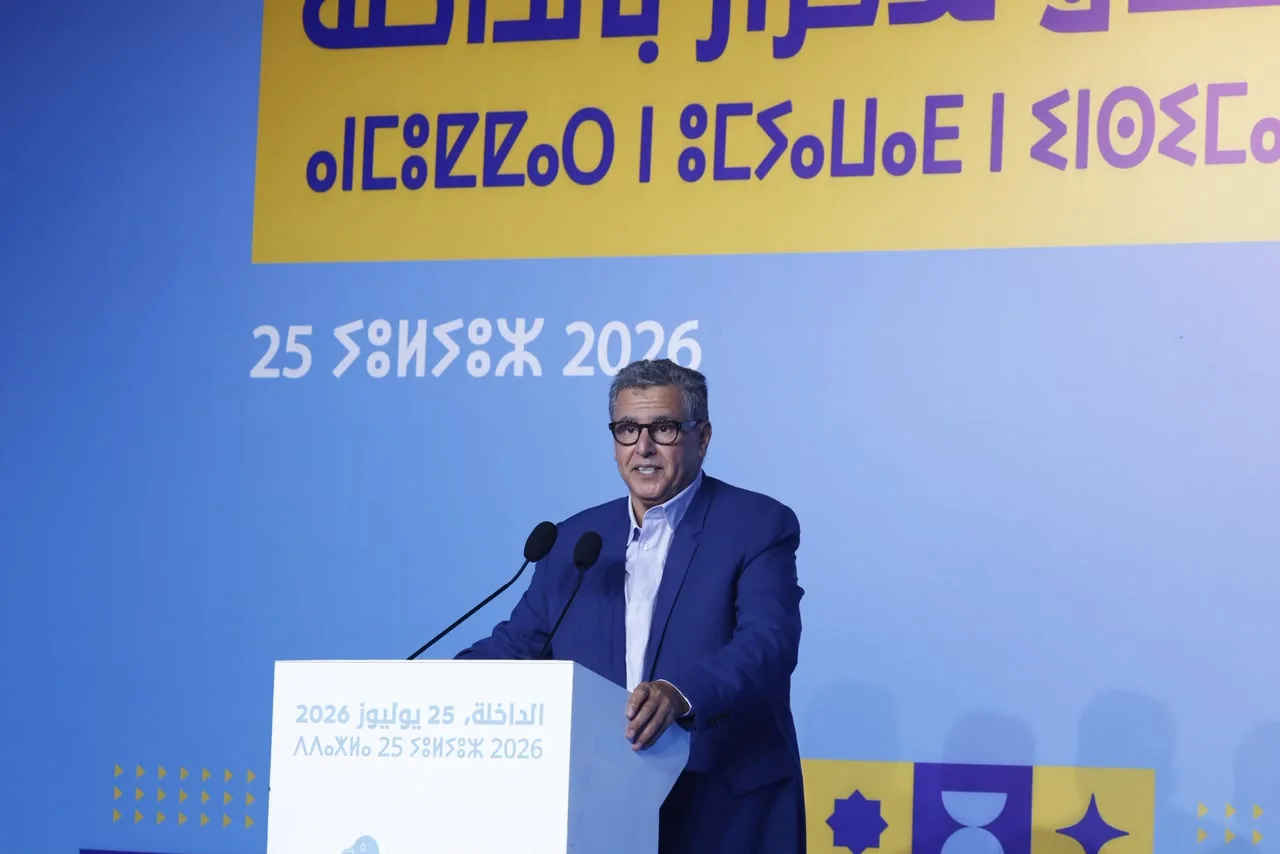
Only minutes after the minister delegate in charge of the budget and president of the Royal Moroccan Football Federation (FRMF) joined the leadership of the “tractor” party, Aziz Akhannouch turned a party gathering in Dakhla into a platform for rebuttal.
The move laid bare a recruitment strategy that Akhannouch would spend the afternoon dismantling: parties courting established figures in the closing stretch of the race rather than building competitive lists through years of groundwork.
Speaking on Saturday under the banner “Dignity and Opportunities for All,” the head of government and RNI leader took aim at competitors he described as absent. Some rivals, in a transparent allusion to PAM, “stopped working for five years and are waiting until the last minute to attract new names to prepare their electoral lists,” he charged.
Then came the line that framed the entire meeting. “We are not in a mercato,” Akhannouch declared, repeating the borrowed football term. “Those who have cadres have them, and those who don’t, don’t.”
He cast the RNI instead as a “nursery of competences” with deep territorial roots. Turning to PAM’s stated goal of becoming the country’s leading political force, he asked, “With whom are they going to play the match? We have within the party 10,000 elected officials and hundreds of thousands of members.”
Elections, in his framing, are not built overnight. They cannot be reduced to “a list of names or ministers one can call on at the last moment,” he argued, describing a party as an organization of militants who work daily and listen to citizens. “Moroccans no longer vote for people, but for programs and projects,” he continued, contending that the RNI “does not waste its time” and “does not sell illusions to Moroccans.”
That message extended to his own base. “Morocco is built by trust and work,” Akhannouch remarked, telling militants that confidence is earned “with calm, serenity, constancy and without pressure.” He closed on a direct appeal: “It is you who will win the elections.”
‘Politics is not a football match’
Mohamed Aujjar picked up the same metaphor in blunter terms. He aimed at “major elected officials” who, “in a mercato, in a moment of ingratitude, change party, change their principles and change their convictions.” Without naming them, he addressed those reported to be negotiating a transfer: “We respect everyone, but please, do not pervert democracy!”
Aujjar then drew a line between national enthusiasm for football and its partisan use. “Because we are a people who love football, we are proud of the exploits of the national team,” he noted, before warning, “But democracy and politics is not a football match! It cannot be a mercato!” He called the last-minute ralliements a “shame,” accusing their authors of underestimating the intelligence and maturity of Moroccans.
The remarks landed as PAM celebrated the very move they targeted. Fatima-Zahra Mansouri, national coordinator of the party’s collegial leadership, announced during the 32nd session of PAM’s National Council the arrival of Lekjaa alongside Yanja El Khattat, president of the Dakhla-Oued Eddahab region. She welcomed “two national cadres of the first rank” as “a real added value.”
Addressing Lekjaa directly, Mansouri framed the move as integration “into a global societal project and a united political family, built through more than eighteen years of continuous militancy.”
She recalled that PAM had emerged “stronger and more resilient” from past crises, and pointed to the 2021 legislative elections, which lifted it to the country’s second political force. “We continue today, with determination, our path to become the first political force of Morocco,” she declared.
Beyond the clash, Akhannouch used Dakhla to defend his record and present the “dove” party’s 2026-2031 program. He tied the meeting to national unity, describing Morocco’s Western Sahara as “a cause of the nation,” and pointed to strategic projects in the region, from the Dakhla Atlantic port to investments in food industries, tourism, and renewable energy.
In health, he listed the rehabilitation of seven proximity centers, two more planned, two new ones under construction, and a university hospital being equipped. Specialist doctors rose from 53 in 2021 to 72 in 2026, and nurses from 331 to 464.
The program, he outlined, would complete reforms in education and health, generalize school transport and canteens, and sustain investment aimed at job creation, including six major projects expected to generate more than 3,700 direct and indirect jobs.
Read also: Afrobarometer: Only 33% of Moroccan Youth Trust Akhannouch Government