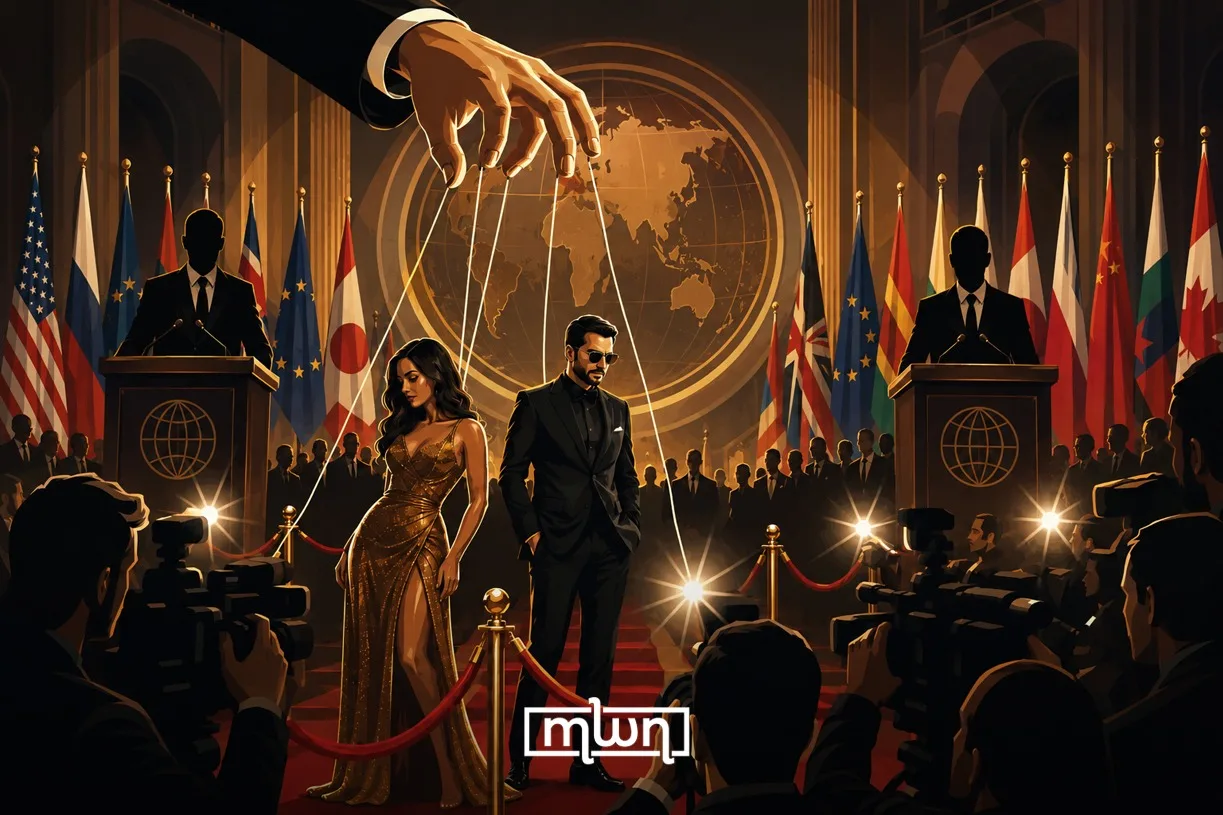
Political news is full of examples of celebrities from all walks of life – broadcasting, entertainment, football, athletics, theatre and film – who decide to change course and dive into politics, whether as elected officials, ministers, administrators, international civil servants or goodwill ambassadors.
On the partisan level, especially on the eve of elections, political parties compete to recruit celebrities, either to polish their image and restore their image, or to outdo other parties by depriving them of this precious sesame of high-caliber and well-known candidates.
This dance of recruitment and co-optation and media support has become a hallmark of contemporary electoral campaigns, particularly in the land of Hollywood, the United States, but also in Europe, Latin America and Africa, at a time when populism is becoming the credo of political parties and a panacea for electoral success.
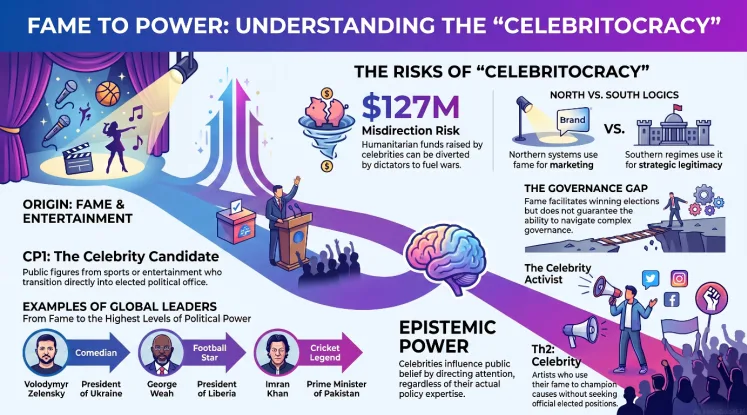
The phenomenon is global; in Ukraine, Volodymyr Zelensky, a comedian who played a virtuous president on a TV series, actually won real power. In Liberia, George Weah, the 1995 Ballon d’Or winner, became president. In the United States, Ronald Reagan, Donald Trump, and Arnold Schwarzenegger made the leap from movie sets or television studios to the highest offices. This trend sparks both fascination and concern, raising fundamental questions about political legitimacy in an age of mass media saturation.
But celebrity involvement in politics isn’t just about running for office. Artists like Joan Baez, Charles Aznavour, and Jane Fonda have chosen a different path-political and humanitarian activism. They use their fame to champion causes, fight dictatorships, or amplify the voices of oppressed peoples, without necessarily seeking elected positions. This form of engagement, which scholar John Street calls ««CP2»«, is just as important for understanding the political role of celebrities.
Yet behind the image of the committed artist lies a more complicated reality. As Cooper Lawrence shows in her book «Celebritocracy: The Misguided Agenda of Celebrity Politics in a Postmodern Democracy» (2020), celebrity activism isn’t always as beneficial as it appears. Lawrence demonstrates that stars’ humanitarian interventions, often well-intentioned, can sometimes do more harm than good. She points to Bob Geldof and Live Aid in 1985, where the $127 million raised for famine relief in Ethiopia was diverted by dictator Mengistu Haile Mariam to buy weapons from the Soviet Union, fueling civil war. Similarly, Brad Pitt’s Make It Right Foundation, meant to rebuild New Orleans after Hurricane Katrina, left residents with mold-infested homes. Oprah Winfrey’s Angel Lane project in Houston turned into zones of neglect and crime. George Clooney, despite heroic efforts for Darfur, couldn’t stop the genocide. These failures highlight the limits of “celebritocracy”-a system where stars, often poorly informed or manipulated, impose their humanitarian agendas without understanding local complexities, sometimes with disastrous results.
Still, as the work of Arter (2026) on the personal vote, Street (2004) on celebrity politician typologies, and Wheeler (2013) on the “celebritization” of politics reminds us, this phenomenon isn’t going away. It reflects a deep transformation of contemporary democracy, where performance, emotion, and fame increasingly compete with expertise and rational debate. So the question isn’t whether celebrities should be involved in politics, but how their interventions-whether electoral or humanitarian-can be properly channeled to serve the public good.
What political scientists say on the phenomenon?
To make sense of this phenomenon, researchers have developed several theoretical frameworks. John Street, back in 2004, laid the groundwork with a typology that remains a reference point, distinguishing between CP1-politicians or candidates whose background is in entertainment, show business, or sports-and CP2-entertainers or celebrities who speak out on political issues without seeking elected office. West and Orman refined this classification into five categories, while Mark Wheeler, in his 2013 book, argued that the “celebritization” of politics has created new forms of civic engagement, even if their democratic value varies widely.
The rise of the celebrity politician reflects a fundamental shift in how political representation is understood and practiced-a move toward what scholars call the aesthetics of popular representation. Traditional democratic theory often focuses on procedural legitimacy or the quality of policy debate. But recent work suggests that representation is inherently performative and symbolic. In this view, the “political persona” is a constructed figure meant to condense “the political” for their audience. Far from being a distraction, political style is seen as a necessary tool to help citizens navigate a complex world. Since celebrities often embody their audience’s sentiments, they offer a model for politicians seeking authenticity and “political attractiveness.”
A major concern about celebrity involvement is the unwarranted allocation of epistemic power; that’s to say the ability to influence what others believe and to validate or discredit other information. Celebrities wield this power through two main channels: perceived credibility, since high-profile figures often enjoy a “credibility surplus” and are trusted on subjects regardless of their actual expertise; and attention-directing power, since in an information-saturated world, the ability to capture and redirect attention is a vital political resource. Celebrities can set the public agenda just by speaking, forcing policymakers and the media to take notice. This influence is often rooted in paroissial relationships-one-sided emotional bonds where audiences view a public figure as a personal friend. These bonds act as “affective heuristics,” helping people process political news when trust in traditional institutions is low.
Five Trajectories, Five Destinies
Several paths and examples come to mind from the four corners of the globe, from the North as well as the Global South, it comes to mind the paths of Nawal El Moutawakel and Said Aouita, Morocco’s two biggest athletics stars, show how partisan positioning can make or break a budding political career. Both were Olympic champions at the 1984 Los Angeles Games-she in the 400m hurdles, he in the 5,000m-and both tried to turn their sporting glory into political capital. But their choices led them in opposite directions. Nawal El Moutawakel, who joined the political bureau of the National Rally of Independents (RNI) a right wing party close to the establishment; was appointed in 1997 by late King Hassan II as Secretary of State for Youth and Sports; H.M King Mohammed VI later made her a full minister in 2007; meanwhile she embarked in international arena and scaled the ranks of the IOC, becoming its Vice-President in 2013.
Said Aouita, by contrast, chose opposition party, running with the Socialist Union of Popular Forces (USFP), a historic left-wing party at that time, contrasting with El Moutawakel, who received ministerial posts and international recognition, Aouita hit the hard realities of the politics; his electoral defeat shows that celebrity alone isn’t enough to guarantee political success without the right partisan alignment and the locality right choice; I remember one left wing party leader from Rabat, was defeated nearly in same conditions in Agadir, even his political prestige, because he disregarded the advice of election specialists.
George Weah’s case in Liberia is perhaps the most spectacular transition from sport to the highest political office in Africa. The striker, the first African to win the Ballon d’Or, was elected president of Liberia in 2017 after two unsuccessful attempts. He perfectly fits the “super celebrity populist” model, using his global fame, his status as a “national hero,” and his image as a child of Monrovia’s slums turned world star to build an anti-establishment message. His rise from poverty to glory gave Liberians hope for better days. His presidency was controversial, though, with accusations of legal violations and intolerance toward the opposition. He did, however, concede his 2023 defeat-a democratic gesture praised across Africa.
Kirsty Coventry’s election as IOC President in March 2025 was historic. The former Zimbabwean swimmer became the first woman and first African to hold the post in the IOC’s 131-year history. After an exceptional career with seven Olympic medals, she was appointed Zimbabwe’s Sports Minister in 2018 and then elected IOC President in the first round. Like El Moutawakel, she represents a path of gradual integration into the system, converting sporting capital into institutional capital.
Volodymyr Zelensky’s case is perhaps the most striking example of the blurring between fiction and political reality. A comedian, he rose to fame through the TV series «Servant of the People», where he played a history teacher who becomes president. In 2019, he turned that fiction into reality, winning with 73.2% of the vote on an anti-establishment populist platform. War with Russia has since transformed him into a symbol of Ukrainian resistance, a leader in crisis. Zelensky embodies the “fictional populist” model-a celebrity who creates and performs a fictional character to deliver a political message.
Last but not least, no example better captures the promises and perils of celebrity politics than Imran Khan in Pakistan. A cricket legend, captain of the 1992 World Cup-winning team, he used his fame to found his own political party in 1996, eventually becoming Prime Minister in 2018. His anti-establishment rhetoric, promise of a “Naya Pakistan” (new Pakistan), and image as a principled leader won over a public hungry for change. As Prime Minister, he embodied hope for radical reform. But his tenure revealed celebrity politics’ limits: facing major economic challenges and unmet campaign promises, he was ousted by a no-confidence vote in April 2022. Imran Khan’s story is a warning to celebrities who decide to embark in politics: celebrity asset can open the doors of power, but it doesn’t guarantee you can govern without a minimum of cautions to prevent from the retro reaction of the system mainly the feedback of other main professional political actors and deep state.
North vs. Global South: Two Worlds, Two Logics
Though the basic mechanisms of celebrity politics seem universal, comparing North and South reveals deep differences in how celebrities are exploited and the paths they take. In the North, the political system uses celebrities mainly as electoral marketing tools. Political parties, facing shrinking membership and declining interest in traditional media, use fame as a shortcut to voters. In the South, exploitation is often more strategic and authoritarian. Regimes seek to harness celebrity popularity to boost their legitimacy and also to control the narrative.
In the North, celebrities are often driven by a desire to influence policy or champion causes. In the South, converting fame into political capital can be a way to gain recognition that traditional routes don’t offer. George Weah, a child of Monrovia’s slums, positioned himself as a “national hero” who understood Liberians’ struggles better than the traditional elites.
In a highly centralized system, running with an opposition party can neutralize the advantage of name recognition.
In conclusion, we can say that celebrity politics can’t be understood without looking at both sides of the coin: the ways political systems exploit celebrities, and the personal ambitions of celebrities to break out of their original roles. The fusion of celebrity and politics isn’t a sign of democratic decay but rather a reflection of the aesthetic, performative nature of representation. Imran Khan experienced both the heights of power and the bitterness of his fall. In the North and the South, the underlying mechanisms are similar- paroissial bonds, celebrity capital, the “personal vote.” But the political, media, and cultural contexts color them differently. The entrance of celebrities in politics can be political market-driven or authoritarian driven depending on the nature of the political system. Personal ambition can be rebellious or conformist. As social media and globalization bring these logics closer together, national specificities still matter especially the cultural and religious ones.
References
– Arter, D. (2026). “Localness, partyness or well-knownness? Dissecting the personal vote of celebrity candidates in Finnish regional elections.” «Regional and Federal Studies».
– Lawrence, C. (2020). «Celebritocracy: The Misguided Agenda of Celebrity Politics in a Postmodern Democracy». New York: Post Hill Press.
– Longoria, A. & Reyes, J. (2025). “The Fame Spectrum Model.”
– Street, J. (2004). “Celebrity Politicians: Popular Culture and Political Representation.” «British Journal of Politics and International Relations», 6(4), 435-452.
– West, D.M. & Orman, J.M. (2003). «Celebrity Politics». Prentice Hall.
– Wheeler, M. (2013). «Celebrity Politics: Image and Identity in Contemporary Political Communications». Polity Press.