
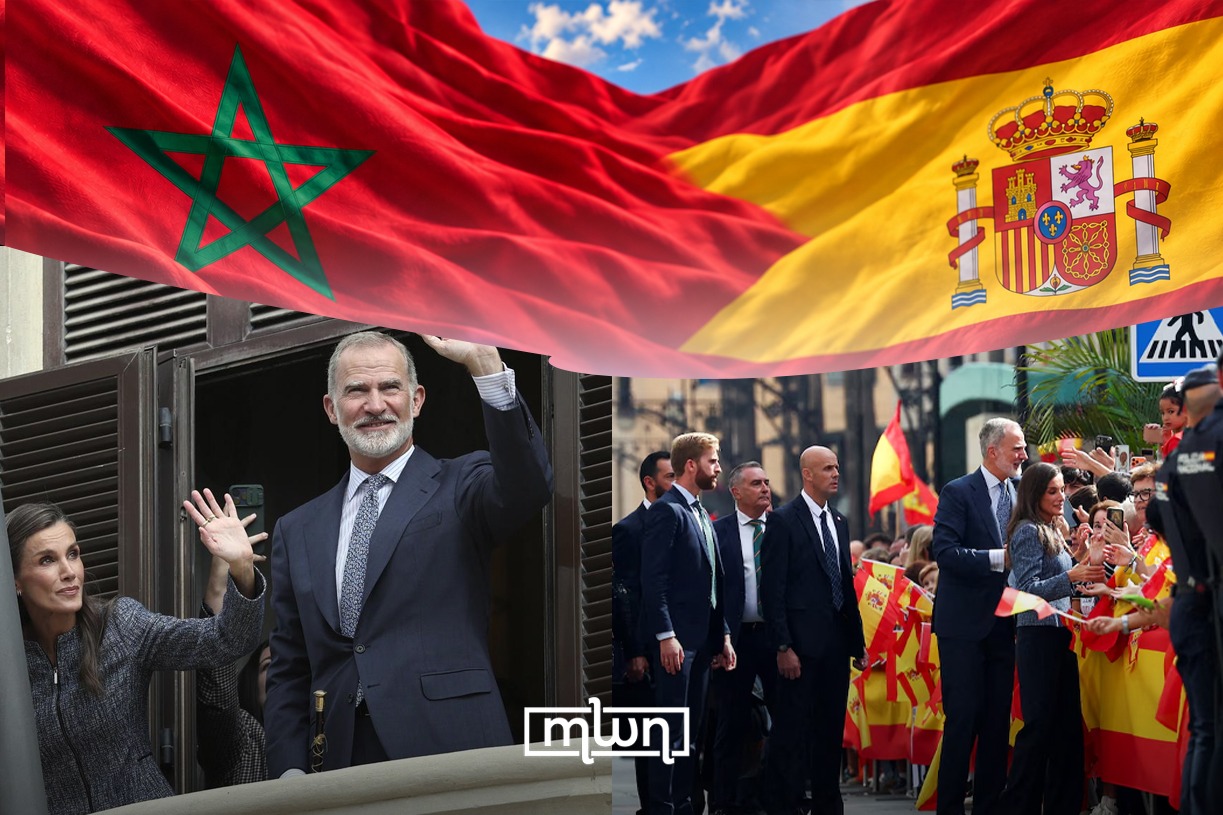
The visit by Spain’s King and Queen to Ceuta and Melilla, and the Moroccan Royal Palace’s silence in response, speak volumes about the opposing strategies prevailing in Madrid and Rabat as the two neighbors navigate what, safe for Morocco’s apparent patience, would have unravelled into one of their most serious diplomatic crises in years. Together, these two attitudes have exposed a revealing strategic asymmetry.
In Spain, the question of sovereignty over the two cities continues to carry considerable symbolic and political weight. And this has prompted repeated affirmations that Ceuta and Melilla are Spanish; that they “are Spain.” Some political and media reactions have also raised questions about Morocco’s intentions and the role of its institutions in this crisis. By contrast, Rabat has shown little inclination to challenge Spain publicly over the controversial royal tour. Nor does it appear to attach the same immediate political importance to Ceuta and Melilla that the issue commands in parts of Spain.
In fact, and as I have repeatedly argued in a number of articles over the past months, Morocco does not appear to attach to Ceuta and Melilla the same immediate political importance that these two enclaves command in the Spanish political and nationalistic imagination. As such, the political significance of Morocco’s silence is that it points to a deliberate choice not to escalate the controversy.
For Morocco, doing so would result in giving an easily instrumentalizable political trophy to the Spanish far-right’s anti-Morocco platform while dragging Rabat into a fight that is currently far from its strategic priorities. If Moroccan foreign policy were a doctoral thesis, the Sahara would be its central subject, the question around which every chapter is organized. By contrast, Ceuta and Melilla would barely merit a footnote.
Anxiety in Madrid
Yet for many Spaniards, the question of Ceuta and Melilla is an integral part of their sentiments of national identity and territorial integrity. The strength of that attachment is illustrated by the fact that mayor of Madrid José Luis Martínez-Almeida once went so far as to call them the capital of Spain. For Morocco, however, the two cities occupy a different place in the political imagination.
For one thing, they are geographically located in Moroccan territory. This is why, should Rabat one day choose to fight this fight, it will not have a hard time proving the fundamental Moroccanness of these occupied regions. For another, the economic fortunes of these two cities have long been closely tied to their relationship with their Moroccan neighbor, and their current difficulties pose a continuing challenge for Spain. In this sense, Morocco knows that geography, economic constraints, and history will be on its side when the time comes to confront Madrid on the status of Ceuta and Melilla.
But, for now, Morocco has bigger geopolitical fish to fry. Which is why the Spanish king and queen’s visit to the two cities has been met with confident silence (some might say strategic dismissal) in Rabat. To be sure, Madrid wanted the royal visit, the first such trip to the two cities since 2007, to carry some resounding symbolic weight. This might have worked wonders on the domestic audience, with the usual political commentators having put out statements and op-eds about the political significance of the visit.
In that sense, at least seen from Madrid, the visit can legitimately be understood as an affirmation of Spanish sovereignty and national belonging at a time when the economic future of the enclaves remains a concern. The model that sustained Ceuta and Melilla for generations has been substantially weakened, and restoring it to its former form appears increasingly difficult.
But symbolism is not policy, and media grandstanding is barely useful as a long-term strategy. From Morocco’s perspective, the debate surrounding the two cities mainly reflects the changing economic landscape in which they operate. Over the past decade, Morocco has invested in major projects, from the Tanger Med port complex and its surrounding industrial and free zones to transport infrastructure and urban development. These investments have been accompanied by economic and border reforms that have brought an end to informal arrangements on which Ceuta and Melilla had long relied.
Both cities depended heavily on cross-border trade for decades, including informal commerce and smuggling. Goods flowed into Morocco through so-called “atypical commerce,” carried by porters and often bypassing Moroccan customs, depriving the national treasury of revenue. When Morocco decided it would no longer tolerate this drain on its economy, the closure of the crossings exposed the enclaves’ dependence on Morocco. The disruption exposed the vulnerability of a model that had relied heavily on cross-border activity, not on a sufficiently diversified economic base. While Morocco’s decision was primarily a matter of economic policy and border management, its consequences for the enclaves were considerable.
Ceuta recorded an unemployment rate of 22.41% in the second quarter of 2026, more than double Spain’s national average. In 2025, both Ceuta and Melilla registered the highest rates of risk of poverty or social exclusion in Spain, at 40.8% and 43.7%, respectively. These figures point to serious socioeconomic difficulties and underline the challenges facing both cities. And although they do not determine the enclaves’ future, they are helpful in explaining why the sustainability of their economic model deserves closer scrutiny.
Why fight a lose-lose war when you can wait for the right time to discuss like adults?
And this, in turn, helps explain why some Spanish politicians have adopted forceful rhetoric toward Morocco and why the royal visit attracted so much attention. A royal visit can be a straightforward expression of sovereignty and national belonging. Yet the emphasis placed on its symbolic significance also shows something ideological and psychological, far beyond the mere political importance attributed to the two cities in Spain’s domestic political debate.
Some Spanish media outlets portrayed Felipe VI’s decision to spend the night in Ceuta as a commendable reaffirmation of Spanish sovereignty over the two cities. Yet a more consequential question is whether these symbolic affirmations are accompanied by efforts to address the enclaves’ underlying socioeconomic difficulties and their changing relationship with the surrounding region.
Morocco approaches this question from a longer strategic perspective. Its foreign policy is not immune to domestic pressures or changing circumstances, but its most consequential territorial priorities have generally been pursued over extended periods. This contrasts with the tendency in Spain to make Ceuta and Melilla instruments of domestic political competition, with parties invoking the enclaves to demonstrate patriotism, mobilize voters, or challenge their rivals.
For Rabat, avoiding confrontation preserves room to pursue its priorities without allowing every Spanish political gesture to dictate its response. Whether economic and political developments will eventually encourage a reassessment of the enclaves within Spain remains to be seen. For now, there is little indication that such a shift is imminent. Morocco has accordingly avoided reacting in ways that might jeopardize its relationship with Spain, which carries considerable strategic value for both countries and has been strengthened in recent years through cooperation on migration, security, trade, and energy. And so, Morocco’s restraint in the face of the Spanish royal couple’s trip to Ceuta and Melilla stems from Rabat’s conclusion that it serves no one’s interest to sacrifice such a hardfought, complex but strategically significant cooperation by reacting to a merely symbolic visit.
The Centrality of the Sahara in Morocco’s Philosophy of Patience
Currently, Morocco’s immediate priorities are to strengthen its economy across the country, including in the north, and consolidate its position on the Sahara question. The Sahara file is indeed where much of its diplomatic energy has been concentrated, and where it has made important gains over the past three decades. The Autonomy Plan has attracted growing international support. In his latest annual report, the UN secretary-general described the autonomy initiative as potentially the most feasible outcome, building on Security Council Resolution 2797. Further solidifying this momentum remains Rabat’s central diplomatic objective, hence Morocco’s readiness to avoid disputes that could complicate its wider agenda.
At the same time, one should be cautious about assuming that a definite resolution of the Sahara question would automatically lead Morocco to intensify its claims to Ceuta and Melilla. Some Spanish commentators have indeed presented such a scenario as a likely next step. But such an assumption rests more on speculated intentions projected onto Morocco, as there is currently scant indication to support this claim. The two questions have different historical and diplomatic contexts, and progress on one does not necessarily dictate what happens with the other.
And even if Morocco were to consider reclaiming the two enclaves from Spain, history offers a useful reminder of Morocco’s stated preference for a negotiated approach. In an interview with the Kuwaiti newspaper Assyassa in March 1986, later reported by El País that same month, King Hassan II said that any new Green March toward Ceuta and Melilla would be one of “patience, determination, dialogue, deliberation, and persuasion.” In September 1989, he again ruled out a military solution, arguing that the dispute should be addressed through calm reflection, away from partisan and media pressures.
Although these statements do not settle the question of Morocco’s future intentions, they offer insight into the approach its leadership has publicly advocated. They also put the current contrast in perspective. While Madrid uses royal visits to reaffirm its attachment to Ceuta and Melilla, Morocco continues to invest in ports, roads, and industries in the hopes of ultimately reshaping the economic geography of its northern regions. In other words, Morocco is building the economic infrastructure that will dictate how the future of the two enclaves will be debated. The royal visit to Ceuta and Melilla may have won the day for today – and perhaps even tomorrow. But Morocco is interested in next month.
Samir Bennis is the co-founder and publisher of Morocco World News. You can follow him on Twitter @SamirBennis.