
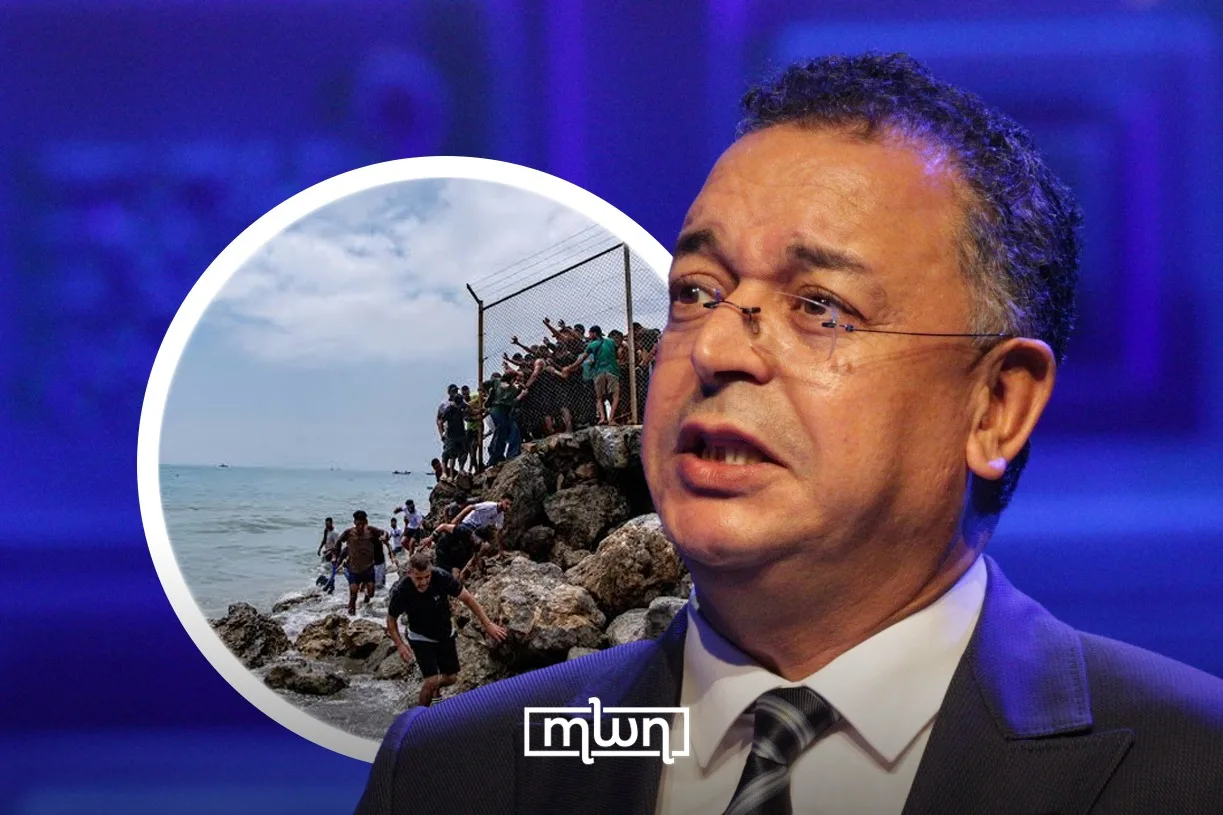
Rabat – Moroccan lawmaker, former Tourism Minister, and political analyst Lahcen Haddad has called for compassion, accuracy, and restraint in discussions surrounding the recent migration crisis in and around the Spanish-occupied enclave of Ceuta.
In comments shared with Morocco World News, Haddad said the tragic events of July 30 and 31 should be examined through the documented factors behind the exceptional movement, including misinformation, migrant-smuggling networks, and the social and economic challenges facing young people in northern Morocco.
The situation demands “compassion, accuracy and restraint,” Haddad said, expressing solidarity with those who lost their lives, those still missing, and their families.
He said the available information points to “several interconnected factors,” including the distorted interpretation of a Spanish court ruling, the exploitation of the rumor by migrant-smuggling networks, the rapid mobilization of thousands of people on social media, and the difficult economic and social conditions affecting young people in Fnideq and nearby areas.
The ruling refers to a recent decision by Spain’s Supreme Court stating that migrants intercepted at sea while trying to reach Ceuta or Melilla cannot be immediately returned under Spain’s “pushback” procedure. Instead, their cases must go through the regular legal return process.
“These documented elements must be distinguished from speculation and politically motivated accusations,” he added.
Haddad rejected claims that Morocco deliberately organized the movement to punish Spain, saying that no established evidence currently supports such accusations.
“Nothing currently established proves that the Moroccan state deliberately organized this movement to punish Spain,” he said.
Instead, Haddad pointed to the response of Moroccan and Spanish authorities as evidence of rapid cooperation between the two countries. Morocco reinforced security measures, worked to prevent further crossings, accepted the return of people who entered Ceuta, and took action against suspected organizers.
Meanwhile, Spain secured the enclave and coordinated large-scale returns. Spain’s Interior Ministry revealed earlier today that over 37,500 migrants who entered Ceuta as have returned to Morocco in the past few days.
Haddad also argued that Madrid’s decision to avoid premature accusations, along with the European Commission’s continued support for cooperation with Morocco, weakens claims that the crisis was a proven act of “hybrid warfare” organized by Rabat.
A Complex crisis
According to Haddad, the tragedy exposed the impact of unemployment, economic exclusion, criminal networks, and misinformation.
“It exposes the desperation created by unemployment and economic exclusion, the dangerous influence of criminal networks and the ability of false information to transform frustration into a mass movement with deadly consequences,” he said.
However, he also stressed that the crisis showed that Morocco and Spain can respond effectively to exceptional situations when they cooperate.
The political analyst warned against allowing extremists, conspiracy theories, or unsupported accusations to exploit the crisis. He said public debate should focus on the victims, accountability for migrant smugglers, the social causes of irregular migration, and the preservation of the strategic relationship between Morocco and Spain.
Haddad said migration crises often generate strong political reactions because they are highly visual, emotionally charged, and widely shared on social media in real time.
“Images of thousands of people crossing a border naturally invite political interpretations, often long before the facts are established,” he said.
He noted that complex events are often reduced to simple narratives, with some accusing Morocco of using migration as a political weapon and others promoting conspiracy theories involving foreign powers.
“Both approaches are attractive because they provide clear villains, whereas the reality is usually more complex and multifactorial,” he added.
Legitimate scrutiny
Haddad stressed that his call for restraint should not prevent governments from being questioned about their actions and policies.
“This is not to say that governments should be immune from scrutiny,” he said. “Legitimate questions can and should be asked about border management, operational decisions and policy choices on both sides.”
However, he emphasized the need to distinguish between verified facts, reasonable hypotheses, and allegations that have not been proven.
He said the available evidence points to a combination of factors, including the viral spread of a misleading interpretation of a Spanish court ruling, the involvement of migrant-smuggling networks, deep social and economic pressures in northern Morocco, and an exceptional mass mobilization.
“Those elements are supported by evidence; claims of a deliberate state-orchestrated operation are, at this stage, not,” Haddad said.
The former minister also called on Morocco to strengthen its strategic communication during major crises.
He said Moroccan authorities should provide timely and transparent information, make verified data more accessible, communicate more effectively with international media and researchers, and explain the broader context of migration.
This context, he said, includes Morocco’s position as a country of origin, transit, and destination, as well as its investments in border management and cooperation with Spain and the European Union.
“Facts alone do not automatically prevail in the digital age—they must be communicated clearly, consistently and credibly,” Haddad said.
“The best response to misinformation is not counter-propaganda, but greater transparency, evidence-based communication and sustained engagement with international public opinion,” Haddad concluded.