
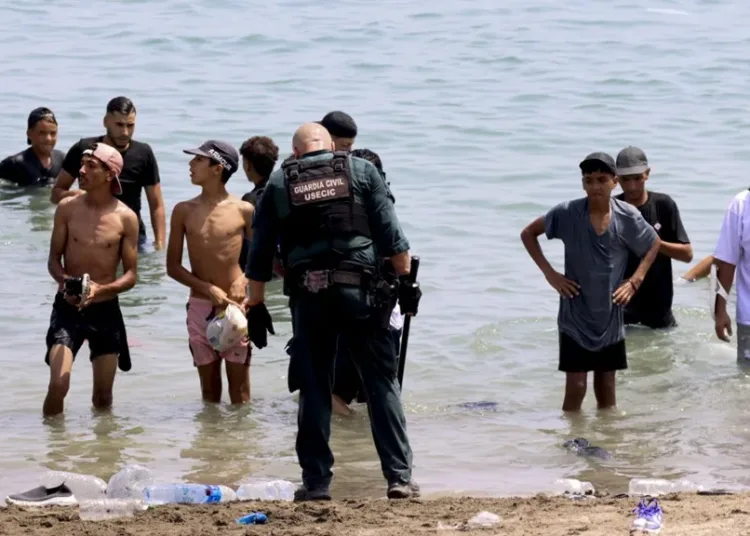
Rabat – EU interior ministers will meet by emergency videoconference on Tuesday to confront the fallout from the mass crossing into Ceuta, a crisis that has quickly escalated into a broader test of the bloc’s border strategy.
The meeting comes after 22 of the EU’s 27 member states called for coordinated action and stronger protection of external borders, reflecting mounting concern over the scale of the influx and its political repercussions.
In a direct message to Spanish Prime Minister Pedro Sanchez, European Commission President Ursula von der Leyen described the events not as an isolated emergency but as a warning.
Europe cannot afford weak points along its external borders, she argued, insisting that protection must become a collective effort, not a burden carried by frontline states alone.
Behind the numbers sit individual stories shaped by hardship, hope, and, in many cases, misinformation.
The surge itself stunned authorities. More than 50,000 people attempted to reach Ceuta within days, in what Spanish officials describe as one of the largest movements ever recorded at this border.
Tensions rose almost immediately. Italy and Denmark pushed for Spain’s suspension from the Schengen area, a proposal Madrid dismissed as unrealistic and lacking solidarity.
Spanish officials instead called for dialogue and shared responsibility, a position that helped prompt the emergency meeting now scheduled at EU level.
Von der Leyen has set the tone for that discussion. She commended Spain’s rapid response but warned that the bloc must draw clear lessons. A fragmented approach, she suggested, leaves Europe exposed. A coordinated one could restore control and credibility.
Read also: Ceuta Crisis: Spain Backs Morocco’s Proactive Migration Cooperation Amid Far-Right Criticism
She also highlighted the importance of close cooperation between Rabat and Madrid, noting that rapid returns and strong coordination on the ground helped limit onward movement toward mainland Spain and deeper into Europe.
Describing Morocco as more than just a neighboring country, von der Leyen pointed to its role as a key partner in addressing irregular migration and countering smuggling networks, underlining that such collaboration remains central to any effective European response.
On the ground, the situation has begun to ease. Spanish authorities report that more than 48,000 people have already returned to Morocco, many within the first 48 hours.
Local services, which treated over 1,000 people, now report a gradual return to stability, though officials acknowledge that normality has not fully returned.
Moroccan authorities estimated that around 40,000 people took part in the attempted crossings toward Ceuta, while more than 1,000 others reached Melilla, dismissing higher figures reported by some media outlets.
The Interior Ministry said it had confirmed 11 deaths and remained in ongoing coordination with Spanish officials to verify the total number of fatalities linked to the incident.
Spanish authorities, for their part, reported a significantly higher toll, stating that 88 bodies have been recovered.
Rabat has also renewed the familiar message that migration management cannot fall on one country alone.