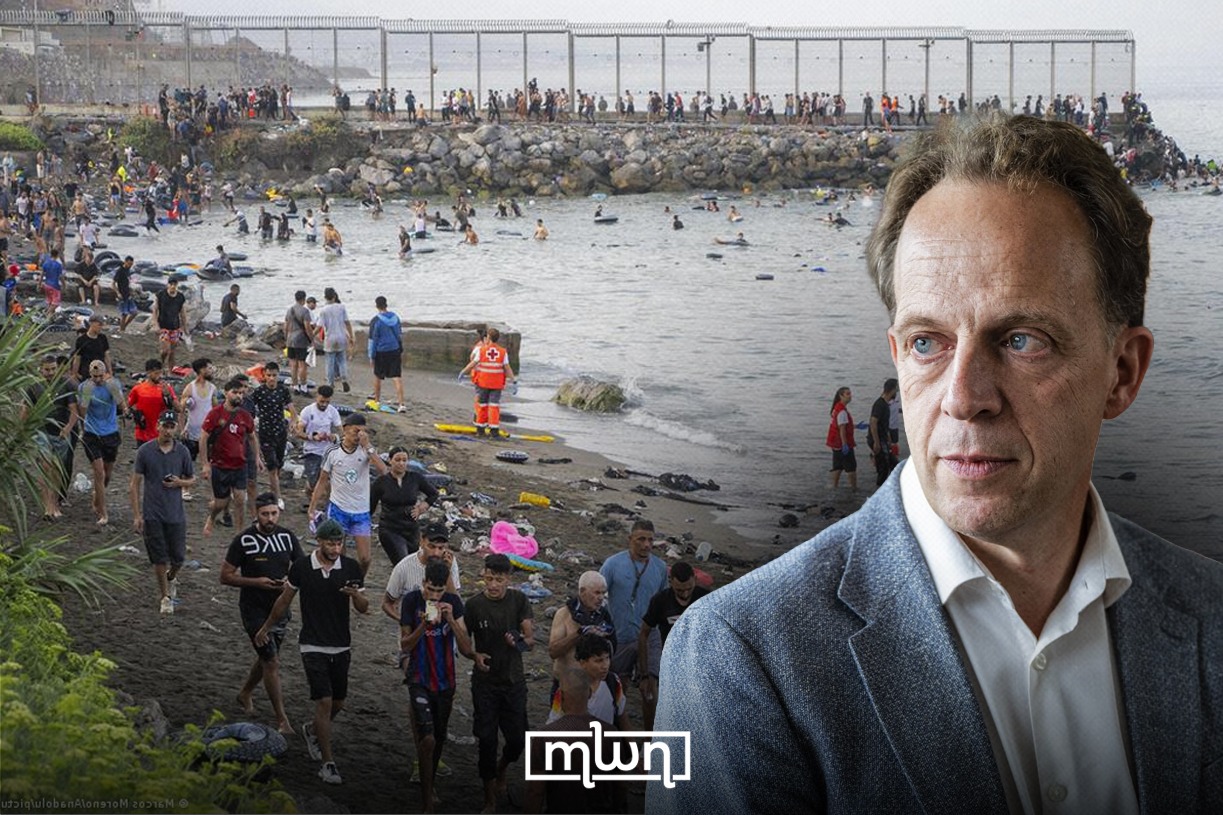
Marrakech – Two decades of growth have made Morocco roughly 2.5 times richer, yet the pressure to leave has not eased. It has climbed. A rush in late July toward the Spanish-occupied enclave of Ceuta, where about 70,000 people tried to cross after border controls briefly collapsed, put that contradiction back in view.
For Hein de Haas, a Dutch sociologist and geographer who has studied Moroccan migration for close to thirty years, there is nothing puzzling about it.
De Haas, a professor at the University of Amsterdam and the author of “How Migration Really Works,” laid out the mechanism in a LinkedIn post a week ago and, in subsequent comments to Dutch broadcaster NOS that were recently published, expanded on it.
His central claim cuts against common intuition. As he puts it, “emigration generally rises as poor countries get richer because it simultaneously increases people’s aspirations and capabilities to migrate.”
He calls this the migration paradox. Rather than holding people in place, development tends to lift the number who leave, at least until a country grows wealthy enough to keep them. “As countries move from low-income to middle-income status, development generally leads to more, not less, emigration,” de Haas writes, drawing on the argument set out in his book.
The reasoning turns on two shifts happening at once. Education, higher living standards, poverty reduction, and wider access to information raise what young people expect from life. They also hand more of them the means to act on it.
“Expanding education and media access rapidly expand people’s mental horizons and aspirations, while labour markets often take longer to catch up,” de Haas explains. When expectations outrun what is available at home, the wish to move grows. “When life aspirations rise faster than local opportunities, migration aspirations tend to increase,” he writes.
Poverty reduction plays a part of its own. De Haas points out that the poorest rarely migrate far, since the journey costs money most of them do not have. “Migrating is expensive,” he tells NOS. “You often see that in poor countries that become somewhat richer, more people can financially afford to migrate.”
Morocco tracks the pattern closely. In his book, de Haas records how adult literacy climbed from about 30% in the early 1980s to more than 76% three decades later, how rural access to electricity reached nearly the whole population, and how yearly emigration grew from roughly 30,000 to 40,000 in the mid-1990s to close to 150,000 by 2008.
He estimates that some 2.3 million Moroccans moved to Western countries between 2000 and 2019.
Schooling reshapes ambition, and for de Haas, that is part of the engine. “It is partly the success of literacy and education in Morocco,” he tells NOS. “Once you’ve gone to school, you’re no longer satisfied with a simple job or working on the farm. Then you have other ambitions.”
Those ambitions collide with wages that have not kept pace. Morocco’s growth is visible in new highways that cut travel times to remote areas and in the Al Boraq high-speed line, running since 2018, that links Casablanca and Rabat to Tangier.
Tangier itself has drawn textile firms and carmakers from Europe and China, pulled in by low labor costs and the nearby Tanger Med port. Yet, per IMF data cited by NOS, an economy 2.5 times larger has not settled the discontent, which appears sharper than ever.
Youssef, a 32-year-old who has spent 10 years in a Tangier textile factory, told NOS that wages are “far too low” against the cost of living. On roughly MAD 4,000 ($400) a month, with rent alone taking MAD 2,000 ($200), the rest goes to food. When production is scaled back or halted, he added, workers are sent home and lose the pay.
That gap helps explain the Ceuta migration crisis. Adnan, a 20-year-old hairdresser from Tetouan, was among those who surged toward the enclave and has since returned. “Here we can basically only eat and drink,” he told NOS. “Thinking about your future is pointless; we’re stuck here in the present.” When word spread that the border was open, he and his friends went to try their luck.
De Haas does not read this as a failure of development. He places Morocco at a turning point. “Morocco is now at a peak moment, a development level at which you can expect migration to be very high,” he tells NOS. Should the coming decade go well economically, together with a falling birth rate, he expects emigration to ease.
That would follow a path others have taken. Spain and Italy passed through the same shift, and de Haas notes that Türkiye and Mexico may now be entering it. The relationship, he writes, “is non-linear: as societies ‘develop’, emigration tends to increase before it eventually declines.” His conclusion reframes the debate: “migration is not the opposite of development but rather an intrinsic part of it.”
Read also: The Morocco That Is Moving Forward While the Young Moroccans Being Left Behind