Marrakech – Madrid never met a Rabat-Washington handshake it could greet with composure. Each time the two capitals draw closer, a familiar tremor runs through Spain’s political class, and this month it has surfaced in its rawest form. The provocation: a US-Moroccan weapons range in Tan-Tan, and a cruise missile that Spanish deputies now treat as a shot across their bow.
The loudest plaint arrived Tuesday from Manuel Domínguez, vice president of the Canary Islands and a Popular Party (PP) figure, in an interview with Libertad Digital.
Pressed on whether Morocco’s militarization alongside the United States should alarm Spain, Domínguez reached for the sentinel’s crouch. One must “always be attentive when there are military movements in a neighboring country,” he warned, calling the development “not good news for Spain in general, and for the Canaries in particular.”
He faulted Madrid for showing “little interest in everything Morocco is preparing.” Rabat, in his telling, “will not relent until it achieves its objectives: first the Sahara, now Ceuta and Melilla,” sensing “the weakness of an overwhelmed government” in Madrid and pressing accordingly.
His verdict on Prime Minister Pedro Sánchez ran to a small thesaurus of grievance – “pitiful, ridiculous, shameful” – capped by the charge that Sánchez “has lost the north.”
The register is not new. Morocco has long been Spain’s reliable electoral cudgel, a card every faction plays in turn – nationalist right and activist left alike – each brandishing the southern neighbor to bludgeon its rivals whenever the domestic winds demand it. Domínguez merely takes his turn at a game older than his party.
The disquiet was seeded a week earlier by Cristina Valido, the Coalición Canaria deputy in Congress, who filed written questions to Spain’s defense and foreign ministries over the same installation.
For Valido, any ballistic activity “so close” to the archipelago must reach the Canary government with “sufficient advance notice,” and it is “not the first time” Moroccan maneuvers near the islands have bred doubt about Madrid’s coordination.
Strip away the parliamentary decorum and the anxiety is naked. Spain fears the slow forfeiture of a role it has arrogated to itself for generations: gatekeeper of the western Mediterranean, sentinel of the Strait of Gibraltar, the indispensable European hinge on Africa’s northern shore.
That self-image curdles a little more each time its southern neighbor is courted by the power Madrid cannot rival. What haunts the Spanish imagination is not a missile 200 kilometers from Lanzarote.
It is the intimation that the strategic center of gravity on this littoral is migrating south – from a querulous peninsular capital to a confident kingdom that Washington increasingly treats as its anchor in Africa.
Hence the ritual. Whenever Rabat and Washington deepen their compact, the same jeremiad issues from Madrid, dressed variously as concern for sovereignty, for the Canaries, for transparency.
The complaint is never wholly about the facts. When 40,000 migrants reached the Canaries in a single year, or when 70,000 surged into Ceuta in late July – reviving Spanish dread of a second Green March – the same voices summoned the same alarm; the dossier changes, the dread does not. The Spanish class does not muffle this fear; it broadcasts it, mistaking petulance for policy.
The object of all this consternation is AMTEC – the Africa Multidomain Training and Experimentation Center.
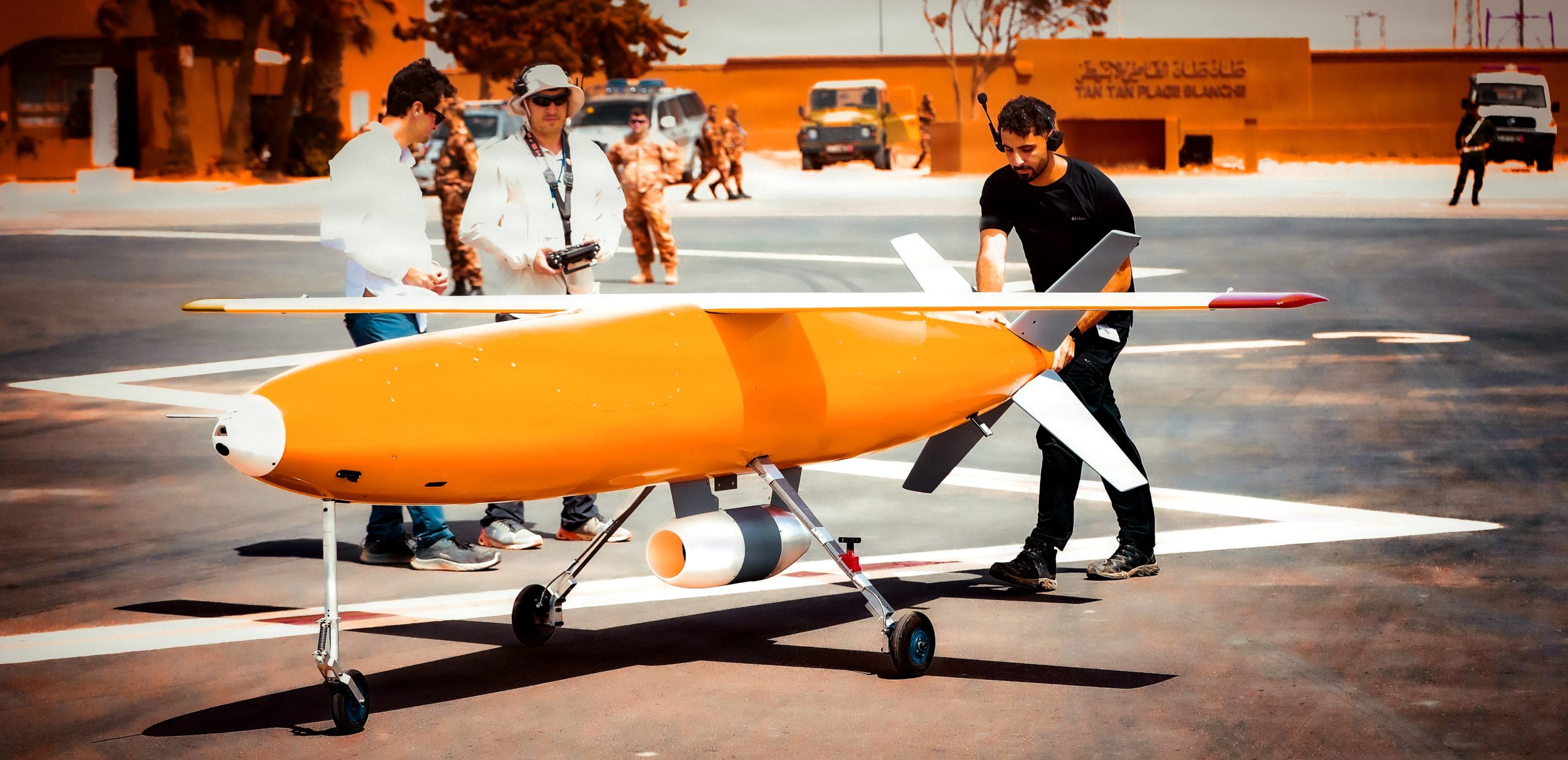
Between August 3 and 7, US service members and Morocco’s royal armed forces staged the site’s first live-fire demonstration, standing up an expeditionary test site to fire a low-cost, long-range precision-strike cruise missile under the US Army’s Test Range Expansion Initiative.
Engineers validated communications systems, assessed the maneuverability of wings, tires, and trolley components, and gathered weather and targeting data. For the Moroccan officer coordinating the effort, Colonel Zouhair El Hamdani, the ambition is a “regional hub for innovation, strategic cooperation and industrial development.”
General Dagvin R.M. Anderson, who commands US Africa Command, cast Morocco’s partnership as “a crucial venue that accelerates readiness for the US joint force and our African partners.” Future work will reach into long-range fires, autonomous systems, and advanced sensing.
None of this is a passing episode. AMTEC sits atop the US-Morocco defense roadmap for 2026-2036, signed in Washington in April, and now poised for codification in Section 1268 of the FY2027 National Defense Authorization Act, which would direct the Pentagon to make Morocco its leading military partner on the continent.
The provision floats cooperative security locations, an all-domain range complex, and a drone center of excellence. Rabat has held Major Non-NATO Ally status since 2004, and Washington already supplies roughly 60% of its arms imports.
That is the reality Madrid must metabolize: a partnership engineered to grow, not recede. Spain may lament, litigate through written questions, and reach again for the smelling salts. Morocco, unbothered, keeps building. The Canaries can watch. They cannot vote on it.