
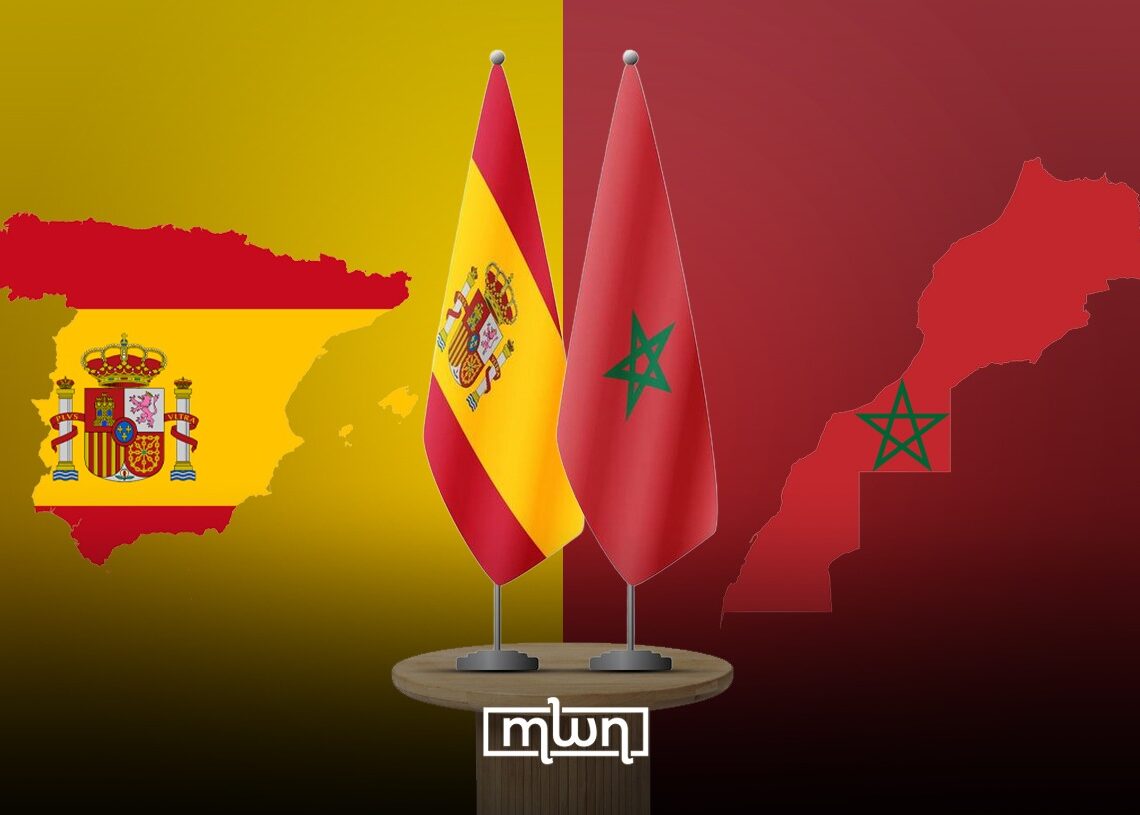
The hysterical reaction of the Spanish government and much of Spain’s political and media establishment to Morocco’s long-shelved claims over Ceuta and Melilla has surprised many Moroccans.
Although the historical existence of Morocco’s claims to both enclaves is widely known in Spain, and despite the fact that Morocco currently appears to have no interest whatsoever in reviving them, the Spanish government and a significant part of the country’s political and media elites have opted for rhetorical and patriotic escalation, embarking on a sort of competition to demonstrate who has more “balls” to adopt the toughest stance toward Morocco.
A striking example of this gratuitously belligerent attitude is that of Defense Minister Margarita Robles. During her visit to the enclave of Ceuta this week, she told the press: “Ceuta and Melilla are not just Spanish, they are extremely Spanish, and they are untouchable. Any aggression against Ceuta and Melilla is an aggression against Spain as a whole. It cannot happen again.”
Even the Spanish Royal Household, which has traditionally refrained from adding fuel to the flames of Spanish nationalism over the two enclaves, has now entered the fray. On August 1, King Felipe VI called for measures that would convey “in a united, clear and decisive manner to the populations of Ceuta and Melilla the support and affection of the rest of Spain.”
At a time when the Spanish monarchy is being questioned more intensely than ever, including by some circles on the right and far right that have traditionally supported it, Felipe VI could hardly afford to let such an opportunity pass without demonstrating his determination to defend the Spanish character of both enclaves. Remaining silent at a moment of nationalist escalation and heightened patriotic fervor could cost him further support among those segments of Spanish public opinion that have traditionally rallied behind the monarchy.
Spain’s Patriotic Escalation and the Politics of “Spanishness”
Yet the remarkable unanimity Spaniards have displayed regarding the “Spanishness” of the two enclaves does not necessarily reflect an equally unanimous conviction that their current status is historically beyond dispute or politically immutable. Spain’s political class, and even a significant part of its academic establishment—with the exception of the most nationalist sectors and circles aligned with far-right organizations such as Vox, Núcleo Nacional, or the Falange—are well aware that the historical record is considerably more complex than the official discourse would suggest.
They know perfectly well that Ceuta and Melilla were neither as Spanish as Madrid or Granada nor always regarded as Spanish, and that, until the end of the twentieth century, Spain repeatedly demonstrated a willingness to abandon both enclaves, or at least one of them, to cede them, or to exchange them for Gibraltar. Spanish authors such as Máximo Cajal and Alfonso de la Serna have each published books in which they expose what they regard as the hypocrisy of Spanish politicians and much of the country’s academic establishment on this issue, as well as their determination to keep Ceuta and Melilla under Spanish sovereignty despite viewing their status as an anachronism inherited from the colonial era.
They have likewise highlighted the lack of attachment that successive Spanish governments displayed, at various points over the past three centuries, to retaining these possessions under Spanish sovereignty, as well as their willingness to cede them, exchange them for Gibraltar, or negotiate their future in return for economic concessions from Morocco.
For example, in the seventeenth century, Spain did not consider the inhabitants of Ceuta to be Spaniards. They could obtain Spanish citizenship only after leaving the city and moving to the Iberian Peninsula.
Until the beginning of the twentieth century, the populations of both cities consisted primarily of prisoners and military personnel. Until 1907, they were referred to as “Presidios”—prisons or penitentiary zones. Between 1907 and 1913, they came to be known as “Plazas Fuertes”—strongholds. Between 1913 and 1955, they were known as “Plazas de Soberanía”—zones of sovereignty.
In December 1955, General Franco enacted a law that, for the first time, declared Ceuta and Melilla territories under full and inalienable Spanish sovereignty. Even administratively, and unlike other Spanish cities, Ceuta and Melilla remained under military rule until 1983.
Moreover, during the Spanish Protectorate in northern and southern Morocco, Ceuta and Melilla were administratively dependent on the Spanish High Commission in Morocco. Under a 1935 decree, Spaniards were required to carry passports to visit them.
The fact that the Moroccan government currently appears uninterested in discussing the future of Ceuta and Melilla with Spain does not mean that Morocco has formally recognized Spanish sovereignty over the two cities. It is one thing to accept, as a de facto reality, that they are under Spanish administration and control; it is quite another to legally recognize Spanish sovereignty over them.
Morocco has historically challenged that sovereignty and has regarded the continued presence of Ceuta and Melilla under Spanish control as a historical anachronism and a vestige of Spanish colonialism. That said, as I have explained in my books and articles, Morocco currently has not the slightest interest in opening a crisis with Spain over Ceuta and Melilla. For Morocco, the overriding strategic priority has been to resolve the Sahara question and concentrate its resources and attention on its major development and infrastructure projects.
As King Hassan II explained to then Minister of Information and Tourism Manuel Fraga Iribarne in July 1963, as long as Spain was prepared not to obstruct Morocco’s efforts to resolve the Sahara question, Morocco could leave the issue of Ceuta and Melilla- which did not carry the same strategic importance- for another three or four generations. In other words, even for another century.
Someday in the future, this issue could be resolved peacefully, naturally, and without upheaval through dialogue between the two governments and the two peoples. The Spanish political class therefore knows that the indefinite continuation of both enclaves under Spanish sovereignty could be called into question in the future and that a day may eventually come- who knows whether in one, two, or three decades- when Spain will have to sit down at the negotiating table with Morocco to discuss their future and seek a peaceful and mutually acceptable solution.
When Toughness Toward Morocco Becomes Electoral Currency
Even if they are aware of this possibility, however, few Spanish political leaders can afford to acknowledge it publicly. They know perfectly well that Morocco has historically been, and will probably continue to be, an issue in Spain’s domestic politics and, consequently, an electoral card capable of generating votes. The simple reality is that negative coverage of Morocco sells. Positive news coming out of Morocco receives far less attention because it apparently generates less public interest. But when the subject is the King of Morocco, the “despot,” an alleged Moroccan threat, or yet another crisis with Morocco, there are suddenly headlines, audiences, and extensive media coverage.
From this perspective, adopting a posture of firmness—or even outright intransigence—toward Morocco can satisfy broad sectors of Spanish public opinion and yield electoral dividends for politicians seeking either to attain power or remain in office.
As Juan Goytisolo pointed out when criticizing his country’s attitude toward Morocco during the Perejil islet incident, awareness of the satisfaction that any demonstration of firmness toward the Moroccan government could generate among broad sectors of Spanish public opinion was one of the factors that pushed the Spanish government to adopt a belligerent posture and resort to force to deter Rabat: “It matters little that the consensus generated around actions such as the ‘reconquest of the islet’ is fleeting and, ultimately, futile: the head of government knew perfectly well that such a course of action would increase his popularity ratings, emulating Mrs. Thatcher in her triumphant recovery of the Falklands.”
Given the attachment of a substantial part of Spanish public opinion to keeping Ceuta and Melilla under Spanish sovereignty, successive Spanish governments since Franco’s death have understood perfectly well that merely opening negotiations with the Moroccan government over the future of these cities could carry an enormous political cost. The same would apply to any official stance favoring their retrocession to Moroccan sovereignty or, at the very least, aimed at finding a solution capable of satisfying both parties while respecting their respective rights and interests, such as, for example, some form of shared sovereignty.
An initiative of this kind would quickly provoke rejection and condemnation from broad sectors of Spanish society. The political cost for any party daring to defend such a position—which its opponents would almost immediately denounce as “surrenderist”—could extend far beyond a possible electoral defeat: it could seriously jeopardize that party’s political future.
This political reality helps explain why, whenever the question of Ceuta and Melilla resurfaces in Spain’s public debate, the ideological differences separating the country’s main political parties tend to fade into the background, giving way instead to a genuine nationalist and patriotic escalation, in which each political actor seeks to demonstrate that it is more uncompromising and more resolute than its rivals in the face of any Moroccan claim.
Samir Bennis is the co-founder and publisher of Morocco World News. You can follow him on Twitter @SamirBennis.