![Spanish soldiers with migrants in Ceuta. [File: Fabian Bimmer/Reuters]](https://www.moroccoworldnews.com/wp-content/uploads/2026/08/Spain-Confirms-24-Scabies-Cases-Among-Soldiers-in-Ceuta-Denies-Migrant-Link.jpg)
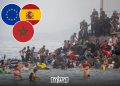
Marrakech – Spain’s Ministry of Defense has confirmed that 24 soldiers stationed with the General Command in the occupied city of Ceuta have contracted scabies, while rejecting any connection between the infections and the recent mass arrival of migrants.
In a Tuesday statement issued through the army, the ministry led by Margarita Robles reported that two of the 24 affected troops were already infected before migrants reached the enclave. On that basis, defense argued that the parasite was already circulating in the occupied city before the influx.
The ministry described scabies as a common infection in areas of high humidity such as Ceuta. It confirmed that measures had been taken to treat the infected and to disinfect military facilities, adding that everyone was receiving the treatment recommended by health authorities once the diagnosis was confirmed.
The Health Headquarters of the General Command also established a protocol to prevent new infections, identify symptomatic personnel early, and apply a single response across all units.
Defense moved to downplay the outbreak. Official sources described it to Spanish media as “something banal” and “not infrequent.” The infected soldiers, drawn from the 54th Regulares Group, were relocated to another part of the barracks.
The ministry expects them back on duty within days, once the itching subsides, and for that reason has granted none of them sick leave – a decision that angered several professional associations.
Those associations traced the outbreak to the soldiers’ lodging. The Union of Troop Military (UMT) first reported at least 14 cases, attributing them to conditions at the old K-8 Coastal Battery in García Aldave, where personnel were housed on Saturday, August 15.
The union described the site as a facility usually out of use, without required hygienic maintenance, with known histories of similar infestations, and in a state of overcrowding.
The link to migration, by contrast, originated with the Spanish side itself. The military command in Ceuta ordered the outbreak zone disinfected and set out to determine whether the mites were already present from the barracks’ disuse or tied to the more than 80,000 migrants who entered the occupied city on July 30-31.
Its own inquiry turned toward the deployment. Defense had tasked the Legion and the Regulares with escorting Moroccans who chose to return home on foot toward the Tarajal crossing, which the command treated as a possible point of close contact.
That theory shifted attention onto the returning Moroccans, yet the army later ruled out that route of transmission, and two of the cases predated the migrants’ arrival altogether.
The medical facts weakened the migrant theory further. Scabies spreads mainly through prolonged skin-to-skin contact, and less often through shared clothing, towels, or bedding. The soldiers worked the streets without gloves or masks, a gap the associations tied to their conditions rather than to any contact with Moroccans.
The associations pressed for transparency and better conditions. The ATME argued that outbreak diseases affecting two or more linked people fall under mandatory reporting, and it requested precise figures on cases, epidemiological links, and affected units.
The UMT questioned whether the outbreak had reached other units and what plan existed to halt its spread toward soldiers’ families and the civilian population.
The UMT also denounced the labor conditions. It reported that troops operated without defined protective equipment, bought their own masks and gloves, and worked exhausting shifts without regulatory rest.
The union further questioned an internal claim of overtime pay set at €17 per three hours worked, demanding to know whether the figure was real and under what legal basis it would be paid.
“Our comrades in Ceuta are demonstrating commendable professionalism and dedication in a critical situation,” the union stated, “but it cannot be allowed that they do so by putting their health at risk, crammed into unsanitary facilities.”
Read also: Ceuta Nursing Council Calls for State of Emergency Amid Spain’s Denial of ‘Healthcare Collapse’