One of the more outlandish claims repeatedly advanced in Spain’s public debate over the events in Ceuta is that what happened was supposedly part of a Moroccan plan not only to retake Ceuta and Melilla, but also to seize the Canary Islands. This is a monumental flight of fancy that overlooks a fundamental historical fact: Morocco has never laid claim to sovereignty over the Canary Islands. More than that, Morocco actively sided with Spain in defending its sovereignty over the archipelago when it came under sustained challenge from Algeria beginning in 1977. The historical record on this point is unambiguous, and is worth revisiting in some detail, if only because it is so consistently and conveniently omitted from the current Spanish discourse.
Following the signing of the Madrid Accord, the Tripartite Agreement between Morocco, Spain, and Mauritania on November 14, 1975, Algeria embarked on a diplomatic campaign lasting several years whose objective was to persuade Spain to distance itself from that agreement and not only to declare that the Sahara question remained unresolved, but also to recognize the Polisario as the “legitimate” representative of the “Sahrawi people.”
Cubillo, the MPAIAC, and Algier’s proxy war
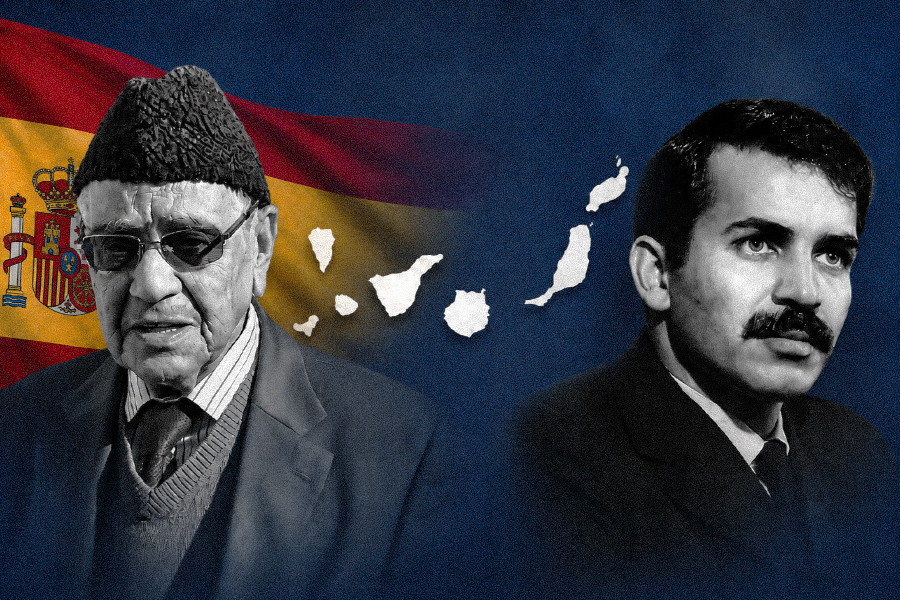
To achieve this objective, Algeria provided refuge to a marginal movement advocating the independence of the Canary Islands. The leader of this movement, known as the Movement for the Self-Determination and Independence of the Canary Archipelago (MPAIAC), was a lawyer named Antonio Cubillo. Algeria granted Cubillo asylum and provided him with the media apparatus needed to conduct propaganda activities in support of his cause, most notably through a dedicated Algerian state radio program, “La Voz de Canarias Libre” (“The Voice of Free Canaries”), which broadcast separatist appeals to the archipelago. It bears noting that the MPAIAC was not merely a rhetorical nuisance. Its armed wing, the Fuerzas Armadas Guanches (Guanche Armed Forces), had carried out a bombing at a shopping center in Las Palmas de Gran Canaria in 1976, further pointing to the fact that Algeria’s sponsorship extended beyond propaganda broadcasts into support for an organization willing to use violence against Spanish civilian targets. This context matters because the threat Algeria was underwriting against Spanish sovereignty in the Canaries was not an abstraction confined to OAU committee rooms, but a movement with a demonstrated capacity, and a stated intent, to strike inside Spanish territory.
When it became clear that Spain still showed no signs of adopting an openly hostile position toward Morocco by recognizing the Polisario as the “legitimate” representative of the Sahrawis, Algeria resorted to blackmail, using Spain’s territorial integrity and sovereignty over the Canary Islands as leverage. Algeria capitalized on the influence it wielded within the Organization of African Unity (OAU) and, beginning in 1977, pushed for the recognition of the MPAIAC as a national liberation movement and of the Canary Islands as an African territory awaiting decolonization.
Algeria’s efforts reached their high-water mark during meetings of the OAU’s ad hoc Liberation Committee, held in Tripoli between February 13 and 18, 1978. There, proposals were put forward to regard the Canary Islands as an African territory under colonial rule requiring liberation, to provide economic and logistical support to the “Canarian liberation” movement, and to task the OAU Secretary-General, William Eteki, with following up on the matter going forward.
Algeria’s Canarian gambit cannot be understood in isolation from the broader Algeria-Morocco rivalry that had crystallized around the Sahara dispute, itself inflected by the global Cold War, with Algiers drawing on Soviet and Cuban backing, while Rabat aligned with Washington and Paris. Having positioned itself as the Polisario’s principal patron and international advocate, Algiers had every incentive to raise the diplomatic cost of Spain’s rapprochement with Morocco and Mauritania. Weaponizing a marginal separatist movement, in this sense, less about the Canary Islands themselves than about manufacturing leverage over Madrid, a pattern of proxy pressure that Moroccan and Spanish historians alike have since documented as characteristic of Algeria’s regional diplomacy in this period.
An article published by El País on February 21, 1978, exposed what was then an open secret both in Spain and in foreign diplomatic circles. “Algerian pressure on these issues appears aimed at getting Spain to change its position on the Sahara, supporting the Polisario Front against Morocco, in order thereby to save the Canary Islands,” wrote José Ramón Ariño Rodríguez, the author of the article, an observation that laid bare the instrumental logic underlying Algeria’s Canarian gambit.
Algeria’s maneuvering took an even more troubling turn for Spain in June of that same year, when the Liberation Committee concluded its ordinary session by reaffirming its support for the independence of the Canary Islands, and, separately, by drawing attention to the attempt on Cubillo’s life in Algiers on April 5 of that year, an episode later attributed to the Spanish security services and which left Cubillo permanently disabled. Together, these developments caused enormous controversy and no small measure of alarm within the Spanish government and among the country’s academic and media elites, who rightly understood Algeria to be using the Canary Islands as a lever with which to force Spain to reconsider its position on the Sahara.
An article in El País in June captured the prevailing mood in Spain in response to the Algerian maneuver with particular sharpness: “The Algerian regime, which has erected the Canarian scarecrow and manipulates it with the declared purpose of blackmailing Spain and making it pay for its ‘mistakes’ in Western Sahara, must feel overtaken by the political charade organized by the MPAIAC in the Tanzanian capital, unless it is itself the instigator of a new maneuver aimed at condemning ‘Spanish imperialism’ at the African conference in Khartoum.”
Rabat stands with Madrid
And what did Morocco do in the face of all this? The North African country expressed, unequivocally and emphatically, its support for Spain’s territorial integrity and its rejection of Algeria’s attempt to pressure Madrid through the instrumentalization of the Canary Islands issue. This is, notably, an aspect of the period that Spanish analysts, academics, and journalists tend to pass over in silence when discussing this chapter of Moroccan-Spanish relations.During the very same meeting of the OAU’s Liberation Committee in Tripoli in February 1978, Morocco firmly and publicly defended Spain’s territorial integrity.
In response to the vehement and extremely harsh statement concerning the Canary Islands made against Spain by Algerian Foreign Minister Abdelaziz Bouteflika, Moroccan Foreign Minister Mohamed Boucetta questioned the credibility of the claims being advanced regarding the “African” character of the Canary Islands. The Moroccan official remarked, with evident irony: “It is surprising that Bouteflika and the government to which he belongs waited until Cubillo arrived in Algeria to discover the existence of a “Guanche people” and a “new colonialism.”
Morocco reiterated its rejection of any attempt to undermine Spain’s territorial integrity in a formal statement issued by its Embassy in Madrid on February 20. In that statement, Rabat reaffirmed its position that the Canary Islands constituted an integral part of Spanish territory, that it had “never called into question their Spanish character,” that it did not recognize the separatist organization headed by Antonio Cubillo, and that it supported the position of the Spanish government.
A diplomacy of reassurance, repeatedly rebuffed
And that is not all. From the early years following its independence, when Morocco began inviting Spain to engage in dialogue over the territorial disputes between the two countries, it consistently demonstrated its willingness to take into account the security and interests of the Canary Islands in any understanding reached between Morocco and Spain, particularly with regard to the Sahara question.
Mindful of the strategic concerns arising from the Canary Islands’ proximity to the Sahara, King Hassan II assured the Spanish ambassador, Manuel Aznar, during a meeting held at the Royal Palace in Fez on April 22, 1963, that Morocco was prepared, once its sovereignty over the Sahara had been recognized, to allow Spain to maintain a military base in the area so as to guarantee the security of the archipelago. Morocco further proposed a bilateral agreement under which the two countries would cooperate in the extraction and commercialization of the Sahara’s natural resources, as well as in the exploitation of resources located on the seabed of the territory’s continental shelf.
Morocco extended comparable guarantees to General Franco in 1970. Neither set of proposals was ultimately taken up, as Spain chose, on both occasions, to pursue a different course from the one Morocco put forward. The episode did not end well for Algeria’s gambit. Spain’s establishment of the Canary Islands as an Autonomous Community in 1982 defused much of the separatist movement’s domestic appeal, and by 1979 the MPAIAC had formally renounced armed struggle. Cubillo himself was eventually granted a royal pardon and returned to Spain, where the independence cause he had championed from exile in Algiers never regained the momentum Algeria had once tried to engineer for it.
This record leaves little room for the revisionism now creeping into segments of the Spanish debate. Far from harboring designs on the Canary Islands, Morocco has, at every decisive juncture over the past half-century, stood on the side of Spanish sovereignty over the archipelago, including at the precise moment, in 1978, when that sovereignty was under genuine and serious challenge from Algeria. Those in Spain who invoke a phantom Moroccan threat to the Canaries today would do well to consult this record before repeating a claim that the historical evidence does not support.
Samir Bennis is the co-founder and publisher of Morocco World News. You can follow him on Twitter @SamirBennis.