
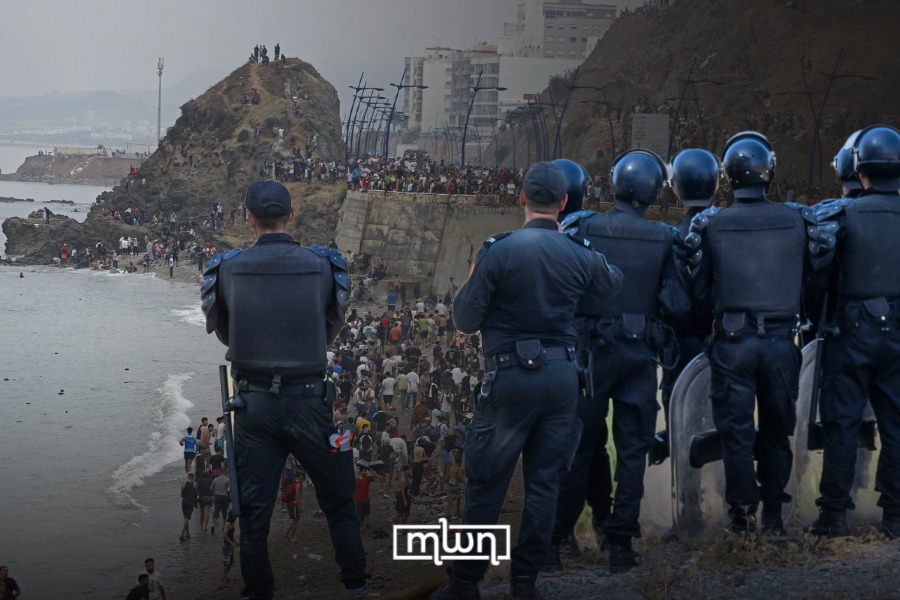
The latest wave of irregular migration toward occupied Ceuta and Melilla has exposed a striking contradiction that was largely absent from Spanish coverage of the crisis. While Moroccan security forces bore the heaviest burden on the ground and paid a significant human and material price in confronting mass crossing attempts and the violence accompanying them, sections of the Spanish media focused instead on blaming Morocco and holding it responsible for what happened.
Updated figures from the health services of Morocco’s General Directorate of National Security (DGSN) illustrate the scale of that cost. A total of 107 police officers were injured during the events, including 89 from the Tetouan Police Prefecture, 17 from the Nador Regional Security Department, and one officer from the Tangier Police Prefecture.
Their injuries included fractures, wounds, head and limb injuries, bruises, and contusions. Some of those affected also required psychological support after showing signs of trauma linked to what they had experienced during field operations.
These were not routine occupational injuries. They occurred amid confrontations involving stone-throwing, violence, arson and property damage. During the first two days alone, 26 police vehicles were burned or vandalized, including 18 in the Fnideq area and eight in Nador, further illustrating the level of pressure Moroccan security forces faced.
A tale of two narratives
These facts present a very different picture from the one promoted by parts of the Spanish media. Several Spanish outlets published reports referring to alleged “Moroccan inaction,” while others went as far as framing the crisis in terms of “hybrid warfare,” accusing Morocco of allowing migrant flows to build pressure on Spain.
Yet a comparison of what happened on both sides of occupied Ceuta and Melilla exposes a difficult-to-ignore contradiction. More than one hundred Moroccan police officers were injured while trying to contain mass crossing attempts and the violence accompanying some of them. At the same time, no comparable human or material toll was publicly documented on the Spanish side. Nevertheless, Morocco found itself cast as the accused party in a significant part of the Spanish media narrative.
The contradiction becomes even more striking when examining how Spanish security forces treated migrants after they reached occupied Ceuta. Videos and testimonies documented incidents of violence, ill-treatment, and physical abuse. Teams from Morocco’s National Human Rights Council (CNDH) also observed signs of beatings and scars on returnees and heard consistent testimonies describing mistreatment and assaults by Spanish forces, particularly away from cameras.
The result was a stark contrast. On the Moroccan side, security personnel were injured while confronting violence, maintaining public order and preventing dangerous crossing attempts. On the other side, images and testimonies emerged of migrants being beaten, kicked and mistreated. There were also reports of people being deprived of food and water, as well as assaults against newcomers by extremist groups inside occupied Ceuta.
A crisis of unprecedented scale
The pressure Morocco faced was not entirely spontaneous, nor was it limited to individual decisions to migrate. Online groups and digital platforms played a major role in mobilization, sharing instructions on routes and the timing of crossing attempts. Monitoring efforts also identified posts pointing to the activity of intermediaries and networks linked to human trafficking.
Foreign accounts and telephone numbers were also identified in groups encouraging crossings and spreading misleading information, with Algerian phone numbers among the most prominently identified.
When new online calls emerged for another mass crossing attempt on August 15, Moroccan authorities did not treat the crisis as over. Security deployments were reinforced, monitoring and arrests intensified, and efforts continued to prevent would-be migrants from reaching crossing areas.
On the eve of the planned attempt, Reuters reported that Morocco had stepped up security measures and detained would-be migrants as part of a broad preventive operation.
All of this makes the Spanish campaign against Morocco even more questionable. A crisis of such complexity cannot reasonably be reduced to ready-made accusations against the country whose security forces sustained injuries and material losses while remaining under continuous operational pressure.
At the same time, parts of the Spanish media devoted far less attention to scrutinizing networks involved in incitement and human trafficking, or to examining the conduct of Spanish security forces themselves toward migrants once they reached occupied Ceuta.
Morocco doesn’t need Madrid’s validation
Morocco does not need Madrid’s validation. The facts on the ground and the available figures speak for themselves. Moroccan security forces bore a real human and operational cost, and their interventions did not end when the initial peak of the crisis subsided. They continued as new waves of online incitement emerged and authorities worked to prevent the same scenario from recurring.
The broader lesson from the events surrounding Ceuta and Melilla is that the burden was distributed in a deeply uneven manner. Morocco paid the heavier human and operational price, while sections of Spain’s media and political establishment retained the luxury of assigning blame.
Between those two realities lies a fact that is increasingly difficult to obscure: the side that paid the price of the crisis on the ground was not the one leading the campaign of accusations.