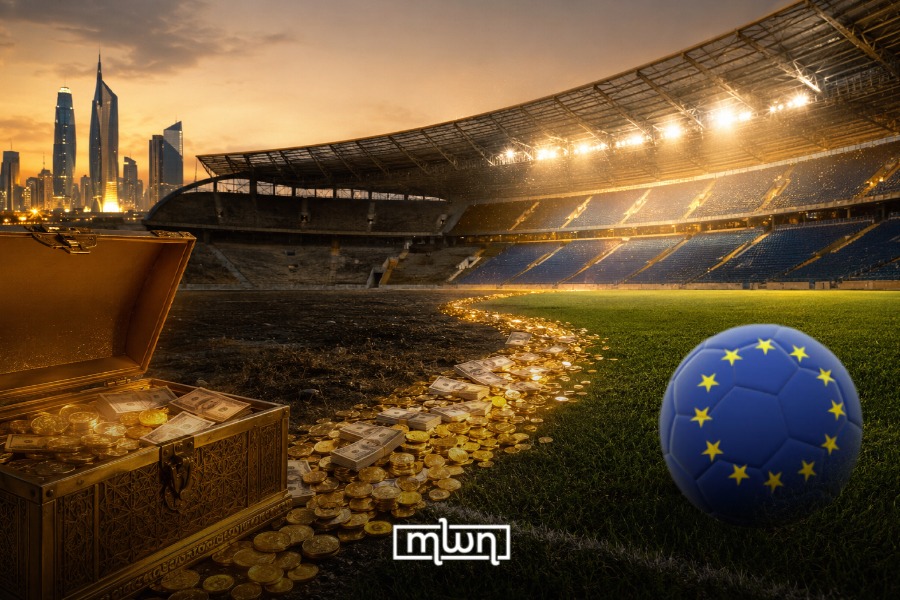
By 2012, Spanish football was drowning. Six clubs in the top flight were in bankruptcy protection, the league’s clubs owed some 750 million euros in unpaid taxes alone, and a year earlier the players’ union had threatened to strike over fears that insolvent clubs would simply stop paying them. Across Europe, the wider picture was no better: the continent’s clubs were collectively losing well over a billion euros a year, spending money they did not have on wages they could not cover. This was the state of the game the Gulf is so often accused of ruining — a game that was, by any honest measure, already broke.
We have been told a particular story about Gulf money in European football. In it, sovereign wealth from Doha, Abu Dhabi, and Riyadh arrives to buy respectability it has not earned, distorting a proud institution with bottomless cash. It is a story about a powerful West reluctantly opening its doors to a Gulf that needs its approval. The numbers tell a different one — and it runs in the opposite direction.
The timeline the panic leaves out
The timeline is worth reading closely. Abu Dhabi’s Sheikh Mansour bought Manchester City in 2008, months before the global financial crisis hollowed out European balance sheets. Qatar Sports Investments took control of Paris Saint-Germain in 2011, buying a majority stake for a reported 70 million euros — pocket change for a capital-city club — at the exact moment French football’s finances were sliding. Saudi Arabia’s Public Investment Fund completed its purchase of Newcastle United in 2021, for around 305 million pounds. In each case, the capital did not arrive to compete with a thriving European market. It arrived to prop one up.
And prop it up it did. Deloitte’s figures show that the influx of Middle Eastern investment coincided with record revenue growth across the top European clubs. The airlines told the same story before the sovereign funds did: Emirates, Etihad, and Qatar Airways became fixtures on the shirts of Europe’s biggest teams long before anyone spoke of takeovers. When a continent’s clubs are losing well over a billion euros a year, the entity that writes the cheque is not a corrupting outsider. It is the capital that kept the game solvent.
Here is where the conventional wisdom stumbles hardest. In the 2024-25 season, Manchester City reported a loss of nearly 10 million pounds — its first in years — despite generating a near-record 694 million in revenue. To ordinary business logic, this looks like failure. But these clubs were never built to make money in the first place. They were built to make presence — and by that measure, they are among the most successful investments the Gulf has ever made. The loss is not a miscalculation. It is the price of the asset, and the asset is influence.
A continent that regulates what it depends on
Once you see it this way, the Western response becomes revealing. Because Europe has not simply accepted Gulf money — it has spent years trying to regulate, investigate, and contain it, all while depending on it.
Consider the legal record. Spain’s top league, La Liga, formally urged the European Commission to act against PSG under the bloc’s Foreign Subsidies Regulation, arguing that Qatari state backing distorts competition. A Belgian second-division club lodged a similar complaint against a club ultimately linked to Sheikh Mansour. UEFA, for its part, has built an entire regulatory apparatus around multi-club ownership — its rules forced Manchester City to place its stake in Spain’s Girona into a blind trust so that both could play in the same competition. By early 2026, roughly 380 clubs worldwide were folded into multi-club ownership networks, nearly 42 percent of the clubs in Europe’s five largest leagues. The continent that is said to have surrendered to Gulf cash has, in fact, been writing rulebook after rulebook to fence it in.
The most consequential of these battles remains unresolved. In February 2023, the Premier League charged Manchester City — owned by Abu Dhabi’s Sheikh Mansour — with 115 alleged breaches of its financial rules, ranging from inflating sponsorship income to failing to cooperate with the investigation. The club denies all of it. But nearly two years after the hearing concluded, no verdict has been published — an extraordinary silence that has itself become the story. Here, too, the contradiction holds: English football built a case that could in theory expel its own reigning champion, and then spent nearly two years without delivering a verdict.
And there is a detail this whole argument tends to leave out. If the fear is that foreign capital is buying up English football, the Gulf is not the buyer worth watching. As of early 2026, eleven of the Premier League’s twenty clubs were majority-owned by Americans or US investment groups — more than half the division. The four most successful clubs in the country’s history — Liverpool, Manchester United, Arsenal, and Chelsea — are all American-controlled. Across the continent the pattern repeats: Americans or Canadians hold nine of Serie A’s twenty clubs, and three in Spain’s top flight. Against that, the Gulf owns two Premier League clubs.
The financial record is no kinder to the assumption underneath the panic. The largest pre-tax loss in Premier League history — Chelsea’s 262.4 million pounds for the year to June 2025 — belongs not to a Gulf-owned club but to an American-owned one, and it beats the record it displaced, set by Manchester City in 2011, by almost sixty-five million. Meanwhile Europe’s top divisions are still, collectively, losing around 1.1 billion euros a year even as revenues climb past 30 billion. The losses are structural. They predate the Gulf, they have outlasted its arrival, and the clubs posting the largest of them answer to American boardrooms, not Doha and Abu Dhabi. Which leaves an awkward question about where Europe has chosen to point its regulators — and where it has not.
And yet. At the very summit of European football’s governance sits a single figure who makes the contradiction impossible to ignore. Nasser Al-Khelaifi is Qatari. He is the president of Paris Saint-Germain and the chairman of Qatar Sports Investments, the state vehicle that owns it. He sits on the board of Qatar’s sovereign wealth fund. He is the group chairman of beIN Media Group, one of the most important broadcasters of European football in the world. He chairs European Football Clubs, the body representing more than 800 of the continent’s clubs. He holds a seat on UEFA’s own Executive Committee — the first leader from Asia to reach a senior position in European football’s governing body — and since October 2025, a seat on the FIFA Council as well.
Read that list again. The man who most fully embodies Gulf ownership is not knocking on European football’s door from the outside. He is inside the room where the rules are written, holding several of the chairs. Europe polices Gulf ownership with one hand and hands it the gavel with the other. This is not hypocrisy in the cheap sense of the word. It is dependence — structural, admitted in practice if never in speeches, and impossible to reverse.
The ceiling on what money can buy
None of this means the Gulf strategy is flawless, and it would be dishonest to suggest otherwise. The tool has a ceiling, and the ceiling is real. Qatar spent a decade and untold billions on the 2022 World Cup, and the most rigorous research since has been sobering for Doha. A large study across eight European countries found that when the tournament was framed around human rights concerns, attitudes toward Qatar worsened — critical coverage, in other words, blunted the very image boost the event was meant to deliver. A separate study of German viewers found that the World Cup did not improve Qatar’s image at all, though it did increase sympathy toward the Arab region as a whole. Soft power bought with sovereign wealth is not the same as legitimacy earned over time. It can be spent, but it can also evaporate under a camera’s gaze.
That ceiling is becoming visible in the Gulf itself. By 2026, its own appetite had cooled. Saudi Arabia’s Public Investment Fund said it would fund LIV Golf only through the 2026 season, as the circuit moved toward a new funding model — cancelling its season finale along the way. Its 2026-30 strategy does not list sport among its priority areas at all, and budgets have been tightened at the Saudi clubs it controls. Newcastle, constrained by the Premier League’s profit and sustainability rules, has been forced to sell prized players rather than buy them — most strikingly Alexander Isak, sold to Liverpool in 2025 for a British record fee. The point is not that Gulf money is vanishing from sport; it plainly is not. It is that the era of the blank cheque — the unlimited sovereign subsidy that could absorb any loss indefinitely — is giving way to something more disciplined, and more ordinary. Even the deepest pockets, it turns out, eventually feel the pressure of the same rules and the same scrutiny as everyone else.
So the picture is not one of Gulf triumph and Western surrender. It is more interesting than that. The Gulf states have used football to convert financial capital into geopolitical presence with genuine skill — and they have discovered, as every power eventually does, that presence and approval are not the same currency. What they have unmistakably achieved is a shift in the balance of power inside the sport. What remains uncertain is whether that shift buys them anything more durable than a seat at the table and a permanent asterisk in the Western press.
There are already hints that the relationship is evolving beyond the purchase model. The 2030 World Cup will not be bought outright by a single Gulf state; it will be co-hosted by Morocco, Spain, and Portugal — an Arab and African nation sharing the tournament with two European ones. It is the closest football has come to a partnership rather than a takeover, and it suggests the story of Arab money in the game is still being written.
For now, return to where we began — to a Spanish league so deep in debt in 2012 that clubs were falling into bankruptcy protection, and players feared going unpaid. The men who ran European football then did not turn the Gulf away. They took its money, used it to steady clubs and grow the business, and only later found a vocabulary of concern about where it came from. That sequence — the rescue first, the objection afterward — is the part of the story we have been trained to forget. It is also the part that explains everything that followed.