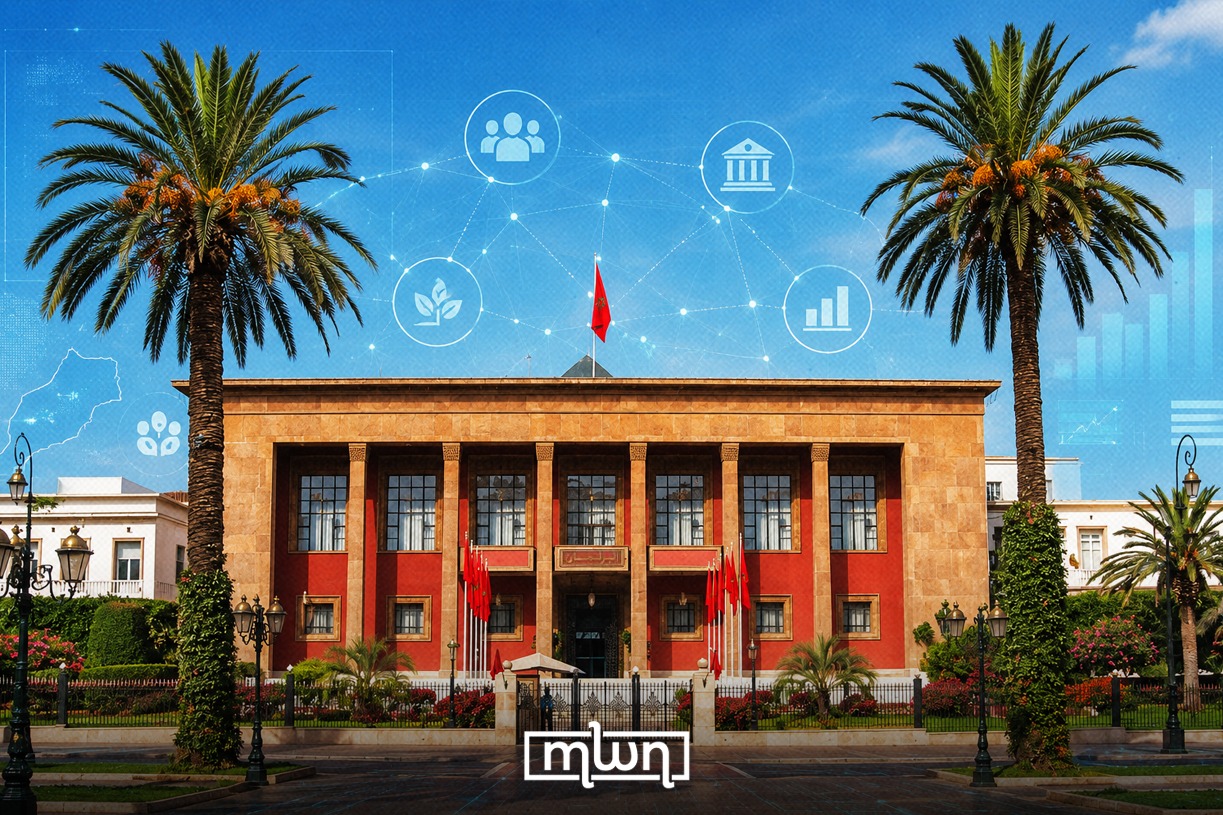
As Morocco prepared to elect 395 lawmakers to the House of Representatives in today’s general elections, the campaign presented a clear dynamic: while major parties have mainly converged around the social state and the 2030 horizon, the legislative track record of the past five years remains largely outside the public debate. With an absolute majority requiring 198 seats, the central strategic imperative is less about individual seat totals and more about preserving leverage for the post-September 23 coalition arithmetic.
The election is structured around a triple structural constraint. First, a demographic decline in the active electorate: with 15,801,162 registered voters, the civic body has lost 1.7 million individuals compared to 2021, marking a particularly severe retraction among first-time voters, with the 18-24 age group accounting for only 3 to 4% of registered voters. Second, a deficit of institutional trust corroborated by the latest Afrobarometer data, in which barely a third of 18-35 year-olds express confidence in Parliament and the executive. Finally, there has been a tighter regulatory framework. The country’s High Authority for Audiovisual Communication (HACA) and lawmakers have formalized the regulation of digital flows, algorithmic sponsoring, and artificial intelligence, shifting the discursive confrontation toward online platforms in an ecosystem boasting over 41 million internet subscriptions.
Faced with a precarious youth whose electoral avoidance reflects a methodical disaffiliation rather than outright hostility, the offer of party headquarters has crystallized around a totemic aggregate: the promise of one million jobs. Repeated endlessly by the National Rally of Independents (RNI), the Authenticity and Modernity Party (PAM), and the Progress and Socialism Party (PPS), this figure increasingly acts as an obligatory bidding war. It rests on systemic imperatives: youth underemployment hovering around 27%, a high incidence of NEETs, and the infrastructure horizon of the 2030 World Cup. Yet, in the eyes of a disillusioned electorate, this convergence of promises (a 5,000 dirham minimum wage, massive investment packages) serves only to disqualify partisan differentiation, fueling civic disengagement to the benefit of reproducing the established balance of power.
Sociology of campaign machines
The effectiveness of an electoral apparatus is measured by the organic articulation of four variables: message unity, territorial sequencing, the personalization of political costs, and a theory of victory linked to post-electoral alliance mechanisms.
The RNI approaches the election through a strategy of preservation supported by the most professionalized machinery of the post-2011 cycle. Its theory of victory relies on the electoral monetization of its material record: direct cash assistance, the rollout of social safety nets, and World Cup 2030 projects. The party leadership operated within the temporal cracks of regulation.
Well before the legal opening on September 10 and the HACA threshold on August 15, the party orchestrated a systematic occupation of the public sphere under the guise of “national communication tours” from Fez on June 22 to simultaneous demonstrations of strength in the South in July. This exploitation of the legal gray zone neutralizes the brevity of the official campaign in favor of an apparatus that already commands state logistics, dense patronage networks, and an ongoing municipal presence.
Nevertheless, the structure’s vulnerability lies in its embodiment. Aziz Akhannouch has relieved himself of statutory party leadership yet the pivotal orator at major rallies crystallizes accumulated socioeconomic grievances regarding purchasing power. The reiterated promise of one million jobs and a minimum wage raised to 5,000 dirhams following a contested term exposes the platform to an elasticity deficit among voters facing persistent living inflation.
The “Tractor” party is not aiming for a return to the opposition; its strategic objective is securing hegemony within the outgoing majority itself by challenging the RNI for first place. Its staging of the Fatima Ezzahra El Mansouri and Fouzi Lekjaa tandem formalizes this attempt to hybridize historical territorial roots with budgetary technocracy. The employers’ confederation’s (CGEM) near-total endorsement of the party’s economic orientations and the announcement of a 350-billion-dirham budget for 2027-2031 constitute the pillars of this offensive.
Yet, such a pursuit of centrality suffers from a structural aporia: claiming a “change of course” after co-managing budgetary arbitrations for five years constitutes a rebranding exercise. The sociological incoherence between the disciplined voting in favor of five finance laws and a belated posture of rupture undermines the credibility of the offer among the middle classes.
Faithful to its historical sociology, the Independence Party rejects the binary drama pitting its two coalition partners against each other. Under Nizar Baraka’s leadership, the party shuns the hyper-technicality of large rallies to reactivate its traditional strongholds and historical patronage networks. The “Watani Moustaqbali” program avoids abstract macroeconomic targets, favoring targeted micro-social incentives instead: marriage bonuses, technical vocational training, the reinforcement of emergency medical care, and a conservative reaffirmation of the family unit. This is the classic stance of the institutional kingmaker: do not contest the lead in the race, but establish oneself as the indispensable segment without which no arithmetic of 198 votes can materialize.
The Socialist Union of Popular Forces is seeking a distinct maneuver: converting five years of methodical parliamentary opposition into a legible fundamental rights contract for urban voters and wage earners. As early as August 27, the socialist party preempted the campaign tempo by releasing twenty exhaustive programmatic commitments, repositioning the vote as a verdict on actual legislative labor rather than clientelist capture. On a technical level, the doctrine relies on past parliamentary voting records: documented rejections of the 2022, 2025, and 2026 finance bills, alongside the introduction of an extensive series of substantial amendments systematically dismissed by the majority.
Refusing to participate in the bidding war over a 5,000 dirham minimum wage deemed destructive to micro-enterprises the USFP proposes a realistic threshold slightly above 4,000 dirhams, paired with a call to political reality: convening an extraordinary parliamentary session prior to the vote to compel the majority to vote on its own headline promises. Its economic framework shifts focus from monetized assistance toward redistributive justice: income tax relief for the middle classes (raising the exemption bracket to 50,000 dirhams, deductibility of family and educational expenses) financed through progressive taxation on unproductive vast fortunes, coupled with reallocating 60% of public investment toward marginalized regions.
For the Justice and Development Party, the primary stake is parliamentary survival following its 2021 rout. Its strategy relies almost exclusively on Abdelilah Benkirane’s rhetorical range and capital of moral indignation, combined with mobilizing pious middle classes. Nonetheless, the hyper-personalization of controversy and the focus on ad hominem attacks particularly directed at opposition figures rather than strictly engaging the macroeconomic balance sheet
reflect an impoverished doctrinal offer. The party deploys a rhetoric of resentment without demonstrating an ability to rebuild the territorial footholds that preceded its electoral collapse.
The logistical baseline and campaign Finance Sociology
Field sociology shows that electoral outcomes often hinge on logistical coordination and local intermediaries rather than programmatic platforms. As polls indicate around 80% of citizens lack party ties and 90% view political machines as distant from daily priorities, voter turnout relies primarily on established community networks rather than parliamentary records.
Machineries reveal themselves not only at rallies, but in the accounts. For 2026, the state increased campaign public funding to 450 million dirhams 400 million allocated to parties and 50 million to youth lists compared to 160 million for the House alone in 2021. Each eligible party first receives a flat sum of one million dirhams, with the remainder distributed according to seats won. The Court of Accounts, meanwhile, tracks a different line: what was collected,
justified, and returned.
In its audit of 2023 accounts, fifteen parties still owed nearly 22 million dirhams to the Treasury in unjustified, unused, or unduly received subsidies, mostly tied to the 2021 campaigns and earlier. The USFP does not figure in this group of outstanding balances: it returned nearly 96,000 dirhams in unused state funds. Its declared revenues remain far below the majority parties’ reserves: 6.18 million dirhams compared to 38.69 million for the RNI, 17.80 million for Istiqlal, and 14.67 million for PAM.
Institutional asymmetry
Executive initiative heavily outweighs parliamentary proposals. Despite Article 82 of the Constitution, practice reflects this disparity: in 2024-2025, 38 of 42 adopted bills came from ministries, with only 4 initiated by parliament. This structural bottleneck directly limited the advancement of the USFP’s legislative initiatives:.
Regarding legislative production, the submission of overhaul proposals on the Penal Code, labor relations, territorial governance, and the Family Code (alongside the PPS in 2024) were all left languishing in committee. A total of 167 amendments were tabled during budgetary battles on the 2025 Finance Bill alone, with more than a hundred addressing purchasing power and progressive taxation. Yet nearly all these progressive reforms were rejected before the bill passed by 171 votes to 56. This trajectory was repeated during the 2026 Finance Bill with more than 60 amendments submitted. On constitutional review, a referral was submitted to the Constitutional Court against Bill 26.25 on the regulation of the press, alongside other opposition forces.
The absence of public registries for committee deliberations reduces institutional visibility. Which in turn allows policy ideas set aside during legislative review to later reappear in majority campaign platforms, overshadowing their original legislative proponents through the government’s broader institutional reach.
Toward a 2026-2030 social technocracy?
Taking the analysis to its conclusion requires moving past standard electoral chronicles to model the binding trade-offs awaiting Morocco immediately following today’s vote. Far from a simple partisan realignment or a return to classical ideological divides, the post-2026 trajectory prepares the inevitable rise of a social technocracy as the exclusive mode of governance. This transition stems not from doctrinal preference, but from state-engineering necessity, as demonstrated by political history.
Heavily dominated by a business and market-driven technocracy, the 2021-2026 cycle has run up against its own exhaustion: structural suspicions of conflicts of interest, flawed transmission of value to the middle classes, and massive civic disengagement. To defuse the risk of the social contract fraying without yielding to demagogic escalation, the state apparatus has chosen to replace partisan spectacle with metrics-based, fiscally sustainable regulation. This mutation of Moroccan politics is driven by five structural parameters.
The comprehensive rollout of the National Population Register (RNP) and the Unified Social Register (RSU) organically depoliticizes redistribution. Historically, the local notable or party branch secretary secured his base through the discretionary allocation of favors or food parcels. With vulnerability-score targeting, redistributive legitimacy shifts from the local elected official to the data regulator. Consequently, baseline clientelism (the mobilization of vest-clad crowds) loses its long-term intermediary efficacy, leading social technocracy to manage the citizen as a profiled end-user and rendering traditional local rent-seeking obsolete.
Unfunded campaign promises (PAM’s 350 billion dirhams, automatic wage indexations) will collide head-on in October 2026 with debt prudential ratios monitored by Bank Al-Maghrib (the Moroccan central bank) and international lenders. Sustaining Mandatory Health Insurance (AMO) and phased subsidy rollbacks requires rigid parametric adjustments that platform-oriented parties cannot politically shoulder. Social technocracy steps in as a mechanism of technical clearance. It absorbs and rationalizes substantive proposals from the opposition (such as taxation on unproductive fortunes and the revision of income tax brackets advanced by the USFP) not out of ideological affinity, but to secure new, viable tax bases.
The electoral illusion of unilaterally increasing the minimum wage to 5,000 dirhams threatens to asphyxiate the network of micro, small, and medium-sized enterprises (MSMEs), which constitute over 90% of the formal economy. The immediate application of such a hike would trigger net job destruction or a massive shift into the informal economy. Social technocracy will act as a microeconomic arbiter, replacing the fetishism of round numbers with a multi-year, conditional phase-in schedule. In practice, this aligns with the pragmatic threshold of just over 4,000 dirhams coupled with payroll tax reductions that socialists defended in an indifferent House.
With youth (especially those aged 18-24) comprising only 3-4% of the electorate, the incoming executive will prioritize programmatic delivery over political mobilization to manage a contracted civic base. Rather than an ideological contest, the September 23 vote tests organizational capacity: the RNI highlights material delivery, the PAM seeks strategic positioning, Istiqlal acts as an institutional pivot, the USFP emphasizes legislative consistency, and the PJD focuses on public mobilization. Ultimately, 2026 institutionalizes a social technocracy tasked with aligning public expectations with fiscal constraints.