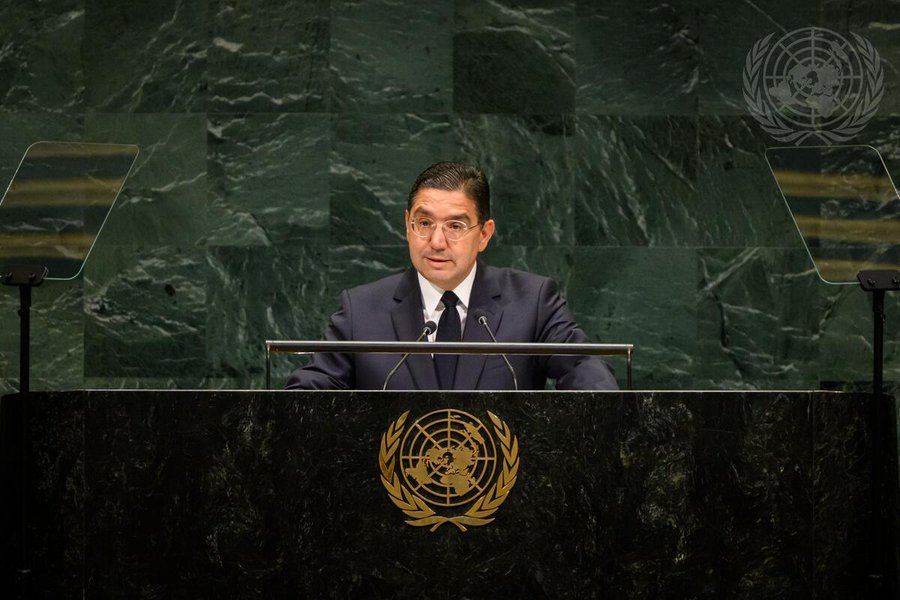
Rabat – Morocco’s Foreign Minister Nasser Bourita reaffirmed Tuesday that the Palestinian cause remains a top priority for the North African country’s foreign policy, stressing Rabat’s continued support for a political settlement based on the two-state solution.
Addressing the general debate of the 81st session of the United Nations General Assembly (UNGA) on behalf of Morocco, Bourita said Morocco views the Palestinian cause as central to efforts to achieve lasting peace and stability in the Middle East.
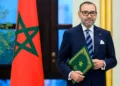
He said Morocco, under the leadership of King Mohammed VI, supports the establishment of an independent and sovereign Palestinian state within the June 4, 1967 borders, with East Jerusalem as its capital, alongside Israel in peace and security.
Gaza ceasefire, humanitarian access
Bourita also addressed the humanitarian crisis in Gaza, where he called for full respect for the ceasefire and for sustained access to humanitarian assistance.
The Moroccan diplomat stressed that essential supplies and aid must reach Palestinians without restrictions or obstacles, amid the continuing humanitarian needs in the enclave.
Morocco also supports stronger assistance to the Palestinian Authority, including financial, technical, institutional, humanitarian, and training support, according to Bourita.
He also pointed to the importance of helping the Palestinian Authority advance institutional reforms, highlighting the role of the United Nations Relief and Works Agency for Palestine Refugees (UNRWA) in providing essential support to Palestinian refugees.
Morocco outlines role in Gaza stabilization efforts
Bourita further pointed to Morocco’s decision to join the international stabilization force for Gaza as part of its broader engagement in efforts to restore peace and security in the territory.
He said Morocco’s contribution includes several areas of support, including the training of Palestinian police personnel and the assignment of senior military officers to work with internal security forces.
Morocco also plans to deploy a military field hospital and has expressed readiness to support a program aimed at countering extremism, Bourita said.
The minister presented these measures as part of Morocco’s longstanding involvement in efforts related to peace and stability in the Middle East.
Rabat voices concern over West Bank developments
Turning to the West Bank, Bourita warned about developments that Morocco considers detrimental to the prospects for a political settlement.
He pointed to legislation affecting the status of Palestinian territory, the expansion of Israeli settlements, and what he described as repeated attacks by Israeli settlers against Palestinian civilians.
According to Bourita, such measures risk contributing to the displacement of Palestinians and weakening the territorial and political foundations required for an independent Palestinian state.
He also expressed Morocco’s concern over Israeli measures and repeated incidents involving Al-Aqsa Mosque.
Bourita said actions affecting the mosque risk further increasing tensions, fueling extremist and hate-based rhetoric, and weakening efforts aimed at de-escalation.
He also highlighted King Mohammed VI’s role as chairman of the Al-Quds Committee of the Organization of Islamic Cooperation.
The King continues to support efforts to preserve Jerusalem’s historical, cultural, and spiritual character, protect its legal status, and improve living conditions for its residents, Bourita stressed.
Those efforts combine diplomatic action with programs carried out on the ground by Bayt Mal Al-Quds Al-Sharif Agency, the operational arm of the Al-Quds Committee.