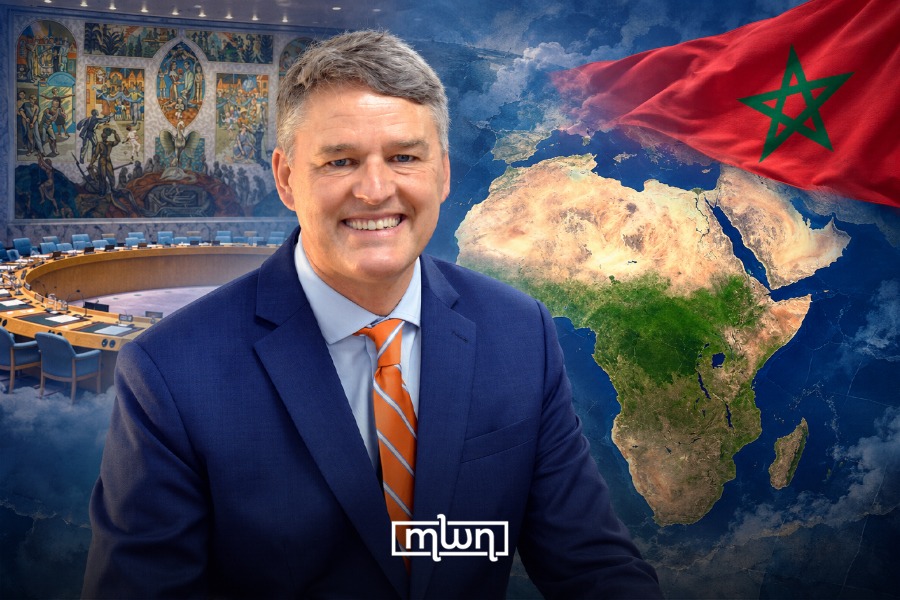
Marrakech – Morocco’s bid for a non-permanent seat on the UN Security Council has drawn the attention of a former senior UN official who worked alongside Moroccan peacekeepers in the Central African Republic.
Hervé Verhoosel spent nearly two decades inside the UN system. He told Morocco World News (MWN) that the North African kingdom’s main contribution to the Council could be its ability to talk to sides that no longer talk to each other. Verhoosel, currently on a visit to Rabat until October 5, framed his answers as personal views shaped by work in Geneva, New York, and the field.
His career began in global health, with the RBM Partnership to End Malaria, Unitaid, and the World Health Organization (WHO). He later served as Director of Communications for MINUSCA, the UN peacekeeping mission in the Central African Republic, where he worked daily with Moroccan Blue Helmets.
Verhoosel was also principal spokesperson for the World Food Programme (WFP) during the Yemen and Syria crises, and spokesperson for the World Humanitarian Summit convened by Ban Ki-moon. He now works as an independent strategic communications adviser and writes on international affairs and diplomacy.
His remarks come as the 81st UN General Assembly closes its high-level debate. On September 22, Foreign Minister Nasser Bourita used the general debate to announce Morocco’s candidacy for the 2028-2029 term. The elections will take place in June 2027.
Morocco’s bid rests on a realistic vision of international cooperation and is grounded in strict respect for international law and for the principles of national sovereignty and territorial integrity, Bourita told the Assembly. Rabat’s top diplomat further tied the bid to the diplomatic experience Morocco has built over centuries and to King Mohammed VI’s vision of the kingdom as a reliable actor for stability and sustainable development.
Secretary-General António Guterres delivered his final address to the Assembly on the same day, calling a 21st-century Security Council without permanent African representation “unjust and indefensible” and urging reform to ensure the body reflects today’s world with the legitimacy and effectiveness current global challenges demand.
Africa still has no permanent seat on the Security Council.
A 21st century Security Council without permanent African representation is unjust & indefensible.
We must reform the Council so that it reflects today’s world with the legitimacy and effectiveness that today’s…
— António Guterres (@antonioguterres) September 23, 2026
Nearly every African leader who addressed the Assembly echoed that sentiment by calling for permanent African representation on the Council, including Presidents William Ruto of Kenya, Duma Boko of Botswana, and Netumbo Nandi-Ndaitwah of Namibia.
A question of political will first
“Probably all three,” Verhoosel answered when asked whether the UN faces a crisis of institutions, political will, or trust. But he put political will first.
“We often talk about the UN as if it were something separate from its Member States,” he explained. “After nearly twenty years working inside the system, I don’t think you can see it that way.” In his view, the organization “can do extraordinary things when countries want it to act,” yet it “can also become almost powerless when the main powers fundamentally disagree.”
Verhoosel acknowledged that multilateralism was never perfect. “It wasn’t when I joined the UN, and it certainly isn’t today,” he recalled. He is less convinced, however, by the model he sees replacing it: a world where the most powerful countries “increasingly do what they want, while others are expected to adapt.”
For him, the answer is to rebuild the system rather than abandon it. That requires listening beyond the usual capitals. “Not every good idea has to come from Washington, Paris, London, Brussels or Beijing,” he stated, calling for serious discussion of reform proposals from Africa, Asia, Latin America, and the Arab world.
Trust erodes when countries look at institutions designed eighty years ago and no longer see today’s world reflected in them, Verhoose argued, stressing: “We shouldn’t be surprised if they question their legitimacy.”
As he sees it, “the question for me is not whether multilateralism works perfectly. Clearly it doesn’t.” Instead, “the question is whether a world with less multilateralism would work better. I see very little evidence that it would.”
What Morocco could bring to the Council
This view of multilateralism informs Verhoosel’s reading of Morocco’s bid. Yet he cautioned against inflated expectations. “First, I wouldn’t exaggerate what any non-permanent member can do,” he told MWN. “One country is not going to arrive on the Security Council and suddenly transform it.”
Elected members can still bring issues to the table, build coalitions, and sustain dialogue when positions polarize. “A lot of diplomacy is less spectacular than people imagine,” he explained. It is about “being present, knowing the files, following them over time, and talking to people who don’t necessarily agree with you.”
In that sense, he argued, Morocco’s profile sets it apart. “It doesn’t fit neatly into one box,” he observed. He described an African, Arab, and Muslim country close to Europe geographically, economically, politically, and in human terms, with stronger ties across Africa and beyond built over the years. For him, “that gives Morocco an interesting position at a time when the world is becoming increasingly divided.”
If Morocco is elected, Verhoosel expects the African dimension to be central. He hopes, however, that Rabat would go further, citing mediation, humanitarian affairs, food security, peacekeeping, prevention, and the link between development and security. “The Council needs countries that can continue talking to different sides,” he stated. “Morocco has the potential to do that.”
Bourita has framed the bid in similar terms. Speaking to the press in New York on September 25, he described the candidacy as a reflection of Morocco’s weight as an active and credible regional and international actor. In particular, the chief of Moroccan diplomacy listed climate change, development, counterterrorism, and major regional issues among the files Morocco would approach with a clear and well-defined vision.
He cited the opening for signature of an African convention on the disarmament, demobilization, and reintegration of child soldiers, championed by Morocco, which several African countries signed last week. He also pointed to the eighth ministerial meeting of the Atlantic African States Process in New York, arguing that the initiative has matured and that member states have taken greater ownership of it. Morocco will host the ninth.
Bourita also pointed to a Morocco-UNDP meeting on public-private partnerships for development. He recalled that Morocco co-chaired, alongside the Secretary-General and the President of the General Assembly, a world conference on countering hate speech through interreligious and intercultural dialogue.
Peacekeeping is the part of Morocco’s record that Verhoosel knows firsthand. He spent time with Moroccan contingents in the field in the Central African Republic, sharing their meals and accepting their tea.
But, of course, he did not present an idealized picture of that time in Central Africa. Relations with local communities “were not always simple,” he acknowledged. Contingents of other nationalities faced criticism too, and the mission sometimes had to adapt its approach. “That is part of the reality of peacekeeping,” he observed.
He recalled Bangassou in particular. Civilians were under threat, and peacekeepers themselves were under attack. On several occasions, he had “the painful responsibility” of announcing the deaths of Moroccan peacekeepers. “When you have sat with people, eaten with them and talked with them, those announcements are not simply numbers in a press release,” he told MWN.
What stayed with him most was that these soldiers were thousands of kilometers from home, “accepting very real risks to protect people who were not their own citizens.”
Morocco’s UN Ambassador Omar Hilale has made a related case. In December 2024, he stated that Morocco has been among the world’s leading contributors of troops to UN peacekeeping since the 1960s.
Hilale credited Moroccan contingents with a fundamental role, particularly in Africa, owing to their understanding of African cultures and languages, their humanitarian engagement, and their efforts to foster dialogue among communities. On that basis, he argued that the kingdom is qualified to represent Africa as a permanent Council member.
Africa’s place and the veto question
Verhoosel extended the peacekeeping point to the entire continent. African countries carry a large share of the burden, he noted. They provide personnel, accept risks, and often know the terrain. “Their voices should matter not only when the UN needs troops and police, but also when decisions about peace and security are taken,” he argued.
The Council’s current structure makes that gap visible. It has 15 members. Five are permanent: China, France, Russia, the United Kingdom, and the United States. Each holds a veto that can block any substantive resolution. The remaining 10 are elected by the General Assembly for two-year terms. The permanent five have not changed since 1945.
In 1965, the Council was enlarged from 11 to 15 members. Africa currently holds three of the elected seats, known collectively as the A3.
The numbers support the case. Africa accounts for 54 of the UN’s 193 member states, about 28%, or more than one in every four votes in the General Assembly. Yet it holds no permanent seat.
The continent is home to about 1.5 billion people, roughly one-fifth of humanity. It has the youngest and fastest-growing population of any continent and is expected to account for a quarter of the world’s population by 2050. With some 30 million square kilometers, it is also the world’s second-largest continent, roughly three times the size of the US.
The continent also dominates the Council’s workload. In 2025, the Council adopted 44 resolutions, including 24 under Chapter VII of the UN Charter, which covers sanctions and authorizations for the use of force. Eighteen of those 24 concerned Africa.
Liberian President Joseph Boakai told the Assembly last week that 80% of the Council’s mandates concern Africa’s peace and security, calling the lack of a permanent seat a “historical injustice.” Ghanaian President John Mahama described reform not as a favor to Africa, but as an “imperative” for the UN’s legitimacy, credibility, and survival.
For Ibrahim Gambari, a former Nigerian foreign minister and former permanent representative to the UN, the imbalance extends to the Council’s daily work. “The P5 assign themselves the role of penholders, which hardly allows elected non-permanent African countries to initiate draft resolutions affecting their region,” Gambari told Al Jazeera. “Even Security Council missions to Africa are not led by Africans nowadays.”
Verhoosel believes the imbalance damages both legitimacy and effectiveness. “I think it inevitably affects both,” he stated. His postings gave him different vantage points on the same decisions, and for him, “the organization looks different depending on where you are standing.”
“In New York, the adoption of a Security Council resolution can feel like the end of a long diplomatic process,” he explained. “In a peacekeeping mission, it is the beginning. Somebody then has to work out what those paragraphs actually mean on the ground.”
He saw the same pattern beyond peacekeeping. Decisions made in meeting rooms, he said, eventually affect real people, “whether you are trying to protect civilians, get food into a country at war or fight a disease across several continents.”
Representation is therefore more than symbolic, he maintained. “People with different experiences will sometimes ask different questions, identify different priorities and see different possible solutions,” Verhoosel argued. “Africa cannot continue to be one of the principal subjects discussed by the Security Council while remaining absent from its permanent representation,” he warned. “Over time, that inevitably raises questions about the credibility and legitimacy of the institution.”
He backs Africa’s demand for two permanent and five non-permanent seats. “I have said that before, and I stand by it,” he affirmed. The current situation, he added, is “increasingly difficult to defend,” since Africa sits at the center of many Council discussions and contributes substantially to peacekeeping.
He separates the principle from the mechanism, however, arguing that the final formula must come from negotiation among member states, with African countries defining their own position. “The essential point is that Africa needs a much stronger and more durable place in the Council,” he summed up. The number of seats, their status, how countries are chosen, and for how long “are precisely the questions that have to be negotiated.”
The question of who would fill any African seats remains open. The African Union’s common position, set out in the 2005 Ezulwini Consensus and Sirte Declaration, calls for at least two permanent and five non-permanent seats, with the AU deciding which countries represent the continent. The AU has not yet named any. Nigeria, Egypt, and South Africa have all pursued permanent representation.
He also questioned whether one country can permanently represent 54. “I don’t think so. But neither can one country permanently represent Europe, Asia or Latin America,” he contended. “France represents France on the Security Council; it does not represent Europe,” he noted. He raised the option of durable regional seats whose occupants are chosen periodically by their peers, as “one possibility worth discussing, not a blueprint.”
On the veto, his view departs from the African Union’s Ezulwini Consensus, which seeks full veto rights for new permanent members for as long as the veto exists. Speaking on behalf of President Bola Tinubu at the UN General Assembly’s 81st session last week, Nigerian Vice President Kashim Shettima restated that position. African leaders want the veto abolished, but argue that as long as it exists, it should extend to any new permanent members.
Verhoosel’s personal preference is not to create more vetoes, since the Council already struggles to act when existing ones are used. “But that should not become an excuse for doing nothing,” he added.
The obstacles are procedural as well as political. Intergovernmental negotiations launched in 2008 cover the Council’s size, membership categories, regional representation, and the veto, but have not settled the core questions. Any change to permanent membership requires a Charter amendment under Article 108. It must first be adopted by two-thirds of the General Assembly, then ratified by two-thirds of all UN member states, including all five permanent members. In 2024, the US under the Biden administration backed two permanent African seats, but without the veto.
Verhoosel expects reform to happen in stages. The priority, he argued, is to open “a serious negotiation” and secure “a real improvement in African representation” rather than wait for a solution “on which everyone miraculously agrees.”
“This may actually be the most important question, because multilateralism is much bigger than the Security Council,” he maintained when asked about Morocco’s wider role. Much of multilateralism “is not about a vote in New York,” but about countries recognizing problems they cannot solve alone.
Beyond the Council, Verhoosel sees Morocco’s greatest potential in less visible fields: African diplomacy, mediation, South-South cooperation, food security, humanitarian affairs, and global health. “Malaria doesn’t stop at a border. Neither does a pandemic,” he observed. Hunger caused by war in one country can affect others, he added, as can displacement, climate shocks, and humanitarian crises.
“We spend a great deal of time discussing what the United States, China, Russia or Europe will do,” he pointed out. “Obviously they matter enormously. But the future of multilateralism cannot depend only on them.” The world “needs more countries able to keep channels open between people who don’t necessarily talk to each other.”
He did not describe that role as neutrality. “That doesn’t mean being neutral about everything,” he acknowledged. “Morocco has its own interests, like every other country. But diplomacy begins with keeping doors open.”
“The countries that make a difference are not always the biggest countries in the room,” Verhoosel concluded. “Sometimes they are the ones that can speak to several sides, understand where each is coming from, and keep a conversation alive.” “I think Morocco has the potential to play more of that role.”
Read also: Eight Decades of Injustice: Why Africa Deserves a Permanent Voice at the UNSC