
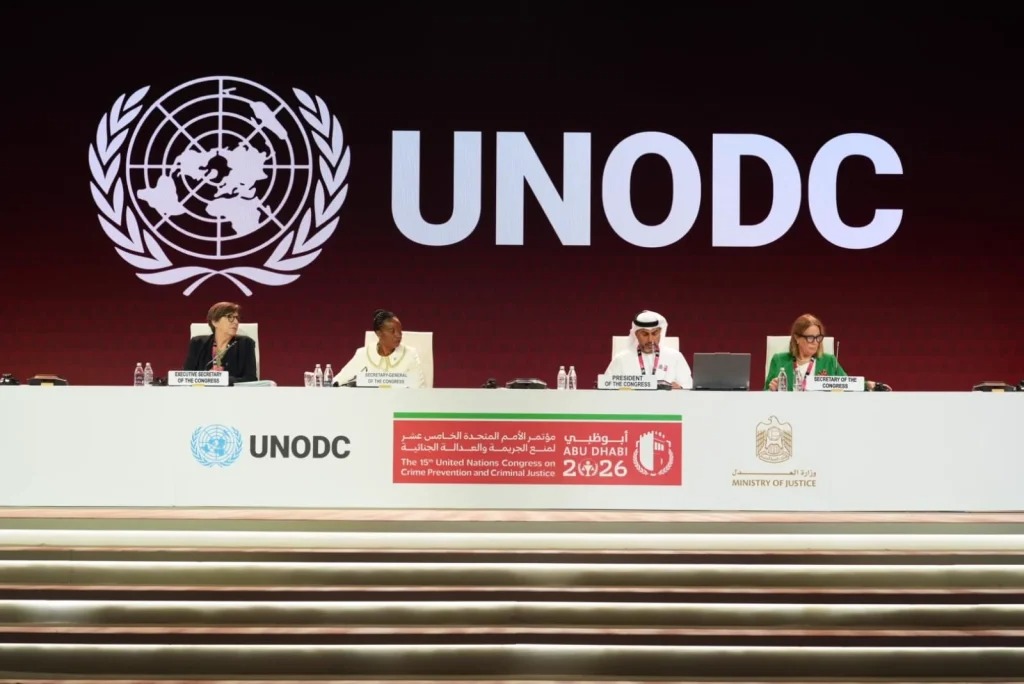
Rabat – Morocco welcomed the adoption of the “Abu Dhabi Declaration” on Thursday, describing it as a roadmap for international efforts to prevent crime and strengthen criminal justice over the coming years.
The declaration was adopted during the opening session of the 15th United Nations Congress on Crime Prevention and Criminal Justice as its main political and strategic outcome. It establishes a framework for international cooperation on justice and the rule of law for the next five years.
The declaration contains 18 articles and 67 paragraphs and sets out a framework for collective action on crime prevention, criminal justice, and the rule of law.
Speaking on behalf of the Moroccan delegation during the closing session of the congress, Ahmed Ouali Alami, Secretary General of the Presidency of the Public Prosecution, said Morocco participated in the event with an approach centered on prevention, cooperation, human dignity, institutional strengthening, and international solidarity.
He said the country remains committed to cooperating with UN member states, the United Nations Office on Drugs and Crime (UNODC), and other international and regional partners.
Ouali Alami also referred to Morocco’s national commitment presented during the congress, saying it reflects the country’s determination to continue reforms and translate shared international commitments into measurable and assessable programs and policies.
Focus on technology and emerging crime
Discussions during the congress addressed a range of issues linked to the changing nature of crime and the modernization of justice systems.
According to Ouali Alami, participants exchanged experiences on crime prevention, victim protection, human-centered justice, alternative sentencing, rehabilitation and reintegration, data collection and analysis, digital justice, the responsible use of artificial intelligence, and international judicial cooperation.
He stressed that the modernization of justice should not come at the expense of its human dimension.
Technology, he said, should remain a tool serving people and the rule of law rather than replacing the safeguards on which justice systems are based.
“We have a shared responsibility to make justice closer to people, better able to protect victims, more effective in addressing crime, and better prepared for the transformations of the digital age,” Ouali Alami said.
He added that these efforts must continue to be grounded in human dignity, the rule of law, and public trust.
Morocco also highlighted meetings on the sidelines of the congress with delegations, institutions, and international and regional organizations. The discussions covered criminal justice, digitalization, combating corruption and organized crime, capacity building, and judicial cooperation.
Ouali Alami said the main challenge now is to move from declarations to implementation, international coordination to practical cooperation, and exchanges of experience to capacity building and tangible results for citizens.
The six-day congress brought together more than 5,100 participants, including over 40 justice ministers and 93 speakers representing states and regional groups.
The event also included 62 high-level participants, with 46 attending in person and 16 participating remotely.
More than 170 side events and meetings were held alongside over 27 exhibition platforms, and over five initiatives were also launched during the congress.
The activities provided governments, organizations, and institutions with a platform to present experiences and solutions related to human-centered justice, crime prevention, organized crime, cybercrime, financial and environmental crime, victim protection, rehabilitation, social reintegration, and the responsible use of technology and data.
The Abu Dhabi Declaration is expected to serve as a framework for international cooperation in these areas over the next five years, with implementation remaining a central challenge for participating states.