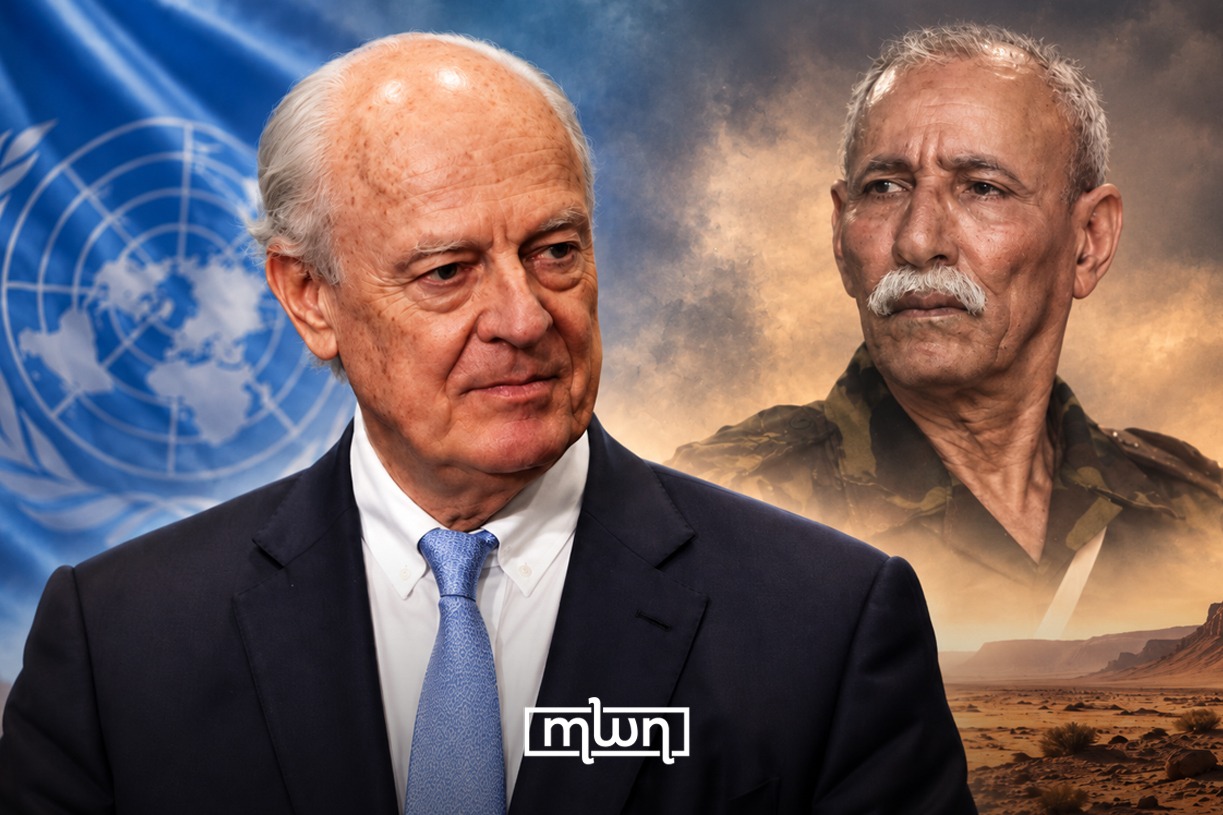
Rabat – UN envoy Staffan de Mistura, who previously came under scrutiny after proposing a partition plan for Western Sahara, is now appearing to give the Polisario Front further reassurance by repeatedly invoking the “principle of self-determination” in a UN-led process where Morocco’s Autonomy Plan has already been practically consecrated as the only reliable, politically sound, and diplomatically feasible framework to genuinely resolve the Sahara dispute.
In his latest annual report draft on Western Sahara, Secretary-General Antonio Guterres said his envoy stressed throughout the negotiations that any proposal for autonomy “should meet the highest international standards,” while also calling for a transition to “genuine autonomy” backed by “strong international guarantees” and a “meaningful consultation process” with the “Sahrawi people” in accordance with “the principle of self-determination.”
The annual report precedes the UN Security Council votes on a new resolution to extend the mandate of MINURSO, the UN’s peacekeeping operation in Western Sahara.
It has long been established that the Polisario is not a legitimate representative of the Sahrawis, given the documented history of how separatists have been using vulnerable people for years to challenge Morocco’s territorial integrity and sovereignty over its southern provinces.
The report, which comes annually, has also documented how Polisario is holding thousands of Sahrawis in dire conditions in a deserted area, where anemia, lack of, or embezzlement of aid are weighing down on Sahrawis and non-Sahrawis held hostage so the separatist group can claim independence in Western Sahara.
Backing illegitimate and exploitative separatists
As an instrument Algeria’s regime has been using to challenge Morocco’s territorial integrity, Polisario has also been linked to terrorism, kidnapping, war crimes, and more. The UN has itself acknowledged the challenges and the worrying situations inside Tindouf camps, where Sahrawis face restrictions and are held in an open prison without the right to move freely in other Algerian territories.
A census to more accurately determine the number and needs of distressed Sahrawis languishing in the Polisario-run camps is also considered a crime by Algeria’s regime and the Polisario leadership. And the reason for this, according to several Sahrawis, is that the separatist group and its supporters fear an independent census will establish that only 20% of those who live in Tindouf are actually Sahrawis.
De Mistura’s appeals, which could be seen or interpreted as being delivered in a tone that appears to “set conditions” for any autonomy proposal, also come amid continued international support for Morocco’s Autonomy Plan, including from the US, the penholder of the UN Security Council resolutions, which has helped facilitate talks between the parties to the dispute.
Recent talks have notably involved Algeria’s regime, which continues to hamper the UN-led political process by refusing to shoulder its responsibility in the dispute and also by lobbying for outdated narratives like self-determination and a referendum.
Morocco, however, has been clear in emphasizing that self-determination can take different forms, including broad local autonomy under Moroccan sovereignty. This is the path Morocco is calling for in its Autonomy Plan, which now has the support of over 130 countries and is considered by the Security Council as the best road to a lasting political resolution of the lingering Sahara equation.
Ongoing momentum vs outdated narratives
In addition to the global support for Morocco’s stance, last year’s October Resolution 2797 of the UN Security Council significantly backed the Moroccan autonomy initiative as a genuine step toward a sustainable political solution.
The UN annual report recalled the momentum the resolution gave to the UN-led political process, which continues to mark challenges.
The resolution urged all parties, namely Polisario, Algeria, Morocco, and Mauritania, to engage in good faith to contribute to finding an agreed-upon and mutually acceptable political solution to end the dispute over Western Sahara.
Secretary-General Guterres’s latest annual report indeed recalls the centrality of this political momentum, emphasizing the importance of last October’s resolution and citing the three rounds of direct negotiations that followed the adoption of the text as evidence of hope for the political process.
This is not the first time De Mistura’s approach to the Western Sahara conflict has drawn scrutiny. In 2024, the UN envoy sparked controversy after raising a long-sidelined 2002 partition proposal. Originally put forward by former UN envoy James Baker, the shelved plan envisioned dividing the southern Moroccan territory between Morocco and an independent state governed by the Algerian-backed Polisario.
Morocco swiftly rejected the idea, with Foreign Minister Nasser Bourita describing it as a “reheated” proposal and questioning who had brought it back to the table and why. De Mistura’s latest emphasis on self-determination and the conditions surrounding any autonomy proposal is therefore likely to draw renewed attention to his approach to the dispute.