
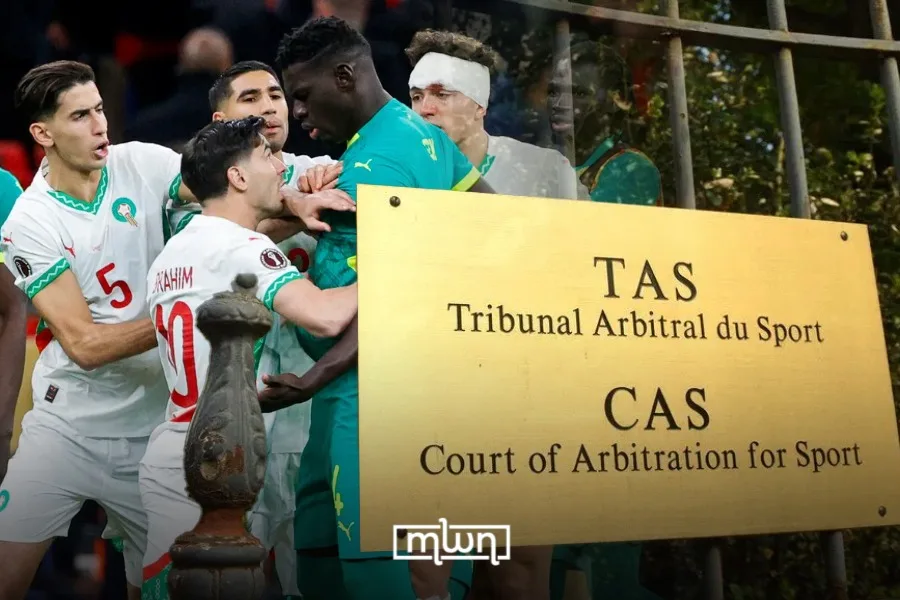
Rabat – The dispute over the 2025 Africa Cup of Nations (AFCON) final between Morocco and Senegal has reached a decisive legal stage, with the Court of Arbitration for Sport (CAS) in Lausanne hearing the case today, Thursday, October 8.
The closed-door hearing is scheduled to begin at 9:30 a.m. and will bring together representatives of the Royal Moroccan Football Federation (FRMF), the Senegalese Football Federation, and the Confederation of African Football (CAF).
The proceedings will be handled by a three-member arbitration panel led by French arbitrator Gérald Simon, alongside Italian Luigi Fumagalli and German Ulrich Haas. The parties have agreed that the proceedings will be conducted in French.
What is CAS examining?
The case concerns the controversial final of the 2025 AFCON , played on January 18.
The match was goalless when Moroccan referee decision-making around a penalty awarded to Morocco triggered a strong reaction from the Senegalese players. Several Senegal players left the pitch, leading to a stoppage of around 16 minutes before they returned and the match resumed.
Morocco missed the resulting penalty through Brahim Diaz, while Senegal later won the match 1-0 through Pape Gueye in extra time.
Although Senegal won the match on the field, the controversy continued after the final.
On March 17, CAF’s Appeal Board ruled that Senegal’s conduct fell under Articles 82 and 84 of the Africa Cup of Nations regulations. It declared Senegal to have forfeited the match and awarded Morocco a 3-0 victory.
Senegal subsequently appealed to CAS on March 25, asking the sports court to overturn CAF’s decision and recognize the result recorded on the field, which would restore the title to Senegal.
Read also: 2025 AFCON Final: The Truth About Senegal’s Walk-Off, Logistics Claims, and a Decisive Rulebook
What is happening during today’s hearing?
The CAS panel is not being asked to replay the final or determine who was the better team on the pitch.
The central issue is legal to define whether Senegal’s decision to leave the field constituted a refusal to continue the match under Articles 82 and 84 of the CAF regulations, and whether CAF was therefore entitled to impose a 3-0 forfeit against Senegal.
Senegal will present its arguments against the CAF Appeal Board’s decision.
Morocco, meanwhile, will defend the ruling that awarded it the title, arguing that leaving the pitch constituted an infringement covered by the relevant regulations and that returning to the field later did not necessarily erase the violation.
CAF will defend the decision of its own Appeal Board before the CAS panel.
The panel is expected to examine the official reports, the sequence of events during the final, the length of the stoppage, the departure and return of Senegal’s players, and the interpretation of Articles 82 and 84.
These details could prove decisive in determining whether CAF was correct to classify the incident as a forfeiture.
When will CAS announce the verdict?
Today’s proceedings are not about announcing a final verdict, but they are a crucial step toward determining it.
The hearing is the stage during which CAS will listen to the parties and examine their arguments. Once the hearing ends, the three-member panel will enter deliberations.
According to the information available ahead of the hearing, CAS has not set a date for announcing its final decision. Therefore, there is currently no confirmed date for when the verdict will be known.
The outcome could confirm CAF’s decision, which would leave Morocco the official 2025 AFCON champion with a 3-0 legal victory.
CAS could also overturn or modify the CAF decision, potentially reopening the question of the tournament’s final result. Another possible outcome, depending on the applicable procedure, would be to refer the matter back to the relevant authority.
For now, however, none of these scenarios has been decided.
A legal battle over 16 minutes
The dispute that has now reached Lausanne ultimately comes down to what happened during those approximately 16 minutes of the AFCON final.
Senegal’s position centers on the fact that its players eventually returned to the pitch and completed the match, winning 1-0.
Morocco and CAF’s position centers on whether the decision to leave the field itself constituted a violation serious enough to trigger the forfeiture provisions of the regulations.
That distinction is now in the hands of the three CAS arbitrators.
Read aslo: Matthieu Reeb on AFCON’s Final: ‘I Don’t Think the Verdict Will Be Today, Nor Tomorrow’
Matthieu Reeb on AFCON’s Final: ‘I Don’t Think the Verdict Will Be Today, Nor Tomorrow’