
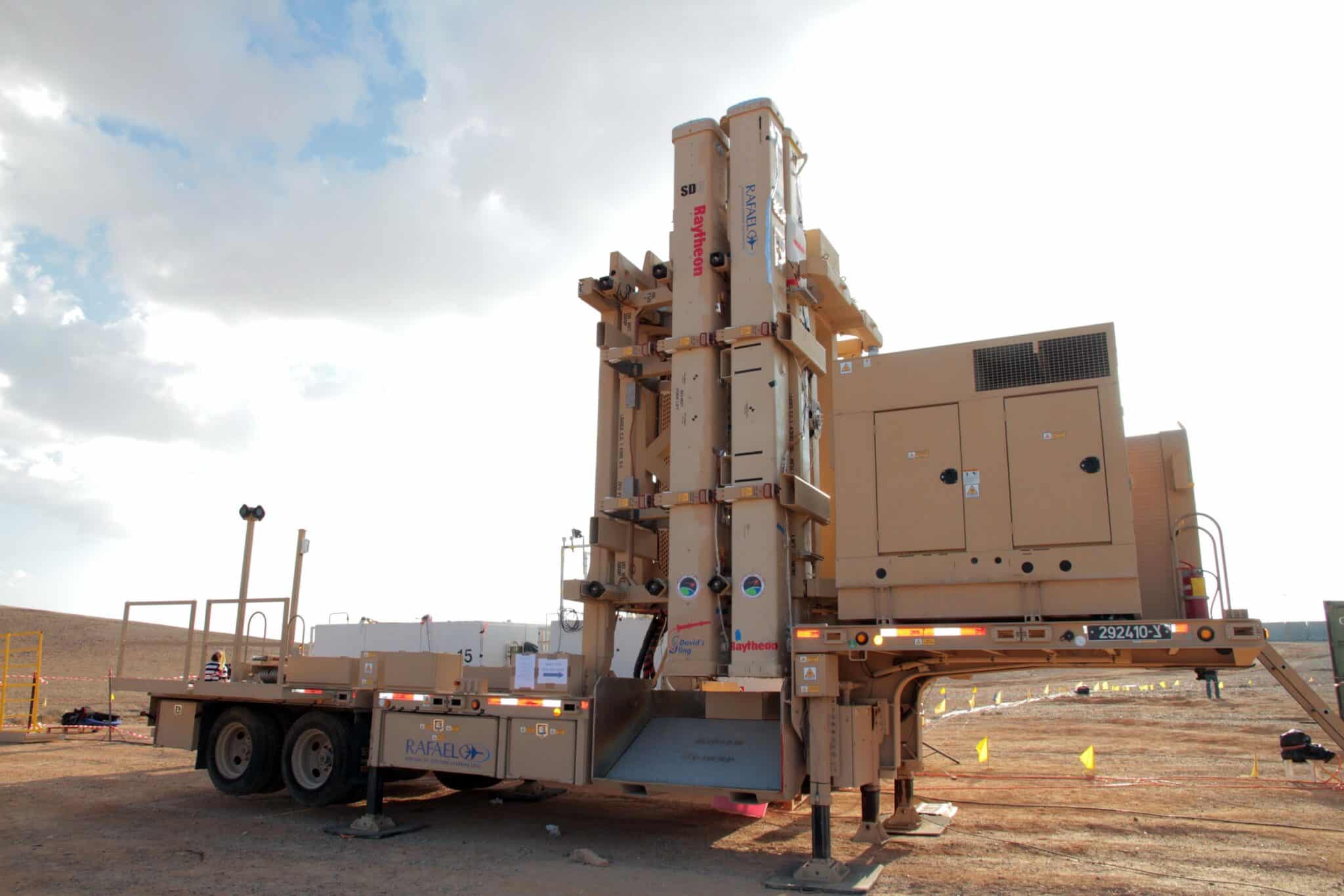
Marrakech – Morocco and Israel are holding advanced talks over the possible integration of the Israeli David’s Sling air defense system into the Royal Moroccan Armed Forces, according to the German defense publication Europäische Sicherheit & Technik (ES&T).
David’s Sling is an advanced Israeli-American air defense system developed by Rafael and Raytheon. The system is built to engage targets at medium to long range, and it would complement air defense systems that Rabat has already acquired from Israel.
Morocco has procured and fielded several Israeli air defense platforms in recent years, among them the Barak MX and Spyder produced by Israel Aerospace Industries (IAI) and Rafael. The reported discussions now center on adding David’s Sling to that mix.
The configuration of any potential Moroccan purchase is not clear from the available information, and it remains open whether Rabat will procure the system at all.
The talks sit within a wider defense relationship that has expanded sharply under the Abraham Accords. Beyond air defense, Morocco has acquired PULS rocket launchers from Elbit and ATMOS howitzers, and the two countries are cooperating on the local production of drone technology.
How David’s Sling works and where it fits in Morocco’s air defense
David’s Sling is made up of several core components. These include a vertical launcher for the interceptors, the ELM-2084 fire control radar, a battle management and operator station, and the Stunner interceptor. The system is designed to intercept ballistic and cruise missiles at ranges of 40 to 300 kilometers, closing the band that sits between shorter-range systems and the defense of more distant threats.
The Stunner interceptor is 4.6 meters long and built in two stages. It is intended to engage targets at altitudes of up to 15 kilometers and at ranges between 40 and 300 kilometers. Propulsion comes from a solid-fuel motor with three thrust pulses: the first two accelerate the missile during the initial phase, while the third activates before interception to add speed and maneuverability. Its top speed is given as up to Mach 7.5.
A distinctive feature of the Stunner is how it destroys its target. According to the website Missile Threat, and unlike the Tamir interceptor Iron Dome uses, the missile carries no warhead and relies on a direct hit to destroy the target. Its asymmetric nose houses two sensors, a combined electro-optical and imaging infrared sensor along with a radar seeker, which allow target acquisition across varying weather conditions.
During the mid-course phase, the interceptor receives updates from ground-based radar over a data link, and the combination of ground-guided control and terminal sensors lets it engage across multiple stages of flight. Production costs are estimated at roughly $1 million (MAD 10 million) per interceptor.
Within Morocco’s existing architecture, which already spans different ranges through the Barak MX and Spyder, David’s Sling would add the capability to counter ballistic and cruise missiles at ranges of up to 300 kilometers.
Drone buildup and Spain’s response across the Strait of Gibraltar
The air defense discussions come as Morocco expands its unmanned systems at a rapid pace, relying mainly on Israeli drones. ES&T reports that Rabat has assembled a broad fleet that includes the Heron from IAI and the Hermes 450 and Hermes 900 from Elbit Systems, alongside other unmanned platforms such as multicopters.
The significance lies not only in numbers. Morocco now holds several years of operational experience with armed drones, while Spain operates American MQ-9 Reapers but so far flies them unarmed.
Rabat is also working to manufacture part of its unmanned fleet at home, building production capacity through licensing agreements with Israeli firms. Over the longer term, that shift from pure imports toward partial local production could give Morocco greater industrial autonomy and potentially larger available numbers.
Military cooperation between the two states has grown considerably since they renewed diplomatic ties in 2020. According to SIPRI, Israel now accounts for about 24% of Moroccan arms imports, making it the country’s second-largest weapons supplier, with Israeli procurements valued at around $1 billion (MAD 10 billion). These include the Barak MX air and missile defense system and other Israeli platforms.
Spain is tracking the trend with concern, particularly over the occupied cities of Ceuta and Melilla, which it holds along Morocco’s northern coast. The NATO mutual defense clause under Article 5 does not apply to the two enclaves as clearly as it does to European Spanish territory, which sharpens the question of Spain’s own defenses there.
Spanish media and analysts have repeatedly warned about Moroccan loitering munitions, several of which reportedly have ranges well beyond 50 kilometers and could in principle reach the occupied enclaves, and in some cases parts of southern mainland Spain. A technical ability to reach an area, however, points neither to concrete Moroccan operational planning nor to political intent.
The overlap between civilian and military airspace surfaced last month, when a Moroccan drone near the border disrupted the approach of an Iberia flight to Melilla airport and caused delays. Madrid then formally asked Rabat to adjust the altitude of its drone flights in the area. The episode was not a military one, but it showed how closely manned civilian aviation, military airspace, and unmanned systems now intersect in the region.
The two countries’ diverging ties with Israel add another layer. As Morocco deepened its cooperation with Israel after 2020, Spain imposed a permanent arms embargo against Israel and canceled contracts worth more than €1.2 billion (MAD 12 billion). That move could affect Israeli systems already in Spanish service, with the long-term supply of spare parts, including for Spike guided missiles, cited as a particular concern.
Madrid is responding on both sides of the balance. It has stationed counter-UAS systems and electronic warfare capabilities in the south of the country, covering the area around the Strait of Gibraltar, where drones pose different demands than manned aircraft because of their small size, low altitude, and potential numbers.
Spain is also trying to build its own industrial base in this field, and in early 2026 it backed a €20 million (MAD 200 million) joint project between the Spanish group Indra and the Emirati EDGE Group to produce loitering munitions domestically.
Spain remains militarily broader and stronger in key areas, especially manned combat aircraft and naval forces, and it retains the backing of NATO membership.
In armed drones and loitering munitions, though, the picture differs. Morocco has fielded such systems for years, is enlarging its fleet with Israeli technology, and is laying its own industrial foundation, while Spain is only beginning to close that gap.
The result is not a full reversal of the balance at the Strait of Gibraltar, but a shift in parts of it that is pushing Madrid to realign both its drone and counter-drone capabilities.
Read also: Israel’s Marrakech Airshow Debut Brings Morocco Defense Ties Into Focus