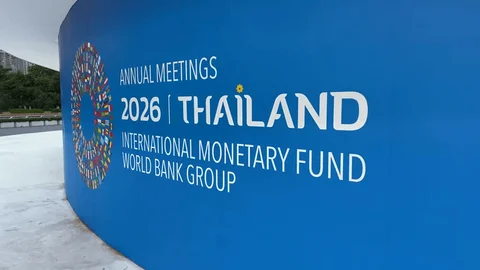
Rabat – The annual meetings of the International Monetary Fund (IMF) and the World Bank Group opened in Bangkok today, bringing together representatives of the international economic and financial community to discuss global economic challenges, growth prospects, and development priorities.
Held from October 12 to 18, the meetings come amid geopolitical tensions, high energy prices, rising public debt, and rapid advances in AI.
Discussions are expected to focus on coordinated responses to economic uncertainty, financial stability, and development financing.
The agenda also addresses how governments can balance fiscal discipline with productive investment and job creation, as economies face mounting pressure to sustain growth.
IMF Managing Director Kristalina Georgieva outlined several of these concerns in her traditional curtain-raiser speech ahead of the meetings. She warned of a combination of risks that could weaken the global economic outlook, identifying the rapid expansion of AI, persistently high energy prices, and record levels of public debt as three major challenges facing the world economy.
Georgieva called for a coordinated global response combining prudent monetary and fiscal policies with structural reforms. She said the necessary policy tools were available, but their effectiveness depended on governments’ ability to use them appropriately and cooperate internationally.
Read also: Morocco Defies Regional Downturn With 4.4% Growth Forecast, World Bank Says
These issues form part of the broader discussions scheduled throughout the week, which will bring together representatives of IMF and World Bank member countries, alongside officials and other participants from the international financial community.
The program includes meetings and roundtables on the potential of AI to create jobs in developing economies, ways to mobilize private capital to support employment, and wider questions related to development and the alignment of economic policies.
Participants will also discuss growth prospects, economic resilience and development financing, with the meetings serving as a forum for national authorities and multilateral institutions to coordinate policies, assess risks to international financial stability and consider common responses to global economic and financial challenges.
The annual meetings are generally held in Washington two years out of every three. Every three years, they take place in another member country of the two Bretton Woods institutions.
Morocco hosted the meetings in Marrakech in 2023, bringing together representatives of 189 delegations. Participants included finance and development ministers, senior officials from the IMF and World Bank, central bank governors, parliamentarians, private sector representatives, civil society organizations and academics.
The Marrakech meetings marked the institutions’ return to a host country outside Washington for that year’s gathering, providing a forum for discussions on international economic cooperation and development.