
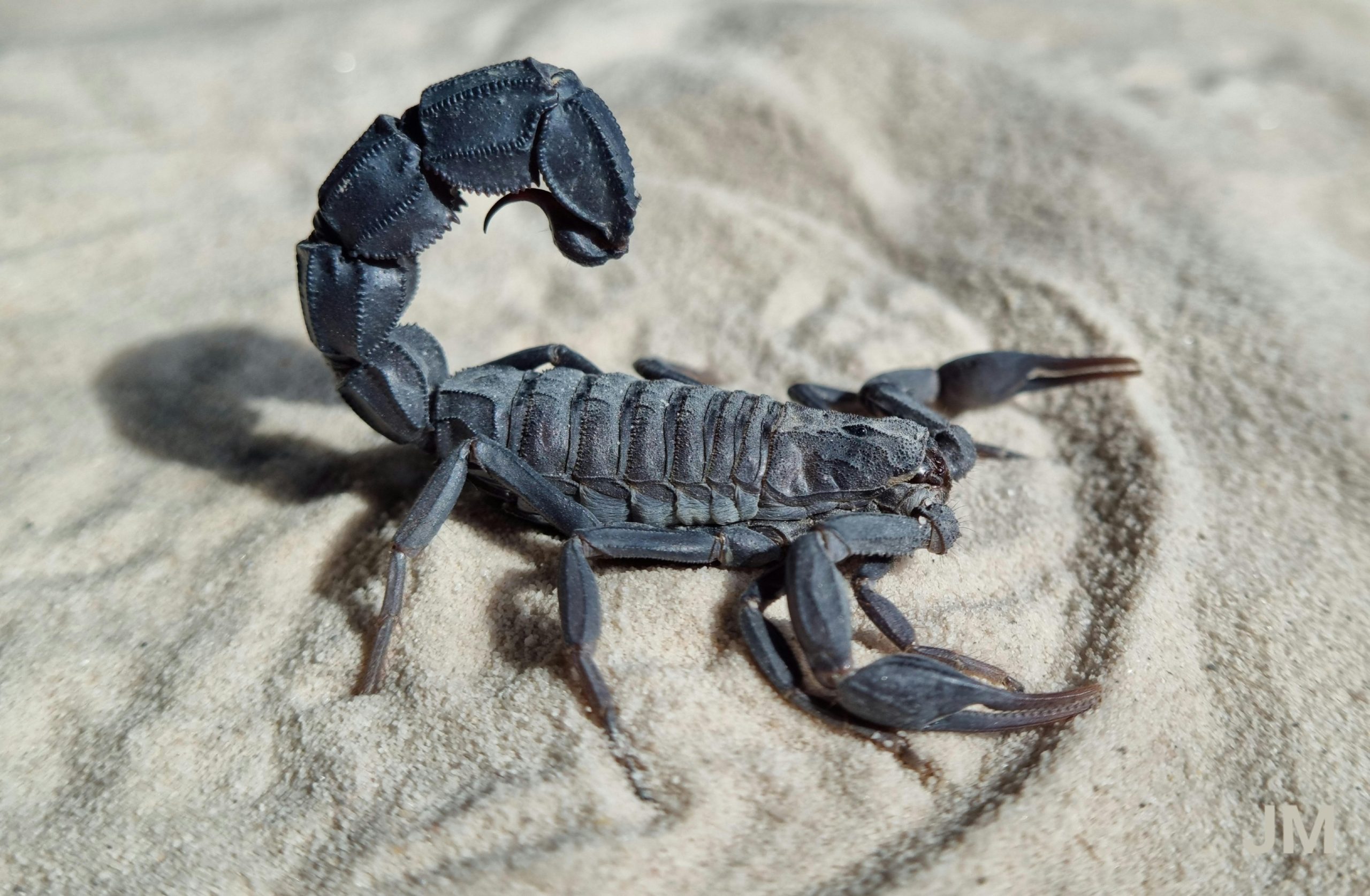
Marrakech – A new study projects that Androctonus mauritanicus, among the most dangerous endemic scorpions in Morocco, could expand its suitable habitat across the country as the climate warms through the end of the century.
Published in the journal Toxicon, the work was led by researchers at Sultan Moulay Slimane University, whose teams span the Polydisciplinary Faculty in Beni Mellal and the Faculty of Science and Technology, with co-authors from the Higher Institute of Nursing and Health Techniques (ISPITS) in Beni Mellal and Ouarzazate. It maps both the current and future distribution of the species using species distribution modeling.
The concern is a matter of public health. A. mauritanicus carries highly toxic venom and lives close to people, a behavior that raises the frequency of contact. The species accounts for 64.4% of scorpionism cases and 58.6% of deaths in Morocco, with most fatalities occurring inside homes or nearby and falling heavily on children under the age of 15.
To build the model, the team relied on the MaxEnt algorithm, which estimates where conditions suit a species based on records of where it has been found.
The researchers compiled 96 occurrence records from field surveys conducted between June 2024 and June 2025, together with data from the Global Biodiversity Information Facility. They paired these records with environmental variables covering temperature, precipitation, soil, terrain, and human presence.
The results point to soil moisture as the single most important factor shaping the scorpion’s distribution, contributing 53.9% to the model. Isothermality, a measure of thermal stability, followed at 20.9%, with mean diurnal temperature range and mean temperature of the wettest quarter adding smaller shares.
These findings suggest the species occupies a defined ecological niche driven by moisture and climate rather than simple tolerance of extreme conditions.
Under current conditions, the model places suitable habitat mainly in northern and central Morocco, with the highest suitability concentrated along the Middle Atlas and adjacent areas. By contrast, the southern, south-eastern, and eastern regions register as largely unsuitable. The total area classified as suitable today stands at 96,494.94 km².
For the future, the researchers generated projections for the 2061-2080 period, drawing on an ensemble of three global climate models under three emissions scenarios.
Across all three pathways, the suitable area grows. Under the lowest-emissions scenario, SSP126, suitable habitat rises to 129,121.10 km², a net gain of 33.81%. Under SSP245, it reaches 124,411.89 km² (+28.93%), and under SSP585, it reaches 122,540.56 km² (+26.99%).
In every scenario, areas of expansion exceed areas of contraction, producing a positive net change. But the magnitude of that gain declines as emissions rise, with the largest expansion occurring under SSP126. The pattern fits a thermophilic species adapted to warm, dry environments, and it mirrors projections reported for other medically important scorpions elsewhere.
These maps carry direct implications for prevention. By identifying where the species is likely to occur now and in the coming decades, the findings can guide surveillance programs and strengthen healthcare preparedness. The authors point in particular to rural populations, which face greater exposure through outdoor work and limited access to medical services.
The study also notes its limits. The predicted maps describe environmentally suitable habitat rather than direct estimates of envenomation risk, which also depends on human exposure, socioeconomic conditions, and the state of local healthcare.
Future projections, moreover, remain subject to uncertainty tied to climate scenarios and to the assumption that the species’ niche stays stable over time.
Even so, the authors position their work as a basis for monitoring and managing scorpionism in Morocco as the climate continues to shift.