
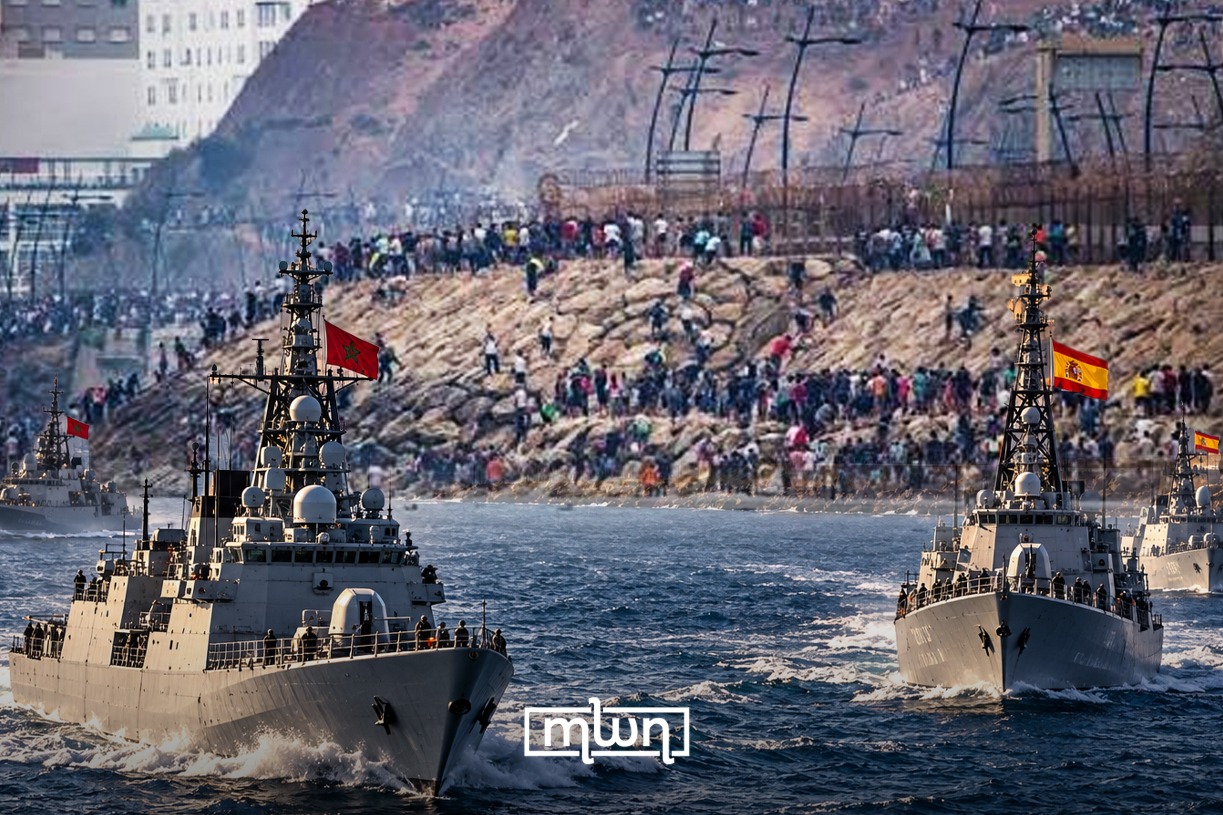
Rabat – Iustitia Europa has asked Spain’s National Court to investigate the alleged entry of Moroccan warships into waters around Ceuta during the mass arrival of migrants at the end of July, a case that has prompted renewed scrutiny of Spanish-Moroccan relations and the legal status of the waters surrounding the enclave.
The private prosecution, which coordinates the case before the National Court, wants investigators to establish the circumstances of the alleged naval incursion, assess the response of Spanish authorities, and determine whether any officials bear responsibility.
Its request calls for access to Spanish Navy and Civil Guard records, intelligence reports, and diplomatic communications between Madrid and Rabat. Investigators would also examine whether the Civil Guard detected Moroccan naval units, when authorities became aware of their presence, what instructions they received, and which civilian or military officials were informed.
Spain’s conservative People’s Party (PP) has also joined the initiative and requested specific investigative measures, according to the document.
The Spanish government has described the episode as isolated. After Tuesday’s Council of Ministers meeting, the government spokesperson said the entry of the vessels into Spanish waters had been resolved “with the utmost normality” within the framework of good-neighborly relations between the two countries.
By contrast, the prosecution argues that the incident warrants scrutiny beyond routine migration control. It contends that the alleged presence of foreign military vessels in maritime areas under Spanish sovereignty could raise questions about Spain’s external security and territorial integrity.
The request cites Article 590 of Spain’s Penal Code, which addresses unlawful or unauthorized acts that could provoke conflict with a foreign power or expose Spaniards to hostility or reprisals.
The court has yet to establish whether the reported naval movements constituted a criminal offense.
Territorial violation?
Moroccan author and political analyst Samir Bennis has challenged the way Spanish media have framed the alleged naval incursion, arguing that reports of a violation of Ceuta’s territorial waters have not adequately addressed the unresolved maritime dispute between Morocco and Spain.
In an analysis of an October 12 report by El País, Bennis argues that the article presents the alleged entry of Moroccan naval vessels as a violation of Spanish sovereignty without establishing the precise maritime coordinates or providing a sufficient legal basis for that conclusion.
He also questions the reliance on unnamed sources that characterize the vessels’ movements as deliberate and repeated. In his assessment, such descriptions reflect interpretations that require evidence rather than facts.
Bennis does not argue that Ceuta cannot, in principle, generate a territorial sea. Instead, he distinguishes that potential entitlement from the question of where Spain’s maritime jurisdiction ends and Morocco’s begins.
Morocco does not recognize Spanish sovereignty over Ceuta and Melilla and disputes the maritime claims associated with the two enclaves. The two countries have not concluded a bilateral agreement to delimit their respective territorial seas around them.
That unresolved status, Bennis argues, complicates any claim that Moroccan vessels violated Spanish territorial waters. Establishing such a violation would require evidence of the ships’ exact positions and an assessment of the applicable international legal rules.
Bennis points to Article 15 of the United Nations Convention on the Law of the Sea (UNCLOS), which both Morocco and Spain have ratified.
The provision addresses the delimitation of territorial seas between states with adjacent or opposite coasts. In the absence of an agreement, neither state may generally extend its territorial sea beyond a median line equidistant from the relevant coastal baselines, unless historic title or other special circumstances justify a different boundary.
Spain’s domestic legislation also addresses the issue. Article 4 of Law 10/1977 on the territorial sea recognizes the relevance of an equidistant median line in relation to neighboring countries, unless the states agree otherwise.
For Bennis, these provisions undermine any assumption that Ceuta automatically enjoys a full 12-nautical-mile territorial sea in every direction, regardless of its proximity to the Moroccan coast.
The absence of a bilateral delimitation agreement does not, by itself, mean that Ceuta cannot generate a territorial sea. Nor does it automatically rule out a determination of whether a vessel entered waters under Spanish sovereignty. Such an assessment would depend on the vessels’ coordinates, the relevant coastal baselines, and the applicable legal framework.