
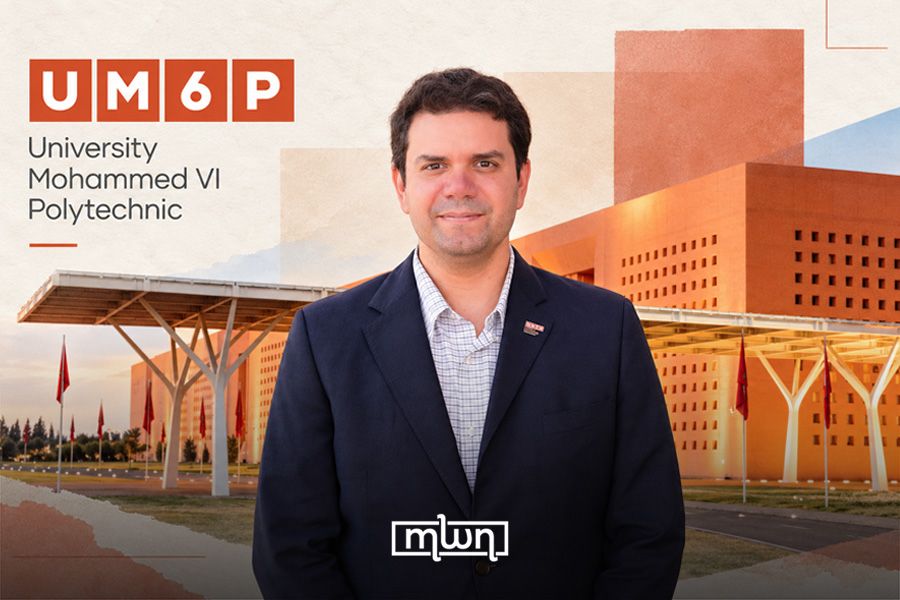
Tan-Tan – As University Mohammed VI Polytechnic approaches its 10th anniversary, the university is expanding its focus beyond conventional higher education and research, seeking to connect scientific work more closely with industry, innovation, and Morocco’s wider development needs.
That approach is evident in the university’s growing focus on moving research from laboratories toward practical and industrial applications, particularly in areas such as agriculture, energy, mining, and health.
Lotfi Belmahi, who leads the university’s Transformation, Innovation & Impact (TI²) office, sees this local focus as a major advantage. “The greatest opportunity for Morocco when it comes to that research is that it is done in Morocco,” Belmahi told Morocco World News.
Research developed close to the industries and communities it aims to serve, he argued, can respond more directly to local needs while benefiting from international partnerships and expertise.
However, the challenge remains to ensure that promising research does not remain confined to the laboratory.
From research to industry
Turning a scientific result into a commercially viable technology can take years. A solution that works in a laboratory still needs testing, adaptation, and investment before it can operate reliably in an industrial setting.
Belmahi described this difficult transition as the “valley of death,” which refers to when researchers must demonstrate that a technology can work outside controlled conditions and meet the practical needs of industry.
Any acquisition of new technology must also make economic sense. Industrial partners need solutions that are not only technically effective but also competitive, which means researchers must work alongside engineers, entrepreneurs, and business specialists throughout the development process.
For Belmahi, this work begins with understanding the market. Researchers and entrepreneurs can speak with potential users and companies to determine whether a technology addresses a real need before committing resources to scaling it up.
If the market potential is there, engineers can help develop pilot systems that produce enough material for industrial testing. A fertilizer sample produced in a laboratory, for instance, may be sufficient for scientific analysis but not for agricultural trials that require much larger quantities.
Moving from small samples to industrial production requires funding, equipment, and repeated testing. Only then can researchers and their partners assess whether a technology has a viable business case.
“It requires lots of money, it requires patience,” Belmahi said.
This emphasis on collaboration is reflected in TI², which UM6P established to coordinate strategic transformation and innovation across the university and strengthen its links with the wider OCP ecosystem. Its responsibilities included supporting the development of emerging technologies, helping research move toward industrial applications, and assessing the economic and social impact of those efforts.
The aim was to create a closer connection between scientific research and the needs of industry, rather than treating commercialization as a separate step that begins once research is complete.
Preparing before a crisis
Belmahi also argued that universities can help industry prepare for challenges before they become urgent.
“The magic of a university” lies in its ability to anticipate major problems and work on solutions years before they arise, he said.
Sulfur offers a practical example, Belmahi says. The material is essential to fertilizer production, and Morocco relies on imports to meet its needs. Changes in international prices or supply conditions can therefore create risks for the fertilizer industry.
Rather than waiting for a shortage to force a response, researchers can explore alternative sources, recovery methods, and production processes in advance. This would give industrial partners more options if market conditions change.
That thinking underpins the Sulfur Excellence Center, known as SULFEX, which UM6P and OCP established in September 2026. The center was created to bring together the university’s scientific, technological, and engineering capabilities around sulfur-related industrial challenges.
SULFEX focuses on several areas, including recovering and recycling sulfur, identifying alternative sources in Morocco and across Africa, improving industrial processes, and developing ways to reduce or replace sulfur in certain applications. Its broader objective is to help OCP reduce its dependence on imported sulfur by identifying technologies that can be developed and deployed at scale.
Belmahi described the center as an “orchestration vehicle” rather than simply a place where researchers working on sulfur are brought together. Its purpose is to identify existing research across UM6P and the wider OCP ecosystem, assess the maturity of different technologies and prioritize those with the strongest potential for industrial use.
The timing matters, he said, because the ecosystem already has technologies at laboratory and pilot stages that could be developed further.
“We have the right critical mass to enforce this and empower this scaling and impact on these technologies,” he said.
For Belmahi, bringing these capabilities together around a clear objective can help shorten the path from research to industrial deployment. Morocco’s response to water scarcity offers a concrete example of how research, technology, and industrial investment can work together to address a long-term national challenge.
Through its water program, OCP has invested in desalination and wastewater reuse to reduce its reliance on conventional water sources, while also contributing to water supplies for Moroccan communities. In collaboration with UM6P and InnovX, OCP Green Water is also working to improve desalination technologies, water reuse, and the efficiency of water infrastructure. One facility, operational since October 2024, has an annual desalination capacity of 60 million cubic meters and helps supply drinking water to southern Casablanca.
The example illustrates how scientific expertise can be connected to industrial infrastructure and deployed at scale to respond to a pressing need. Belmahi sees a similar principle guiding UM6P’s work on strategic technologies by identifying promising research, mobilizing expertise across the OCP-UM6P ecosystem, and scaling solutions for industrial use before supply chain disruptions expose critical vulnerabilities.
Recovering sulfur from phosphogypsum
One potential route toward greater sulfur autonomy involves recovering the material from phosphogypsum, a byproduct of phosphate processing.
During the production of phosphoric acid, sulfur is used to process phosphate rock. The process also generates phosphogypsum, which contains sulfur-bearing compounds that researchers can investigate for recovery and reuse.
“Morocco has a mine of sulfur that can be recycled through phosphogypsum,” Belmahi said.
The idea is not new, and researchers have been working on recovery technologies for years. The main obstacle has been making them economically competitive with imported sulfur.
Changes in global prices and supply conditions can alter that calculation. A process that was too expensive to justify in the past may become more attractive as the cost or availability of imported sulfur changes.
Belmahi said the goal is to advance solutions that can become competitive and attract investment, while also considering the strategic value of having an alternative source available.
Even if recovered sulfur is not always cheaper than imports, the technology could give OCP another option when international markets become less reliable.
“It is an option for the group,” he said, adding that some solutions may now be ready to scale and could remain valuable “at least on the sovereignty dimension.”
For Belmahi, technological sovereignty means developing domestic capabilities that reduce reliance on external suppliers in strategically important sectors. It does not necessarily mean abandoning international trade, but ensuring that Morocco has alternatives when supply chains come under pressure.
That ambition extends beyond sulfur. Looking toward 2037, Belmahi said UM6P could aim to bring at least one sovereign technology to industrial scale in each sector it addresses in Morocco and Africa.
“Bringing at least one sovereign technology in each of the sectors that we tackle for Morocco and Africa at an industrial scale” is a reachable objective, he said.
The challenge for UM6P, then, is not simply to produce scientific research, but to help turn it into technologies that can be deployed, compete in the market, and address longterm industrial needs.