
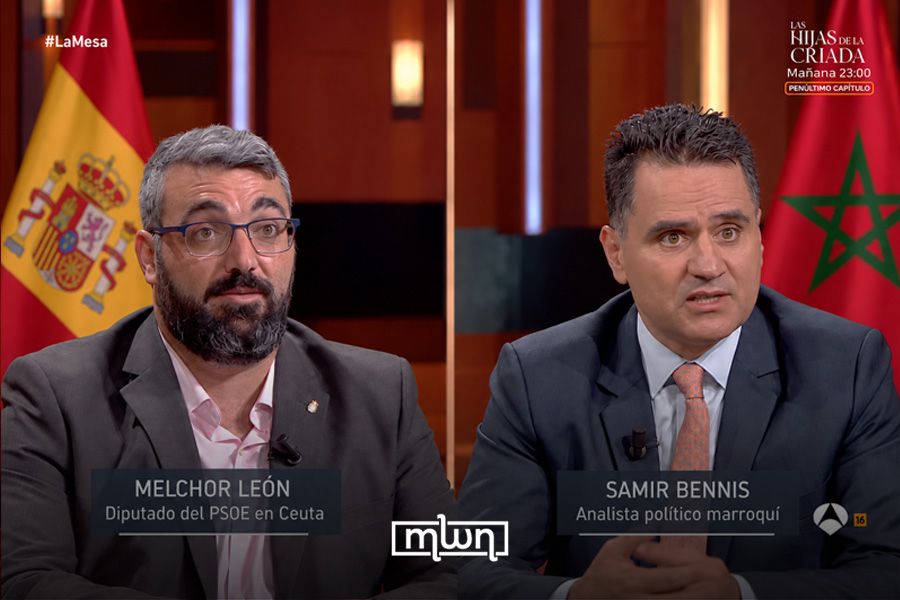
Marrakech – “Each word has its weight.” With that terse corrective on Antena 3’s La Mesa Wednesday night, Samir Bennis punctured the single term around which Spain’s political class has built three months of fevered theater: invasion.
The Moroccan author and political analyst reminded Melchor León – a PSOE deputy and first vice president of the occupied Ceuta assembly – that the word carries a precise and ugly meaning, “the intention to seize a territory by force,” and that nothing of the sort occurred at the Ceuta fence.
What gave León’s stance its peculiar edge is that his broadside came not from the opposition benches but from within the governing party: a Socialist deputy turning on his own, declaring the handling of Ceuta “a failure on the part of the government and a failure on the part of the president” – a direct rebuke of Pedro Sánchez. León, visibly rattled, could not bear the lesson. He interrupted, hectored, raised his voice, and earned the night’s most telling line from his interlocutor: “Let me finish my words, please.”
The panel’s other voices only sharpened the spectacle. Susana Díaz, the Socialist senator who has pledged her vote to Sánchez, nonetheless flayed his handling of the crisis, charging that the government “arrived late and badly, with grave errors,” absent for the first 30 days and stirring to act only 75 days on. She went further, demanding an emergency decree to return every migrant to their country of origin – a line indistinguishable from the right’s.
León, for his part, announced he would cast a blank ballot rather than back Sánchez, naming Interior Minister Fernando Grande-Marlaska the chief culprit for Ceuta. The tableau was its own indictment: Socialists outbidding one another in contrition over a “crisis” whose factual premises their own state’s intelligence had already demolished.
Bennis delivered his own verdict Thursday morning on X, and it was unsparing. What unfolded, in his telling, “was not a confrontation, but rather a clamorous act of disrespect by an ill-mannered person who feels a profound insecurity before a Moroccan” who arrives “armed with arguments based on verifiable facts” and remains “calm, as his country is calm, regarding Ceuta and Melilla.”
Lo que ocurrió anoche en La Mesa, de Antena 3, entre el señor Melchor León y yo no fue un enfrentamiento, sino más bien una clamorosa falta de respeto por parte de una persona maleducada que siente una profunda inseguridad frente a un marroquí que no solo llega armado de… https://t.co/EjOkghnsus
— Samir Bennis (@SamirBennis) October 15, 2026
He had sensed the deputy’s hostility from the antechamber, he recounted – a hostility conspicuously absent from his cordial exchanges with Esperanza Aguirre, Javier Nart, and Susana Díaz. In León’s glare Bennis read “the inquietude of one who knows that, sooner or later, history, geography, demography, and economics will impose their own realities.”
The word that Spain cannot prove
Then came the familiar machinery of insinuation, and that obduracy on the Spanish side is not incidental. It is the organizing principle of a campaign. The right and far-right have spent the summer manufacturing a casus belli out of a migratory surge, and moderator Cristina Pardo’s own intervention repeated the catechism – brandishing the program’s copies of the Guardia Civil papers to insinuate that “the Moroccan authorities deceived the agents.”
Former European deputy Javier Nart recycled the “hybrid war” formula and the claim that Ceuta was “an attack on territorial integrity,” while Jorge Dezcallar, a former CNI director, mused that the appearance of Moroccan patrol boats in Spanish waters amid the surge was “a surprising coincidence” – before conceding, in the same breath, that Sánchez had always denied Moroccan involvement “for lack of proof.” That concession is the whole story in miniature. Strip away the coincidences-that-must-mean-something and the indignation performed for voters, and what remains is precisely what Bennis told the panel: a country calm about Ceuta and Melilla, and another that cannot stop talking about them.
The declassified record says the reverse. Spain’s intelligence services did not stumble upon a Moroccan plot; they turned to Rabat to help forestall one. The CNI’s own documents log more than 12,800 attempts to enter occupied Ceuta by swimming in 2025, of which a mere 431 succeeded – hardly the signature of a border thrown deliberately open. When social-media channels, among them a group baldly named “Assault on the Ceuta Fence,” urged migrants to exploit the Throne Day celebrations precisely because Moroccan forces would be distracted, the CNI alerted its Moroccan counterparts and thanked them for their “invaluable and continued cooperation.”
The agents overwhelmed on July 30 were Moroccan gendarmes and auxiliaries, not accomplices. Even CIFAS, assessing the day, judged it “highly likely that the Moroccan authorities are not actively facilitating the migratory wave.”
This is the evidentiary rubble on which León’s “invasion” and People’s Party (PP) leader Alberto Núñez Feijóo’s “hybrid war” are built: a verdict in search of proof. A 40dB poll found that roughly 90% of Spaniards now blame the Moroccan government for Ceuta – a triumph of propaganda, given that the same poll never asked whether Rabat had planned, organized, or coordinated anything. Weeks of twisted headlines have engineered the consensus, and Wednesday’s panel was its microcosm: the Spanish politician asserting, the facts resisting.
A royal sleepover and a studied silence
Which brings us to the royal tour, now concluded, that gave this week its backdrop. King Felipe VI and Queen Letizia visited occupied Ceuta and Melilla – the first such trip since 2007 – and Madrid wanted the stagecraft to resound. The timing was anything but innocent. The spectacle was choreographed in October, mid-campaign, as Spain barrels toward snap elections on November 29 – and, pointedly, at a moment when Morocco was busy elsewhere: assembling a government in the wake of its September 23 ballot and marshaling its diplomacy for the October 31 UN Security Council vote on Western Sahara. The PP and Vox have spent the summer mining the occupied-Ceuta crisis for electoral ore, casting Morocco as the external enemy and their own leaders as the men who will “put it in its place.”
Felipe’s decision to spend the night in the enclave was duly packaged by the Spanish press as a reaffirmation of sovereignty. Bennis called it what it was: “a non-event.” And he reached for the most inconvenient precedent in the Spanish archive. Franco toured Sidi Ifni and the Sahara in October 1950; those lands were proclaimed Spanish, formally converted into provinces in 1958, granted seats in the Francoist Cortes. Spain ceded Ifni in 1969 and quit Sahara in 1976. “Neither the administrative category of a territory nor the visits of a head of state,” he wrote, “constitute perpetual guarantees of sovereignty.”
Con lo que muchos españoles no contaban era con que Marruecos iba a ignorar por completo esta visita, porque sabemos que la visita de un monarca o de un jefe de Estado nunca ha constituido una garantía de permanencia bajo una determinada soberanía de un territorio con un pasado… https://t.co/DxXR78Njuk
— Samir Bennis (@SamirBennis) October 15, 2026
Rabat answered with a silence more eloquent than any communiqué. King Mohammed VI withheld the customary felicitation on the Día de la Hispanidad – a courtesy he extended even amid the grave crises of 2002 and 2021 – and no Moroccan minister graced the Spanish embassy reception in Rabat. The message to the two royal houses, long bound by cordiality, was unmistakable: the visit registered as a provocation and a lurch toward the Spanish right’s combative line, and Morocco declined to perform the outrage its antagonists craved. “We will not give those seeking confrontation the reaction they expect from us,” Bennis wrote. “Serenity is not a sign of weakness, nor should patience be confused with surrender.”
That restraint is a sovereign calculation, not a flinch. The King and the foreign ministry have affirmed, repeatedly and without ambiguity, that Morocco prizes its strategic partnership with Spain as a deliberate choice of its own – never a concession extracted by pressure or blackmail. And the cold arithmetic favors silence. Rabat has banked hard-won European backing for its Autonomy Plan, and it will not hazard that capital in a squabble over two enclaves. It is thinking in longer horizons – the 2030 FIFA World Cup it will co-host, the energy, migration, trade, and security files that now bind the two capitals. Seen in this light, Spain is the adult at the table who periodically makes the noise; the wiser party lets him exhaust himself and waits for maturity to arrive.
None of this means Morocco has forgotten occupied Ceuta and Melilla. It never has. The question is one of hierarchy. A country dismembered by several colonial powers does not reclaim its pieces in a single motion; it does so in stages, by order of priority. The Sahara comes first. The enclaves come after. That is not neglect – it is sequence, patient and deliberate, the kind of long strategy Spain has never quite learned to read.
Patience as strategy, not surrender
Here the Moroccan logic deserves to be stated plainly, because Spain persistently misreads it. If Moroccan foreign policy were a doctoral thesis, the Sahara would be its central subject and the twin enclaves barely a footnote. Spain treats Ceuta and Melilla as a matter of life and death – the mayor of Madrid once called them the capital of Spain – while Rabat regards two exiguous vestiges of colonialism whose subsistence depended for decades on the Moroccan hinterland.
That dependence is the hinge of the whole affair. A generation of Moroccan megaprojects – Tanger Med and its free zones, the soon-to-open Nador West Med port, new roads, industry, border reform – has dismantled the contraband-and-“atypical-commerce” economy on which the occupied cities floated. The figures are merciless: Ceuta posted 22.41% unemployment in the second quarter of 2026, more than double the national rate, and in 2025, Ceuta and Melilla registered Spain’s highest risk of poverty or social exclusion, at 40.8% and 43.7% respectively. No amount of royal pageantry resuscitates a model already consigned to history.
These were never thriving cities so much as garrisons and penal outposts – mere coastal appendages that Spain once floated the idea of bartering away for Gibraltar, and that survive today only on transfers from the mainland treasury, a life-support stipend sustaining the pantomime of an imperial potency that expired long ago.
And while Spain stages pageantry, Morocco builds leverage. Rabat has spent these years knitting together a formidable diplomatic web – the United States, which under the December 2020 proclamation recognized Moroccan sovereignty over the Sahara; France, which crossed the same threshold in 2024; a growing roster of European and Arab capitals; and even powers with which it holds sharp differences, kept in working dialogue rather than rupture. In parallel, it has moved to modernize its military arsenal across land, air, and sea. This is the quiet accumulation of weight – economic, diplomatic, strategic – that renders a shouting match over a royal sleepover not merely unnecessary but beneath the ambition. A state assembling that kind of ballast does not trade it for the momentary satisfaction of taking Madrid’s bait.
And so the asymmetry hardens. Spain must shout itself hoarse insisting that the enclaves “are Spain”; Morocco need neither denigrate its neighbor nor reactivate dormant claims to feel secure. Bennis invokes Hassan II, who told Kuwait’s Assyassa in March 1986 – as El País reported that month – that any future Green March toward the enclaves would be one of “patience, determination, dialogue, deliberation, and persuasion,” and who in September 1989 foreclosed a military path altogether. “We can wait generations,” the late king held. The philosophy is unchanged: patience, persuasion, concertation, dialogue, from a state with thirteen centuries behind it, whose agenda does not pivot on electoral cycles.
Spain’s own conduct toward Gibraltar supplies the sharpest rebuke to its theatrics over the occupied enclaves. Madrid has protested British royal visits to the Rock with practiced indignation. In 2009, under the Socialist government of José Luis Rodríguez Zapatero, Foreign Minister Miguel Ángel Moratinos personally conveyed Spain’s rejection and consternation to British Foreign Secretary David Miliband over Princess Anne’s trip. In 2012, the conservative PP government of Mariano Rajoy summoned British Ambassador Giles Paxman ahead of Prince Edward and Sophie Rhys-Jones’s visit, and Queen Sofía pointedly canceled her visit to London for Elizabeth II’s Diamond Jubilee; and even under Sánchez, Spain lodged objections to Prince Edward and Sophie’s royal visit in 2022.
Yet when Princess Anne returned to Gibraltar in November 2023, again under Sánchez, Madrid fell conspicuously quiet, registering no publicly confirmed protest – and when fog diverted her aircraft to Málaga, Spanish authorities obligingly waved her onward journey into Gibraltar by road. Does this mean Spain has simply forgotten about Gibraltar? Hardly. No one in Madrid imagines the Spanish claim extinguished because the government swallowed its objections one November afternoon.
Spain understands perfectly well that a sovereignty claim does not evaporate because its holder, for reasons of timing and interest, declines to make a scene, which is precisely the courtesy it refuses to extend to Rabat. When Morocco meets a royal visit to occupied Ceuta and Melilla with calculated silence, Spain reads surrender; when Spain does the identical thing at Gibraltar, it calls the same silence prudence. The double standard writes itself – patience is statesmanship when Madrid practices it, and capitulation only when Rabat does.
Spain, in short, wants to win today. Morocco is interested in next month. The royal visit may have carried the day, perhaps even tomorrow. But while Madrid stages symbols, Rabat builds ports, roads, and industries – the economic architecture that will, in the end, dictate the terms on which the future of occupied Ceuta and Melilla is finally discussed.