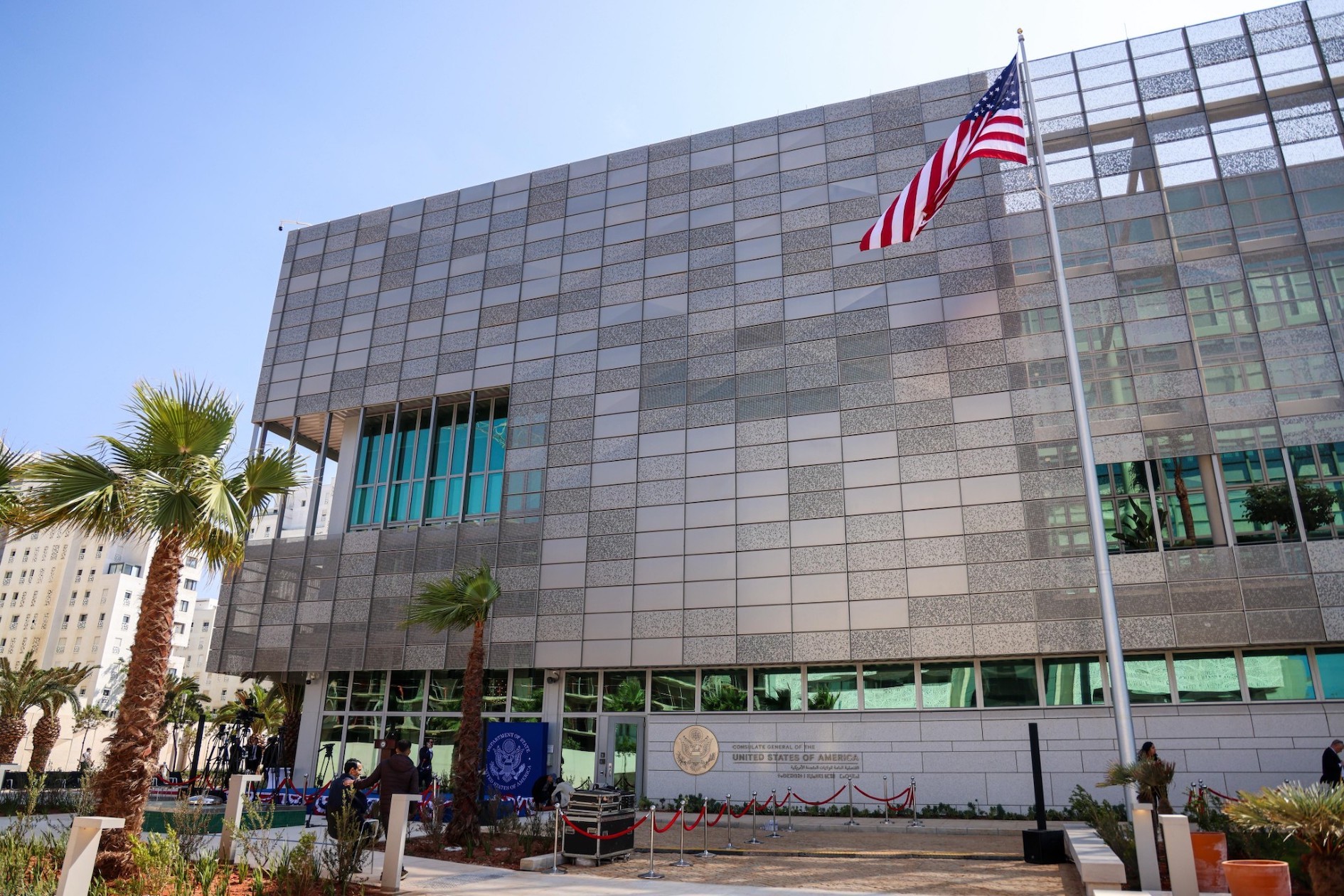
Marrakech – The US Consulate General in Casablanca will take passport and notarial services directly to American citizens in several Moroccan cities, including Laayoune for the first time. Its American Citizen Services (ACS) unit announced a four-city outreach tour that opens in October and runs through December.
The schedule places Marrakech first, in October. Laayoune and Ouarzazate follow in November, and Oujda closes the tour in December.
For Laayoune, the move carries added significance. It marks the first time the US mission will deliver consular services inside a major city of Morocco’s Western Sahara, a step Moroccan media described as unprecedented. The mobile consulate will begin its Laayoune operations in November, according to the published timetable.
View this post on Instagram
Americans seeking an appointment must email [email protected] with the subject line “[City Name] – Appointment Request.” The message needs the full name of each applicant, the names of anyone accompanying them, and the type of service requested, either passport or notary.
The consulate will reply to confirm the date and location. Applicants must pay their fees online through Pay.gov before the appointment and bring a printed receipt, and the consulate cannot accept incomplete applications.
The outreach follows a year of expanding US engagement across Western Sahara. Throughout 2026, Washington extended its diplomatic, economic, and military activity in the territory well beyond the recognition it first issued in December 2020, when Secretary of State Mike Pompeo announced during Donald Trump’s first administration that the US had begun establishing a consulate there.
Washington inaugurated a virtual presence post at the same time, and promised that a working physical consulate would follow. In January 2021, Assistant Secretary of State David Schenker, US Ambassador David Fischer, and Foreign Minister Nasser Bourita visited the premises designated for that future mission in Dakhla, the first inspection of the site.
The consulate has still not opened. During Trump’s second administration, Massad Boulos, the president’s senior adviser for African affairs, told Asharq News in October 2025 that Washington intended to open it during the current term, answering affirmatively when asked directly, though he gave no date.
That engagement has repeatedly touched Laayoune itself. Ambassador Duke Buchan III visited the city on July 28 for the announcement of US Trade and Development Agency (USTDA) funding for a large-scale green ammonia project, and he reaffirmed US support for Moroccan sovereignty over the Sahara.
The USTDA funding covers preliminary engineering studies for a plant projected to produce up to 560,000 tons of ammonia a year. Project developer ORNX selected a consortium of American companies led by KBR, alongside GE Vernova, Electric Hydrogen, and Terabase, to carry out the studies. Buchan described the project as proof of the strategic value of US investment in the region, adding that “more is to come in this critical region.”
US activity has reached other sensitive points in the territory. On June 25, a US Mission delegation traveled to the El Guerguerat border crossing with Mauritania for the first time, discussing counter-narcotics cooperation, trafficking prevention, and border security.
The Dakhla Atlantic Port has also attracted growing US diplomatic and military interest. On August 14, the US Embassy announced that officials from its economic and political sections had visited the port construction site, describing the project as an opportunity to strengthen regional connectivity, trade, and investment.
“From Tangier to Dakhla and beyond, U.S. Mission Morocco continues to deepen our economic engagement,” the embassy declared, situating the visit within nearly 250 years of Moroccan-American friendship and a shared commitment to economic growth and prosperity.
On September 1, the embassy reported a separate visit by senior US military officials, who examined the region’s maritime sector and exchanged views with Moroccan counterparts on maritime infrastructure, regional connectivity, economic development, and shared security priorities.
The developments in the consular sphere coincide with a succession of diplomatic signals that have further consolidated Washington’s position. On August 1, Morocco’s Royal Office published a message from Trump to King Mohammed VI marking Throne Day, in which the US president reaffirmed Washington’s recognition of Moroccan sovereignty over Sahara and its support for Morocco’s Autonomy Plan as the only basis for resolving the dispute.
That same day, Moroccan authorities made public a separate royal letter, dated July 2, in which the Moroccan monarch informed Trump of his decision to name the Tiznit-Dakhla expressway the “Donald J. Trump Highway,” honoring his administration’s historic recognition of Moroccan sovereignty over the territory in December 2020.
More recently, on September 25, US Deputy Secretary of State Christopher Landau met Bourita on the sidelines of the 81st session of the United Nations General Assembly in New York.
Following their talks, Landau reaffirmed Washington’s commitment to “our shared vision for the development of the Sahara region and for strengthened cooperation under Morocco’s sovereignty over this territory.” He also called for a definitive settlement of the decades-long dispute, declaring that “this status quo cannot be maintained.”