Marrakech – The National Rally of Independents (RNI) will vote against the 2026-2031 government program, its parliamentary group in the House of Representatives announced Thursday, casting the new majority’s plan as a continuation of the outgoing cabinet’s path rather than the change its leaders promised voters.
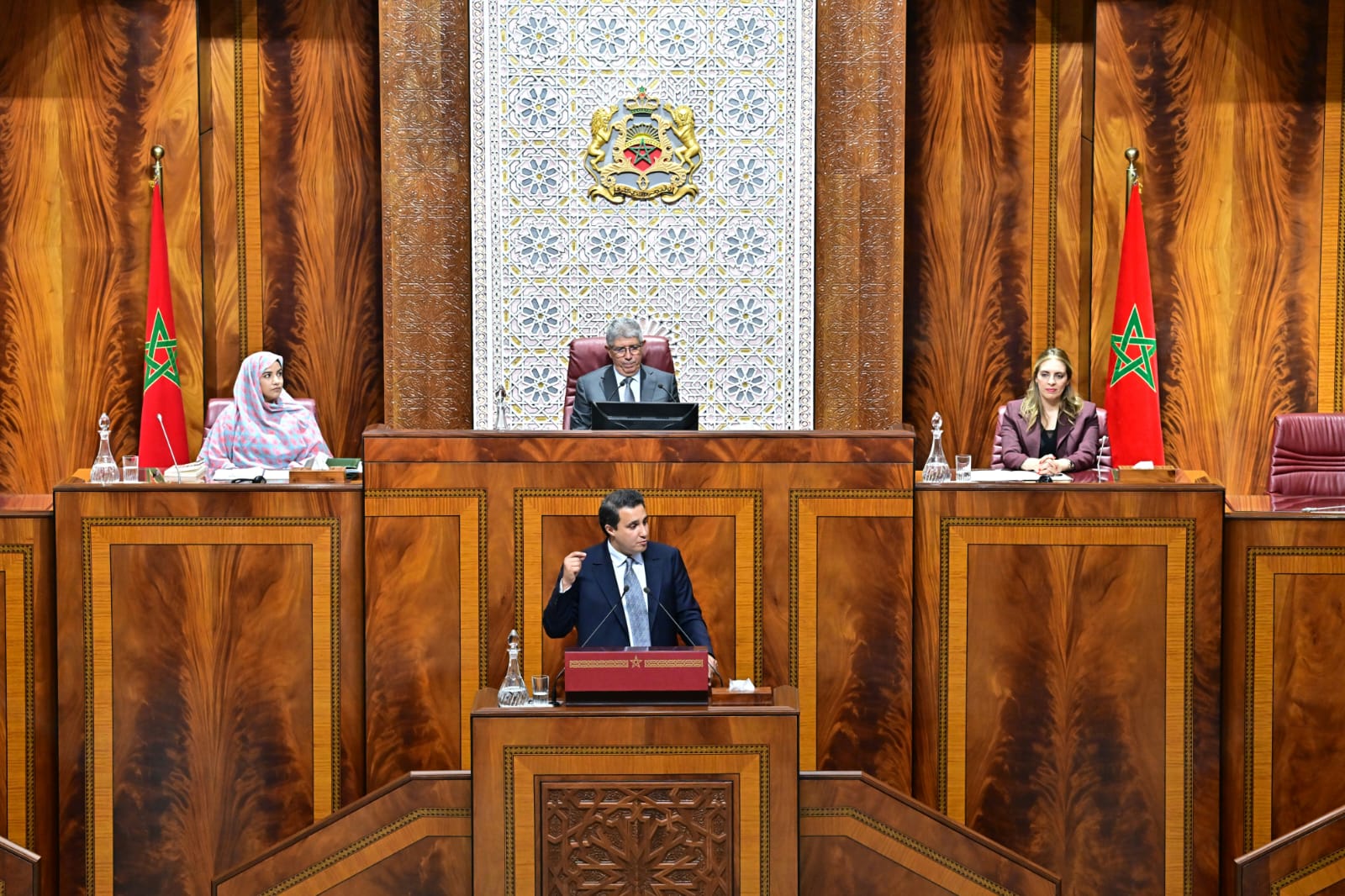
Yassine Oukacha, who heads the RNI group, delivered the party’s position during the constitutional debate on the program the head of government presented under Article 88 of the Constitution.
He opened by congratulating her on the royal confidence and framing the appointment of a woman to lead the government as a political milestone tied to the reform path led by King Mohammed VI. His opening also recalled gains on Morocco’s Western Sahara, including UN Security Council Resolution 2797, and voiced the group’s pride in the Royal Armed Forces (FAR) and the security services.
‘A change of path’ that stayed the same
From there, Oukacha turned to a critique of both the plan’s substance and the way it was drafted. He argued that much of its direction extends the philosophy of the previous government. “You promised Moroccans a change of path,” he told the chamber, before charging that the majority had instead announced continuity “on the same path.”
He welcomed the coalition, in his words, “to the path you were criticizing” and “to the Trojan horse you used during the electoral campaign,” and he mocked the rebranding of old policy as a new course.
He credited the previous government experience with a positive legacy: inflation falling below 1%, a growth rate of 4.6%, and a budget deficit trimmed to 3%. Those figures, he argued, should push the current cabinet to build on the rollout of the social state, not restart it.
The group president then questioned the program’s drafting. He described a government “built on the logic of quota-sharing and appeasements” at the expense of competence, contrary to the pledge of a streamlined cabinet.
He put women’s representation at six ministers, or no more than 18%, which he called a failure to apply the constitution’s parity principle. He also contended the program was rushed, dominated by the leading party, and imposed on the rest of the majority as “an adhesion contract” with only the option to sign.
Oukacha pressed the government on dropped and deferred commitments. He asked what became of the promise to cut income tax from 37% to 20%, and of the talk of a MAD 5,000 ($500) minimum wage.
He questioned the decision to push the program’s targets to 2031, including raising direct public support to MAD 1,000 ($100) only by the end of the term, and he faulted the plan for presenting a pledge to raise annual transfers to the regions to MAD 12 billion ($1.2 billion) from 2027 as a new commitment.
The program, he added, lacks performance indicators and baseline measures that would let parliament track progress. “Parliamentary confidence is not a blank check,” he told lawmakers, calling instead for clear commitments, measurable results, and accountability based on delivery.
A second part of the intervention addressed what Oukacha called the absent program. He listed areas missing from the plan: Moroccans abroad, whose transfers reached MAD 122 billion ($12.2 billion) in 2025; persons with disabilities, some 1.73 million people, or 4.8% of the population, of whom 67.7% have no educational attainment; the informal economy, which employs 2.53 million people and turns over about MAD 526.9 billion ($52.7 billion) a year; the care economy; and mountain areas, which cover 26% of national territory.
On crisis management, he recalled that the previous government allocated MAD 120 billion ($12 billion) over five years to rebuild after the Al-Haouz earthquake, yet found no comparable preparation for international crisis risks.
He also questioned the near-absence of advanced regionalization and administrative deconcentration from the program, and pointed to what he called “deception” between the anti-corruption rhetoric in the oral statement and the written text he traced to page 30.
On youth, Oukacha called it an incomprehensible regression that the government now announces an integrated national youth strategy, eight years after the King’s August 2018 call for one and its adoption in a government council in 2019. On employment, he noted that pledges to create one million net jobs and cut unemployment to 7% by 2031 vanished from the statement, replaced by training and professional-experience programs with no firm job-creation target.
From governing party to opposition bench
He closed with a summary verdict: those who promised a change of path chose continuity, while those who criticized the previous path adopted it.
He tied the RNI’s “no” to the coalition’s limited parliamentary base – the leading party alongside the parties ranked third, sixth, and seventh – and to its reading of economic and social risks, from supply-chain pressures to protests in primary education.
“We do not fear the government’s failure as much as we fear that Moroccans will pay the price of a government we expect to fail,” he told the chamber.
The shift marks a sharp reversal for a party that led the outgoing coalition. The RNI governed from 2021 to 2026 alongside the Authenticity and Modernity Party (PAM) and the Istiqlal Party, with former party leader Aziz Akhannouch as head of government after the RNI finished first that year.
Relations with PAM frayed over the term, and in the September 23 elections PAM finished first while the RNI fell behind. PAM ruled out renewing its partnership with the RNI and built the new majority without it, leaving the party that once headed the government on the opposition benches.
The parliamentary stance tracked a statement from the RNI political bureau, which met Wednesday under party president Mohamed Chouki. The bureau framed the move to opposition as part of the normal course of democratic life, not a break with the party’s record or its social-democratic reference.
It committed the party to “useful opposition” – independent in its positions, firm in oversight, and productive in proposals – while pledging to keep defending social protection, health, education, employment, social dialogue, and spatial justice. “Continuity of reform does not mean continuity of alignment,” the statement read.
The bureau also announced the party’s ordinary National Congress for January 22-23, 2027, which it presented as a moment for internal evaluation and organizational renewal, and it called for general assemblies of the party’s youth and women’s federations to renew their offices.