
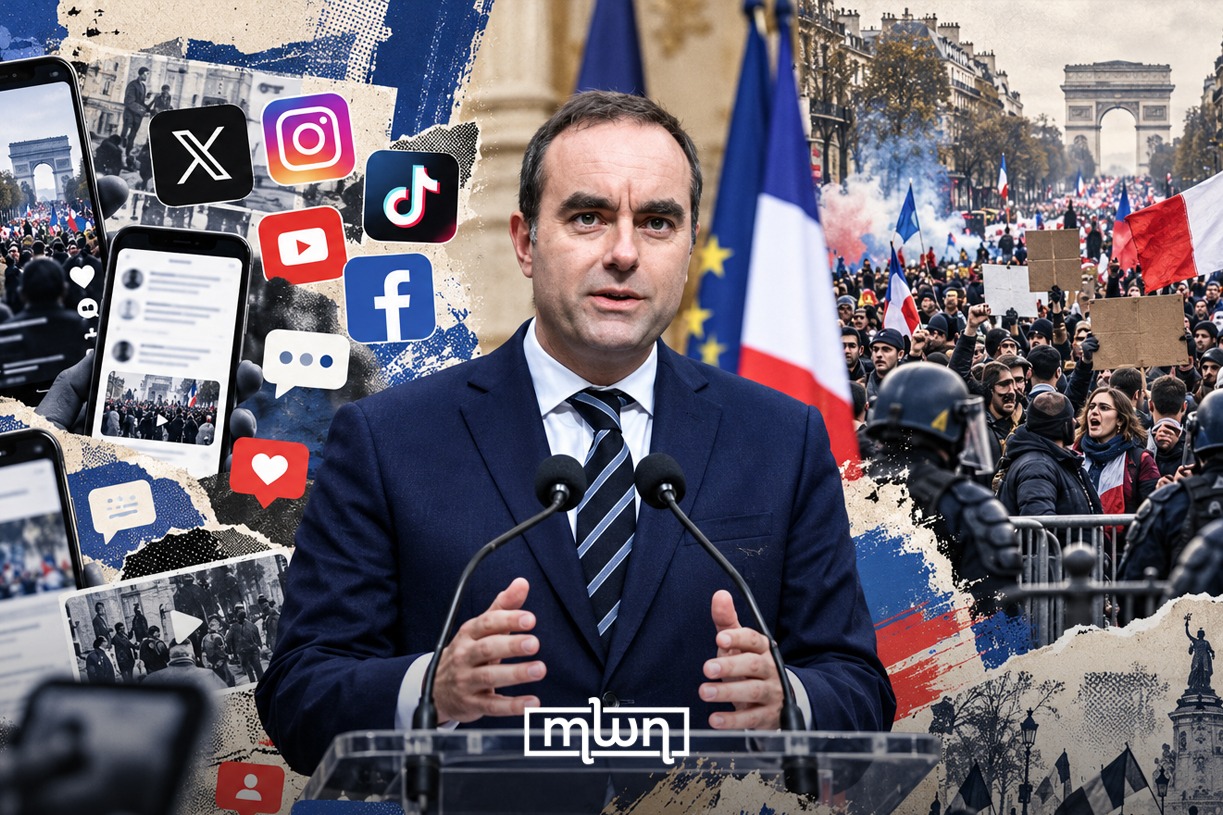
Rabat – France’s government asked four major telecom operators to prepare for a possible shutdown of TikTok, Instagram, Snapchat, and X before nationwide protests on October 24, despite legal concerns over the restrictions, an investigation by French outlet Blast revealed.
Prime Minister Sébastien Lecornu sent the request on October 22, two days before the demonstrations. The letter, obtained by Blast alongside the minutes of a subsequent meeting, shows that officials sought the technical capacity to suspend access to the platforms at short notice if urban violence resumed.
The government ultimately did not activate the measure. However, the preparations exposed tensions between the authorities’ security objectives and the legal safeguards that protect freedom of expression.
Government wanted platforms blocked within hours
In his letter to the heads of Orange, SFR, Free, and Bouygues Telecom, Lecornu asked the companies to prepare for a temporary suspension of the targeted services.
The proposed restrictions could last several hours and take effect on October 24 or 25, depending on the situation. The government initially planned to block TikTok, Instagram, and Snapchat through domain name system (DNS) filtering. X was added to the list after the letter’s dispatch, according to Blast.
Officials cited protests on October 17 and 18 to justify the request. The prime minister’s office argued that social media had helped spread illegal calls to action and facilitated acts of violence, including looting, the identification of targets, group movements, and the exchange of information about police positions.
Lecornu asked the operators to prepare the necessary technical measures without delay so they could act immediately if he issued an order. He also requested strict confidentiality, although he described the initiative as exploratory.
The request placed telecom companies on alert for a potential restriction that could affect millions of users, even though the government had yet to settle the legal questions surrounding such a move.
Telecom companies challenged the plan
A meeting on October 23 brought together government representatives and the legal teams of the four operators. According to the minutes obtained by Blast, the companies raised serious doubts about both the feasibility and the legality of the proposed shutdown.
The government wanted a targeted restriction that would affect mobile users in specific areas. The operators said they could not deliver that level of precision at short notice.
They also warned that users could bypass DNS filtering through virtual private networks (VPNs) or alternative messaging services. That limitation raised a central question: could the government justify such a sweeping restriction if people could circumvent it with relative ease?
The legal debate also focused on the duration and scope of the proposed measure. The operators questioned whether a shutdown of three platforms for up to 12 hours would meet the standards of necessity and proportionality. They also argued that the government had not established that less restrictive alternatives would prove inadequate.
The government cited a Council of State ruling of April 1, 2025, on France’s 2024 TikTok shutdown in New Caledonia. However, the court had overturned that restriction, which authorities imposed amid unrest in the French Pacific territory.
Although the ruling left room for temporary restrictions under strict conditions, it did not provide the government with an unrestricted right to block social media.
The operators also demanded a formal legal instrument that would specify the grounds for the decision. They wanted a signed, dated, reasoned document that would be made public. Orange argued that the government should issue a formal administrative order.
Matignon took a different view and considered individual instructions to each operator sufficient, without publication in France’s Official Journal. Officials also considered a public announcement about 30 minutes before a possible shutdown at around 2 p.m. on October 24, Blast reported.
Protest restrictions raise free speech concerns
The proposal also raised concerns about the public’s ability to access information during demonstrations.
Social media can help coordinate unlawful acts, as the government argued, but the same platforms also allow protesters to communicate their demands, share footage from the streets, and document alleged police abuses.
A shutdown during a major protest could therefore limit the public’s access to real-time information precisely when independent accounts of events matter most.
The controversy echoes the government’s decision to block TikTok in New Caledonia in 2024. The Council of State later overturned that measure, which authorities had introduced amid unrest in the territory.
France did not proceed with the shutdown ahead of the October 24 demonstrations. The protests nevertheless drew large crowds nationwide. The Interior Ministry estimated turnout at 400,000, while the General Confederation of Labor (CGT) put the figure at 800,000.
Blast reported that Lecornu’s office declined to comment on the matter.
Although the proposed restrictions never took effect, the documents suggest that the government had moved beyond a theoretical discussion and asked telecom operators to prepare for a rapid shutdown. The episode leaves open whether authorities might revisit the same approach during future protests, despite the legal obstacles and questions over its effectiveness.