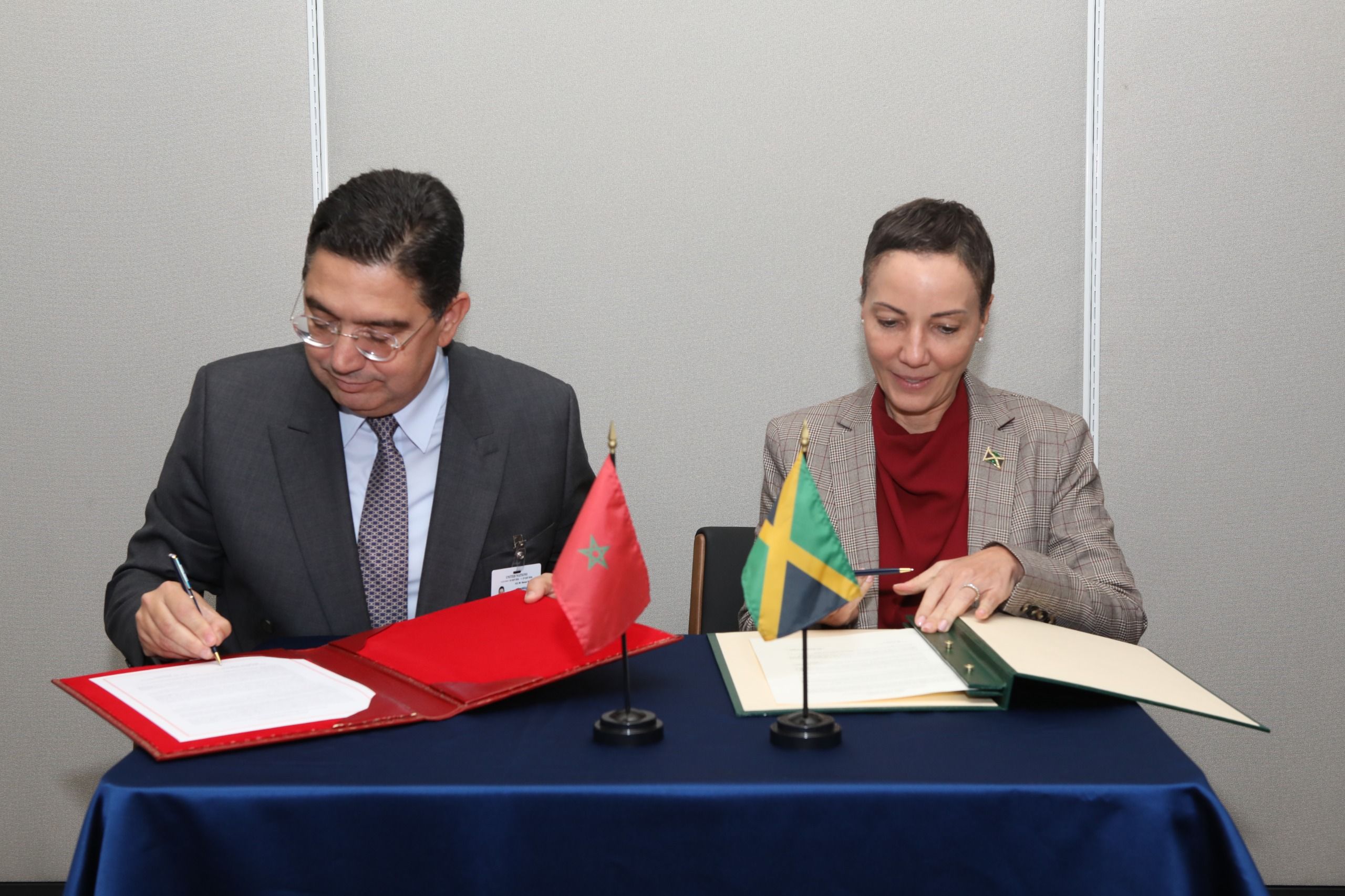
Marrakech – Jamaica’s Minister of Foreign Affairs and Foreign Trade, Kamina Johnson Smith, welcomed on Wednesday in New York the adoption of United Nations Security Council Resolution 2797.
The text expresses “full support to the UN Secretary-General and his personal envoy to facilitate and conduct the negotiations, taking as a basis the Moroccan autonomy plan, and affirming that genuine autonomy under Moroccan sovereignty could be one of the most feasible solutions.”
Johnson Smith set out her country’s position in a joint communiqué signed with Nasser Bourita, Morocco’s Minister of Foreign Affairs. The move marks an evolution in Kingston’s position on the dossier. The two ministers convened on the margins of the 81st session of the UN General Assembly.
The statement congratulated the North African kingdom for its “diplomatic efforts aimed at obtaining an international consensus and creating momentum in favor of the autonomy plan, under the impetus of His Majesty King Mohammed VI.”
During their talks, Bourita and Johnson Smith agreed to continue political consultations between Rabat and Kingston and to coordinate their positions on questions of common interest.
Jamaica’s alignment lands within a broader realignment across Latin America and the Caribbean, a region long treated as a reliable reservoir of support for the Algerian-backed Polisario Front.
That bloc is unraveling. On October 31, 2025, the Security Council adopted Resolution 2797 with eleven votes in favor, three abstentions from China, Pakistan, and the Russian Federation, and no participation from Algeria – the patron that was present but refused to take part in the vote, exposing its shrinking room to maneuver.
For the first time, the council fixed Morocco’s 2007 autonomy plan as a fundamental basis for a solution and moved away from the referendum framing that separatism had leaned on for decades.
The numbers tell the story of that collapse. At least 130 of the UN’s 193 member states now support Moroccan sovereignty over the Sahara or accept the autonomy plan as the only basis for a final settlement. Under the current momentum, the number of governments still recognizing the self-styled “SADR” is widely estimated at a handful in the low 20s.
What remains is a paper state with no territory, no functioning institutions, and no UN seat, watching its diplomatic scaffolding come apart capital by capital.
The retreat is steepest in Latin America, where the separatist cause once drew some of its firmest backing. Costa Rica, which, like many of its neighbors, aligned with the Polisario in the 1970s and 1980s out of Third Worldist reflex rather than grounded realities, endorsed the autonomy plan in March as the most appropriate, serious, credible, and realistic basis for a solution.
Colombia reversed the pro-Polisario line of Gustavo Petro’s government in August, while Ecuador and Panama suspended their recognition of the “SADR” in late 2024; Bolivia severed ties with the Sahrawi entity in February, Honduras announced a similar move in April, and Peru’s new government openly supported Morocco’s position in July.
Chile, meanwhile, backed Morocco’s sovereignty over the Sahara on the sidelines of the 81st UN General Assembly session this week.
The Caribbean has moved in the same direction. Haiti, Dominica, Saint Kitts and Nevis, Antigua and Barbuda, Saint Lucia, Suriname, and Saint Vincent and the Grenadines have joined the momentum behind the autonomy plan, while the Organization of Eastern Caribbean States (OECS) has opened a consulate in Morocco’s Dakhla.
The pattern is consistent. Capital after capital has abandoned a sterile separatist narrative – propped up for years by ideological inertia and external patronage rather than legal substance or geopolitical viability – in favor of concrete engagement with Rabat on trade, investment, and Atlantic connectivity.
Jamaica’s endorsement of Resolution 2797 adds one more voice to a consensus that has left Algeria and its proxy increasingly alone.