Women’s access to the highest executive positions has long been exceptional and limited to leading figures mainly in Asia : Sirimavo Bandaranaike in Sri Lanka from 1960, Margaret Thatcher in the United Kingdom, Benazir Bhutto in Pakistan, Megawati Sukarnoputri in Indonesia, Chandrika Kumaratunga in Sri Lanka, Sheikha Hasina in Bangladesh (the only survivor of the decimated family of the first president of Bangladesh Sheikh Mujibur Rahman), Cristina Fernández de Kirchner in Argentina.
These exceptional trajectories were mainly the result of contexts of political ruptures or dynastic legacies without establishing a lasting standard.
Like economic entrepreneurship, politics has also begun to Speak in a Female Voice in the Kingdom of Morocco since 2002, but September 29, 2026 will be a milestone: King Mohammed VI appointed the first female head of government in the person of Mrs. Fatima Ezzahra El Mansouri, this decision, in a Sunni Muslim country with a thousand-year-old monarchical tradition, is not a matter of contingency, it is the culmination of a historical and legal trajectory.
Let’s go back in time to the seventh century, the Amazigh queen Dihya (Kahina) wielded significant political and military power in North Africa during the Arab conquest; then let us mention Kenza al-Awrabiya, daughter of the chief of the Amazigh tribes Awraba, the wife of Idriss I, who is said to have played a considerable political role around the young Idriss II; then in the eleventh century, Zaynab an-Nafzawiyya played a decision-making role in the consolidation of the Almoravid Empire; in the sixteenth century, Sayyida al-Hurra governed Tetouan and supervised the maritime routes of the western Mediterranean and in the eighteenth century, Khnata bint Bakkar, influential wife of Moulay Ismail, arbitrated the successions within the Alawi Sharifian dynasty.
The quantitative leap came in 2002, with the introduction of legislative quotas (a measure imposing a minimum percentage of women candidates or elected representatives): female representation in Parliament increased from 0.6% to more than 10% in a single election, Article 19 of the 2011 Constitution enshrined the principle of parity in the constitutional framework and in 2024, the kingdom had 24% women ministers and 26% women deputies. The appointment of 2026 thus crowned two decades of progressive institutionalization.
This historical reminder sheds light on an essential point: the appointment of a woman as head of government is a belated institutionalization rather than a cultural rupture.
The feminization of executives: global trends and regional contrasts
Our X-ray is mainly based on data from the University of Oslo’s Who Gov dataset, which counts 60,458 ministers in 177 countries since 1966; the global share of women ministers has increased from 6% in 1990 to 23.3% in 2024, three phases can be distinguished: a slow take-off between 1990 and 2000 (6% to 11%), an acceleration between 2000 and 2010 (11% to 16%), then a slowdown between 2010 and 2024 (16% to 23%) marked by stagnation since 2020. The average annual rate has fallen from 0.7 points during the 2000s to 0.5 points today. At this rate, parity at the top of the world executive would only be achieved after 2070.
The take-off of the 2000s can be explained mainly by the spread of quotas: between 1995 and 2010, more than a hundred countries adopted them. Since 2015, the momentum has run out of steam: countries likely to adopt quotas have done so, others are resisting, and several populist governments – in India, Brazil, Hungary and the United States – have reduced the share of women in their governments. Hungary has thus gone from 10% to 5% of women ministers between 2010 and 2024, with no more women in sovereign portfolios.
The disaggregated analysis also reveals three measurable effects of the application of a quota law: an increase in the total size of the government (+0.8 to +0.9 posts); an increase in the absolute number of women ministers (+0.6 to +0.7 posts); and a stability in the absolute number of male ministers.
Between 1990 and 2024, the representation of women in the executive branch has increased structurally both globally and in Muslim countries (OIC). The proportion of women ministers has risen from 6.0% to 23.3% globally, compared to “2.1% to 11.1% at the OIC level. This evolution reflects a gradual feminization of government elites, but at different paces and levels. The OIC has experienced particularly significant growth in relative terms – its female representation has increased more than fivefold – which testifies to a real institutional transformation rather than a simple stagnation. However, this dynamic has not yet led to convergence with the world average: the gap has increased from 3.9 points in 1990 to 12.2 points in 2024.
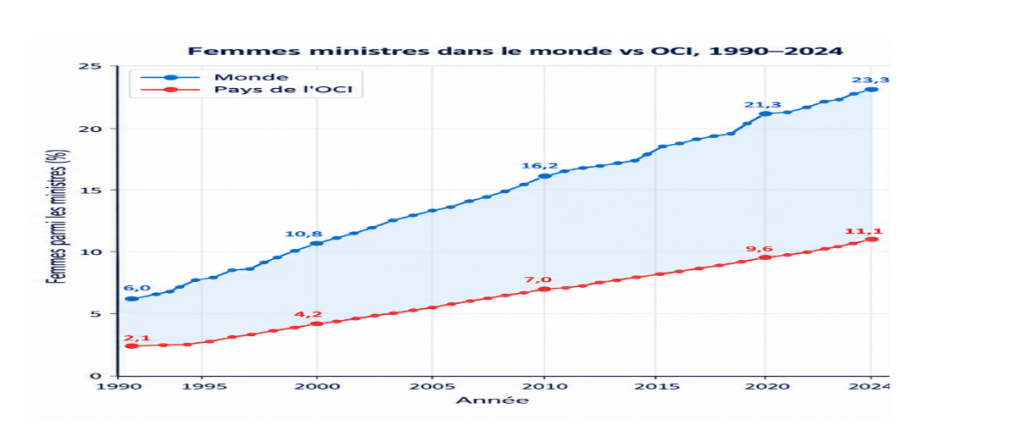
However, it is worth warning the reader that the digital presence of women does not directly measure their “effective political power”; it only provides information on the feminization of governments, without distinguishing between strategic portfolios, influence on the government agenda, or access to real decision-making centers. The true measure of the transformation would be to know whether their progress is accompanied by increased access to sovereign ministries, leading functions, and decision-making mechanisms.
Institutional configurations, styles and individual backgrounds
Women’s path to breaking the political glass ceiling in the party apparatus follows two very distinct trajectories; on the one hand, there are the countries that can be called “push”, where the impetus comes from above: the elites impose quotas or reforms for strategic reasons, often linked to political legitimacy or international image. This is the case in North Africa, Pakistan in Asia and Kuwait in the Middle East, where governments have opened up spaces for women’s representation to display modernization. On the other hand, there are the “pull” countries, where the dynamic was born from below: social mobilizations, feminist movements and international pressure have “pulled” women towards the political sphere. Rwanda, which emerged from a devastating conflict, now holds the world record with 68% of women parliamentarians. In Latin America, Argentina and Mexico have seen their parity laws emerge under pressure from feminist movements. In Scandinavian countries such as Sweden and Norway, they exemplify an egalitarian culture that has fostered high female representation without quotas imposed from above.
The intersection of countries along two axes – the level of institutional support and the degree of dependence on self-esteem (confidence in one’s own ability to act in politics) – produces four configurations.
- “Successful models”(high support, low dependency) include systems that have de-psychologized access to mandates (Tunisia, Morocco, Senegal, United Arab Emirates). In Senegal, the 2010 law has produced such a normalization effect that political ambition has become an ordinary rational choice.
- “resilience” (strong support, strong dependence) corresponds to frameworks where rules exist but are subject to variations in application (Turkey). Individual trust remains essential.
- The “glass ceiling” (low support, high dependence) includes countries without binding quotas, where access to power requires exceptional psychological capital (Nigeria, Japan, Pakistan). This configuration is the most unequal: it selects trust more than talent.
- “Stagnation” (low support, low dependence) No collective dynamic of access to political office occurs in the absence of an institutional framework. Without quotas, only solitary heroines – Bandaranaike, Thatcher, Bhutto, Megawati – are generated, never a norm.
It would also be appropriate to shift from the macro to the micro level to present the profiles of women ministers; two classifications stand out; the ECPR typology emphasizes behaviors and styles: some women are present mainly for image and political endorsement; others adopt a Thatcherite style, conforming to masculine codes to establish their legitimacy; and finally, some are gender-friendly, assuming a political identity based on equality and institutional transformation. The typology by trajectories, on the other hand, emphasizes the paths of access: some arrive through parliament, often thanks to quotas; others are recruited for their technocratic expertise; some are appointed for their partisan loyalty; and still others follow symbolic trajectories, linked to image considerations. (ECPR Cabinets and Gender, Joint Sessions, 2010; Barnes, and al 2026 Gender quota laws and women in cabinets. Journal of Politics).
Women, Islam and Political Power: Overcoming the Paradigm of Cultural Determinism
The gap in women’s representation between Muslim countries and the rest of the world has widened – from 1.6 points in 1990 to 12.2 points in 2024 – and this had fueled the controversial thesis of an “Islamic exception” (Fish, 2002; Hudson & den Boer, 2004), according to which Muslim political culture inherently hinders democracy and women’s autonomy. However, recent literature invalidates this cultural determinism in favor of agency and systemic factors.
Coffé and Dilli’s research (The gender gap in political participation in Muslim-majority countries 2014) highlights a clear finding: in Muslim-majority countries, women participate less in political life than men, and this gap is mainly explained by individual and social factors rather than by the culture or structural characteristics of states. The authors show that education, employment and income play a decisive role: women who are less educated or less present in the labor market have fewer resources and confidence to get involved. In addition, their interest in politics is often lower, as a result of socialization that orients them towards the private sphere and a lack of visible female role models.
This dynamic can be nuanced depending on the living environment. In rural areas, women’s political participation is mainly manifested through community forms of commitment, motivated by a logic of collective empowerment and social recognition. On the other hand, in urban areas, political involvement is based more on personal or family motivations (political heritage, politicized family circle, co-optation in existing networks), all of which is fueled by a high level of education, a more marked cultural openness and the desire to go beyond the “glass ceiling” that limits their access to decision-making spheres (an identical finding was observed by an empirical study – by questionnaire – carried out by Ms Imane HZAINE on women’s entrepreneurship in 2017 among African businesswomen in the Kedge Business School Master’s degree thesis).
Thus, women’s political participation is in fact the result of an interaction between the macro-institutional (quotas, public policies) and micro-social (education, self-confidence, recognition) dimensions. Quotas are not limited to correcting numerical inequality: they transform social and psychological representations, allowing women to convert their individual motivations into assertive political ambitions.
Two-speed Africa
The evolution of women’s political participation in Africa is characterized by two distinct dynamics. In North Africa, progress is mainly based on the late adoption of electoral quotas, often imposed by political elites in a logic of legitimation and social control.
These measures, introduced “from above”, aim to project an image of modernity and to neutralize certain oppositions, particularly Islamists. Algeria is a good example of this process, with rapid progress after 2012, but the rates of female representation remain lower overall than those observed further south. The Muslim religion has not been a decisive obstacle, as some Islamophobes claim.
Conversely, sub-Saharan Africa embodies a “bottom-up” dynamic, driven by the mobilization of women themselves and by international pressure. Post-conflict contexts have fostered ambitious constitutional reforms and a desire to include women in political and social reconstruction. Rwanda is the most emblematic example, with a world record of 68% of women parliamentarians, while Uganda, Ethiopia and South Africa have also seen a strong presence of women in ministries and parliaments. Here, religious diversity has not been a major obstacle; it is above all women’s coalitions, both local and transnational, that have transformed crises into opportunities, relying on international NGOs and regional institutions such as SADC or the African Union.
For example, North Africa illustrates a logic of push factors, where elites impose quotas for strategic reasons, while sub-Saharan Africa reflects pull factors, where social demand and female mobilization attract women to the political sphere. This difference explains why female representation rates are higher and more sustainable south of the Sahara. In sum, while North Africa has progressed through reforms imposed from above, sub-Saharan Africa has undergone a real structural transformation, placing women at the heart of the political process.
The Making Process of Women’s Political Ambition
What the empirical analysis of the determinants of the feminization of executives reveals is above all that political ambition does not arise out of nowhere. It is the product of a combination between a reassuring institutional framework and a solid inner confidence of women. At the heart of this mechanism is a pivotal variable, often invisible but decisive: the perceived legitimacy that transforms a simple legal opportunity into a personal vocation.
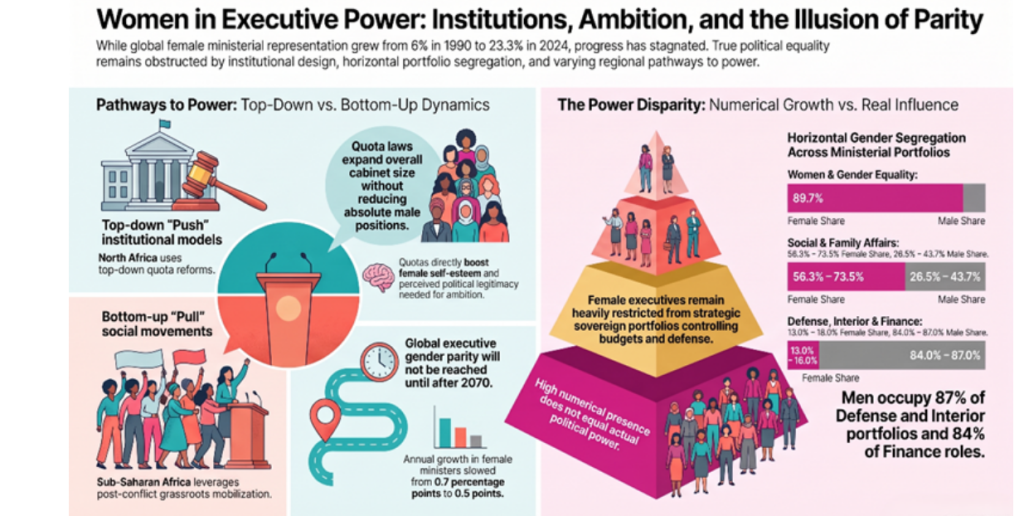
Women’s political ambition is based on two complementary levers: perceived legitimacy (feeling of having one’s place in politics) and self-esteem (confidence in one’s own abilities). Perceived legitimacy plays a central role in the transition from institutional opportunities to political engagement, while self-esteem has the strongest direct effect on political ambition (β = 0.52/0.58). Legal quotas, party openness to the gender dimension and liberal democracy contribute to strengthening this legitimacy, but the effects of different electoral systems remain weaker and variable. In other words, the presence of gender parity-friendly rules is not enough: women must also feel legitimate and capable of exercising power.
The analysis also shows that the effect of institutions depends on the political context and individual resources. Quotas can boost participation, but their effectiveness varies according to the electoral system and the level of self-esteem. Women’s political ambition thus appears to be the result of an interplay between “institutional opportunities, personal trust and social recognition”. Institutions can open the door to politics, but perceived legitimacy and self-esteem give women the confidence to cross the Rubicon.
Women in Politics: Symbolic or Substantive Representation?
The numerical share of women ministers is not a sufficient indicator to measure their power in our opinion; one country can have 40% of women in government while confining them to soft and non-sovereign sectors (social affairs, women’s affairs, culture, etc.); another may have only 25%, but it entrusts them with Finance, the Interior or Defense.
The fact is that the distribution of ministerial portfolios reveals a persistent horizontal segregation, where women remain concentrated in the fields of health and social services or in an intermediate prestige category (culture, environment, trade, tourism), while the sovereign ministries of sovereignty are massively beyond their control.
The most recent global data are clear; they show that 87% of the Ministries of Defense and Interior are held by men, as well as 84% of Finance and 82% of Foreign Affairs. Conversely, the most feminized portfolios are, unsurprisingly, Women and Gender Equality (89.7% women), followed by Family Affairs and Children (73.5%), Social Affairs (56.3%), Social Inclusion and Development (55.4%) and Social Protection (39.9%). Women are also more present in sectors such as culture (35.4%), education (30.6%) and tourism (30.5%), while they remain in the minority in the ministries of energy and mines (11.8%), transport (9.7%) and religious affairs (6.4%). This gendered distribution of portfolios is not insignificant: it limits women’s access to decisions on security, budget and diplomacy, while confining them to areas often perceived as soft.
Moreover, the specialized literature and our observations indicate that the nature and quality of institutions count enormously in the balance; democratic regimes and the voting system directly influence women’s access to positions of power; Single-member majority systems, where only one candidate is elected per constituency, favor men who are already established and make it more difficult for new female figures to emerge, conversely, proportional list systems, which allow the election of several candidates according to the percentage of votes obtained, offer more opportunities to women, because parties can include female candidates on their lists (provided that they are well placed 1st or 2nd position).
In authoritarian or hybrid regimes, even if elections exist, they are often controlled by the establishment in place; women may be present symbolically, but their real influence remains limited.
It can be deduced from the above that the presence of women in government depends less on culture than on political architecture and electoral engineering (form of the regime, voting system, quotas, government recruitment methods, political party system) and women’s individual trajectories, which are often motivated by self-esteem and the desire to break the glass ceiling.