


































































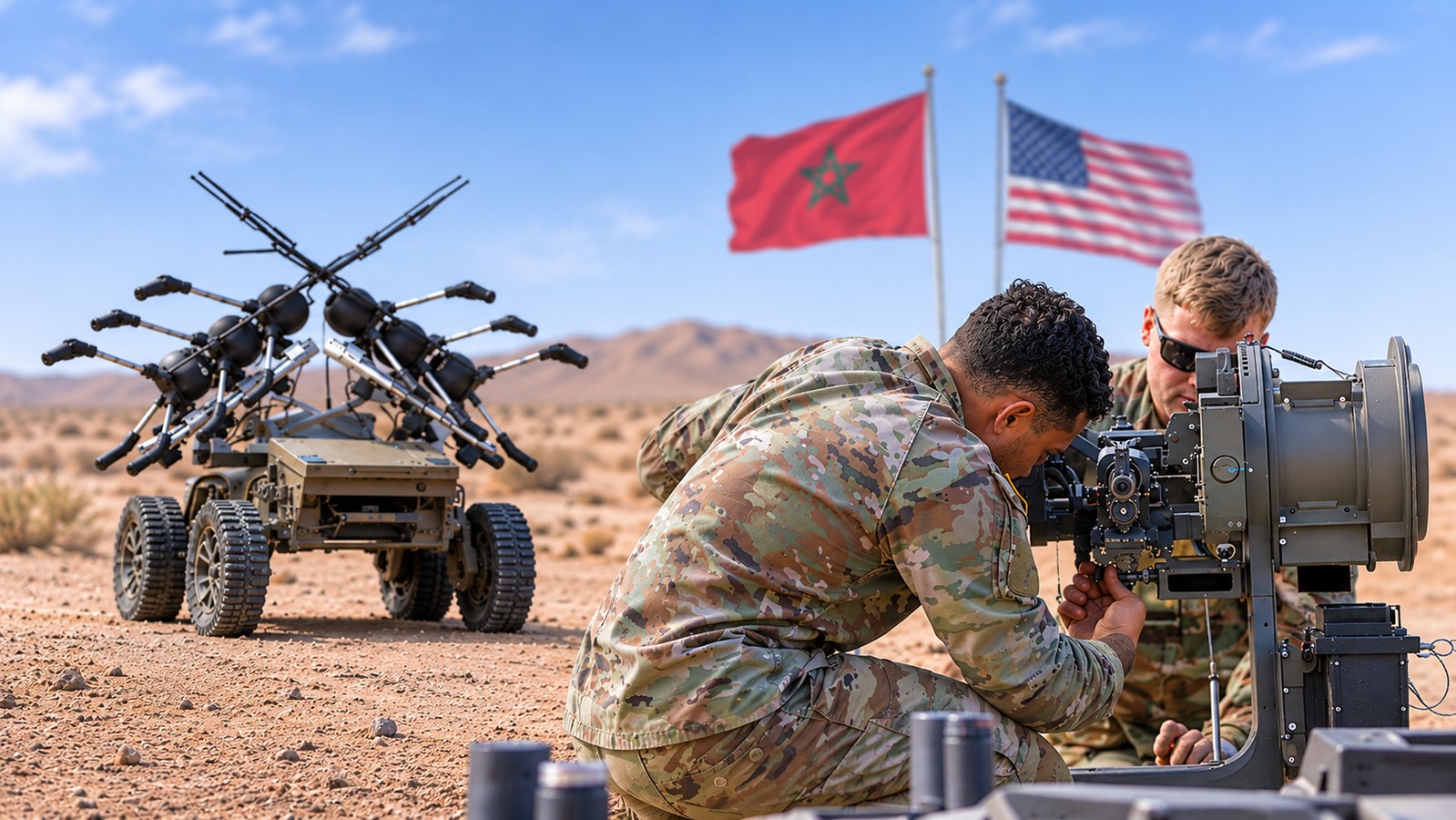
Agadir – Morocco and the United States have tested autonomous military systems designed to detect and counter drone threats during joint military exercises in Tan-Tan, according to a report the US Army shared today.
The tests took place from October 3 to 14 at the Moroccan Multidomain Training Area (MDTA), bringing together US and Moroccan soldiers and more than 10 US defense industry partners.
The exercise, known as Needs-Driven Acquisition for Near-Term Operations Accelerated Capability (NANO ACE), focused on unmanned ground vehicles equipped with counter-unmanned aerial systems (C-UAS).
The prototype systems combined autonomous ground platforms with different mission equipment, management software, and communications technologies. The evaluation aimed to determine whether these systems could extend counter-drone coverage and operate semi-autonomously in difficult terrain and under electronic warfare conditions.
Industry developers tested the platforms against operational requirements, including their ability to navigate unimproved terrain independently while functioning in environments where electronic communications and systems could face disruption.
The initiative also addressed an emerging US joint-force requirement to deploy integrated autonomous sensing and response capabilities within a shorter acquisition timeline.
According to the US Army, the evaluation involved nine military organizations, including the Army Test and Evaluation Command (ATEC), US Africa Command (AFRICOM), US Army Central, and the US Army Southern European Task Force, Africa (SETAF-AF).
Read also: US Army to Test Up to 15 Counter-Drone Systems in Morocco in 2027
The Tan-Tan exercise followed preliminary assessments in Yuma, Arizona, which concluded in September. The tests in Morocco allowed military personnel and industry partners to further assess the technology under different operational conditions.
“Our Soldiers are the ones who will rely on this capability, so they need to put it through the tests now,” said a US Army first lieutenant who helped evaluate the technology. “If it can’t handle this terrain or this spectrum, we need to know before it ever reaches a forward position.”
The accelerated evaluation forms part of a broader US Army effort to reduce the time needed to integrate new military systems from months to days by working directly with defense industry partners.
US Army Major Kyle Rau, a counter-UAS evaluator with ATEC, said the technology could reduce the workload and risks faced by soldiers during operations.
“This particular capability set that we are looking at is something that can save the US Soldiers effort, time and cognitive load,” Rau said. “Also, it can stop them from having to go into that kill zone. Our tests provide a snapshot for senior leaders to make the decision of how and when they want to deploy it and give them a recommendation on possible iterations in the future.”
Morocco-US cooperation on military innovation
The tests are part of broader military cooperation between Morocco and the United States through the planned Africa Multidomain Training and Experimentation Center (AMTEC).
On July 13, the Royal Moroccan Armed Forces and AFRICOM signed in Stuttgart a memorandum of understanding outlining the establishment of the center.
The agreement provides for three components: a multidomain training area, an academy dedicated to drones, and an innovation and experimentation center.
According to the US Army, the Moroccan training area offers conditions suited to testing emerging military technologies, including an open electromagnetic spectrum, uncongested airspace, and challenging terrain.
The October evaluation allowed planners to assess not only the autonomous systems but also the capabilities of the Moroccan training area, which is still under development.
US Army Lieutenant Colonel Corbett Baxter, SETAF-AF deputy director of AMTEC and African Lion branch chief, said bringing military organizations together at the site helps accelerate the assessment and acquisition of new capabilities.
“With the various organizations here, in one place we are able to test, evaluate, validate and procure, so we can put this capability in the hands of warfighters,” Baxter said.
US Army Colonel Woodrow D. Miner, SETAF-AF director of AMTEC, said the initiative gives military formations and private companies an opportunity to test their systems under demanding conditions.
“NANO ACE gives our tactical formations and private industry a series of events to stress test their systems, operate in a degraded and contested area, and find out what capabilities can be provided to senior military leaders on the battlefield,” Miner said. “This allows real hands-on feedback to build the readiness we owe to the joint-force warfighter.”