


 Join on WhatsApp
  Join on Telegram
 By Sydney McCourt
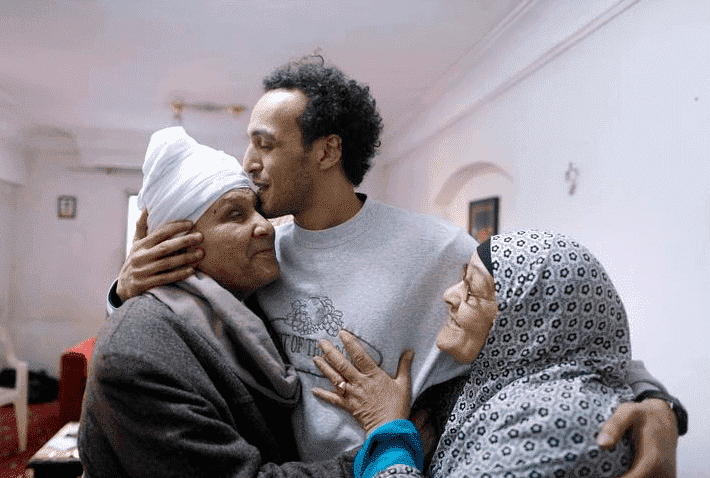
Rabat – Egyptian authorities released award-winning Egyptian photojournalist Mahmoud Abu Zeid, better known as Shawkan, from prison on Monday, March 4, after more than five years behind bars. Security forces arrested Shawkan in August 2013 while he was taking photos of demonstrations in Cairo’s Rabaa Al-Adawiya Square.
Shawkan announced his release by posting a picture on Twitter accompanied by the caption “hello asphalt,” a phrase commonly used by freed Egyptian political prisoners. In the tweet, he also used the hashtag #Shawkan_Is_Free.
The hashtag #FreeShawkan united the international campaign for Shawkan’s release and helped garner support for his cause from a number of major human rights organizations. Amnesty International condemned his imprisonment, saying he was arrested simply for doing his job.
In honor of World Press Freedom Day in 2015, Shawkan wrote an open letter for Deutsche Welle News in which he described the conditions of his imprisonment and called for international support. The letter ends with Shawkan’s desperate plea: “I am a journalist not a criminal…Help Me!!”
Despite the transformation of the hashtag from #FreeShawkan to #Shawkan_Is_Free, his freedom is not unconditional. Shawkan’s release is constricted by the terms of probation, which require him to spend 12 out of every 24 hours at the police station for the next five years.
The head of Reporters Without Borders’ (RSF) Middle East desk, Sophie Anmuth, has said that the campaign to free Shawkan cannot be considered finished until Shawkan has “recovered his complete freedom, not just 12 hours a day.”
Shawkan’s Arrest
Egyptian police arrested Shawkan on August 14, 2013, while he was covering clashes between Egyptian security forces and supporters of former President Mohamed Morsi in Rabaa Al-Adawiya Square in Cairo. The clashes resulted in the deaths of more than 800 people at the hands of the security forces as well as the arrest of thousands, including Shawkan.
The police held Shawkan at Cairo Stadium with journalists Mike Giglio and Louis Jammes, although they released his foreign counterparts after just a few hours.
At the time of his arrest, Shawkan was doing freelance work for UK-based journalist site and photo agency Demotix as well as the digital media company Corbis. In 2013 Demotix sent a letter confirming his employment to the Egyptian authorities in an attempt to gain Shawkan’s release, to no avail.
Security forces took Shawkan into custody in August 2013, but he did not appear in front of a judge until May 2015 when he faced charges of illegal assembly, weapons possession, murder, and being a member of a terrorist organization.
He stood trial in 2018 alongside 739 other defendants, 75 of which received the death penalty. The court sentenced Shawkan to five years, including time served. He spent an additional six months in prison for failing to pay fines for unspecified damages which occurred during the protests.
During his imprisonment, Shawkan received multiple honors for his dedication to journalism from the Committee to Protect Journalists’ International Press Freedom Award (2016) to the UNESCO Press Freedom Award (2018).
International Press Freedom
Since being released, Shawkan has told Reuters that he has every intention of continuing his work as a photographer, saying: “All journalists are at risk of being arrested or killed while doing their work. I am not the first and I will not be the last.” The sentiment rings particularly true because there are still more than 30 journalists in jail in Egypt.
RSF ranks Egypt 161st out of 180 countries in terms of freedom of the press, and considers it “one of the largest prisons in the world for journalists.”
While in a better position than Egypt with a ranking of 135st, Morocco, too, faces criticism on press freedom. RSF notes the increase in judicial harassment of journalists in Morocco. In particular, they criticize the obstruction of the press in the events surrounding the Hirak Rif protests. Most famously, the Moroccan press spoke out against the arrest and imprisonment of Hamid El Mehdaoui in connection to the Hirak protests.


