 Join on WhatsApp
 Join on Telegram
Rabat – After the Hirak protests of the Rif and Zagora and more recently in Jerada, Moroccans need to find another form of civilian resistance to fight those who “own the country” and, ultimately, hit them where it hurts the most: their businesses and profits.
The prices of consumer goods have been rising at an alarming rate in the last five years, while the salaries have not increased at all. As a result, the working class citizens are the most affected. They are living in total unfavorable conditions, with no hope of improvement in sight.
The government—unable to scrap the remaining subsidies of such foodstuffs as bread, oil, sugar, and butane, for fear of facing a popular uprising—is resorting to increasing prices of other products, including petrol.
Two Moroccos, two different speeds
In the past, right after independence, there were three social classes: upper class, middle class, and lower class. Today, the situation has changed tremendously. There are only two classes left, miles apart from each other: the very rich made up of the Makhzen families, military top brass, co-opted politicians, and nouveaux riches, who made their wealth from corruption and embezzlement; and on the opposite side is the class of survivalists, comprised of the former middle class, the poor, and the very poor. As a matter of fact, since the beginning of the third millennium, Morocco has split into two Moroccos, each one cruising at a different speed:
The Morocco of the Golden Triangle comes from the colonial Maroc Utile, which has expanded its territory lately. It starts in Tangier and goes all the way to Laayoune from north to south, then from Casablanca to Fes from west to east. Beyond that are the rural areas and the Amazigh Mountains, where poverty exists to an extreme. There is no decent infrastructure, very high illiteracy, no means of independent subsistence, and rampant poverty. In the past, these regions survived because of employment in Europe, but in the mid-1980s, Europe closed its borders to immigration and the people of these regions fell into total despair, with no jobs and no future for their families.
Officially, Morocco encourages foreign investment, but in the Golden Triangle, the lack of adequate infrastructure in the periphery perpetuates the hopelessness in that part of the country. The colonial Maroc Utile instead becomes truly useless and forgotten when it comes to government development programs.
Moroccan Slums
Even inside the Golden Triangle, not everything is golden when it comes to the life of the total population. Almost every Moroccan city has its own belt of poverty made up of people who migrated decades ago from the countryside because of the drought, hoping to improve their economic status. Instead, they live in utter poverty and are easily recruited by Islamists to carry out terrorist attacks in Morocco or elsewhere or even to join ISIS. This is evidenced by the case in Casablanca in 2003, which was highlighted in the excellent film of Nabil Ayouch, “Horses of God.”[i]
Most big cities in the Moroccan Golden Triangle have their own slums, from which we see pickpockets, drug peddlers, muggers, thieves, prostitutes, and cheap labor emerging en masse. In these slums, the living conditions are terrible. The families are usually large and live in over-crowded and unhealthy shacks where sleeping is done in shifts due to the scarcity of rooms and beds. Nobody has yet died of hunger there because the main foods are still subsidized by the government. However, if the government gives in to the pressure of the World Bank, a popular revolution will no doubt ensue.
In these poverty belts the common investment is a café, of which there are so many. Poor people often joke by saying that, in the poor quarters, “between a café and a café, there is a café,” meaning there is no serious infrastructure. These cafés are crowded all day by unemployed youth seeking escapist solutions to their predicaments by chatting on their smart phones, watching soccer games on satellite television, smoking hashish, or talking to their friends while waiting for the change that is unlikely to arrive on its own.
During the Arab Spring, the Moroccan social movement 20 Février denounced, in massive demonstrations, all the problems of modern Morocco, i.e. corruption, nepotism, embezzlement, patriarchy, and tribalism. Activists called on the monarchy, which is respected and seen as a symbol of stability, to become a true constitutional monarchy through the adoption of incremental democracy. Realizing the strength of this popular uprising, the monarchy revamped the Constitution in 2011 and triggered the devolution of power.
The ensuing general elections brought the Islamists of the Partie de la Justice et du Développement (PJD) to power. However, they did not have any real executive authority since the Moroccan electoral system does not permit strong independent parties, but rather parties that must resort to coalition government cooperation.
Thus, the Islamists governed for a full term of five years but were unable to enforce the new Constitution or stay true to their electoral platform. Instead, they had their own share of power abuse and sex scandals, just like other secular parties in the past. Prime Minister Abdelilah Benkirane spent those five years squabbling with opposition parties instead of bringing the programs of his party’s electoral platform to fruition. As a result, the Islamists fell in popularity with the general public, which had originally wholeheartedly supported their policies and objectives.
However, in 2016, despite the general public disapproval of their performance, PJD still won more seats in the general elections (125 of the 395 seats in the House of Representatives, a gain of 18 seats compared to the 2011 elections). In contrast, they lost the support of the Makhzen because they could not form a coalition government for almost six months due to the intransigence of the opposition. This was somewhat blamed on Benkirane’s pig-headedness, but in reality the perception of the Islamists’ strength is waning worldwide. The opposition wanted to impose their own man, the rich businessman Aziz Akhennouch, to curtail the Islamists’ influence and potency.
The rich population in Morocco has always had access to the Makhzen and its privileges in return for blind allegianceand unquestionable support. Akhennouch and all the rich people of the country are automatically allies of the monarchy and are in agreement with a mutual advancement agenda.
The Cyber Hirak
The government does not seem to show any signs of wanting to end the grassroots Hiraks of the country peacefully. Instead, it is putting the militant activists on trial and might even condemn some of them to the death penalty to preserve its hiba (loftiness) and state standing.
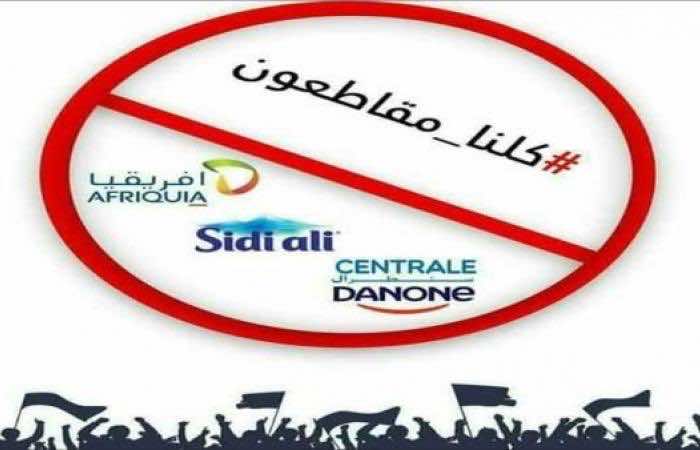
In the face of the intransigence of the establishment and as a further manifestation of the Arab Spring, the Moroccan poor people launched the electronic Hirak, boycotting the products of two rich Moroccan rentiers: Akhennouch’s dairy products (Lait Centrale, Danone, etc., as well as Afriquia petrol) and Meriem Bensaleh’s popular mineral water (Sidi Ali).
In this regard, Safae Kasraoui states forcefully in Morocco World News that:[ii]
“Baraka criticized the exorbitant prices of hydrocarbons, ‘which have reached a maximum that citizens can no longer stand.’
While several officials called the campaign a weak plot, Baraka said that ‘the important thing is not to know who is behind the campaign, but rather to understand the message conveyed’ through the campaign.
The official said that the campaign reflects the suffering of citizens due to the high cost of living.
Several Moroccan celebrities have also expressed their support and solidarity with the online boycott campaign in protest of the rise in commodity prices, including Moroccan divas Asmae Lamnawar, Latifa Raafat, Saida Caharf, and Najat Aatabou.”
So far, the boycott, using primarily Twitter, Facebook, and WhatsApp, is a total success because Akhennouch, his profits dwindling, publicly called the boycott an act of treason. Nevertheless, the grassroots activists, angered by his attitude, will be tempted to include his other products in the boycott in order to punish him and bring down the prices of foodstuffs on the eve of Ramadan, a month of larger consumption.
The electronic Hirak will certainly strengthen the Islamists and their government, now led by Saadeddine Othmani, which were powerless since the formation because of heavyweight politician Akhennouch. Now, the chances of the latter leading the next non-Islamist government are nonexistent. This will undoubtedly disappoint the establishment that was counting on him to reduce the influence of the Islamists, especially after the miserable failure of the palace party Parti de l’Authenticité et de la Modernité, led by Ilyas Omari. This electronic uprising might even weaken other politicians close to the palace in the future.
Who is behind this electronic Hirak?
This uprising calls itself a “spontaneous movement,” but in reality, it is not. It is more likely that the PJD is behind it because Benkirane holds a grudge against the establishment for removing him from the government. It is a well known fact that one of the strengths of PJD is its electronic army, known as Al-kataib Electroniya, which is able to shape the public opinion through WhatsApp and other social media using the partaji ya mouwatin (“citizens, share the message”) successful scheme.
On this particular point, Zoubida Senoussi writes in Morocco World News:[iii]
“While some believe that this campaign comes as a direct result of denouncing the high cost of living–especially ahead of Ramadan, which witnesses a high peak consumption demands of dairy products–others opposed the boycott, asserting that this call is essentially a settlement of political accounts rather than an outburst of popular anger.
Moroccan media outlets, such as the Arabic daily Al Ahdath Al-Maghribiya, claimed that this campaign, which will run for over a month, is a facade for a deeper political manipulation, orchestrated by what they have termed an ‘electronic army’ close to Abdelilah Benkirane, former head of the Moroccan government and former Secretary General of the Justice and Development Party (PJD).”
The Arab Spring has turned violent in Yemen, Syria, and Libya lately and has dissolved the dream of democracy of the majority of Arabs. Will the Moroccan electronic uprising be able to revive the moribund Arab Spring and offer the poor a new means to make their voice heard?
Only time will tell.
The views and opinions expressed in this article are those of the author and do not represent any institution or entity.
© Morocco World News. All Rights Reserved. This material may not be published, rewritten or redistributed without permission.
You can follow Professor Mohamed Chtatou on Twitter: @Ayurinu