In the seemingly barren southern deserts of Israel, a research institute is making immeasurable bounds towards productive dialogue between Arabic, Jewish-Israeli, and international communities. The Arava Institute for Environmental Studies (AIES) aims to tackle obstacles impeding “environmental and regional cooperation” in their uniquely historic and all-inclusive environment.
Arava aims to find sustainable solutions for crises such as environmental problems caused by the political unrest of the Middle East. Political tension spills into environmental issues in cases like the Hebron Bresur River.
Heavy pollution of the Hebron Bresur River effects communities in both the West Bank and Israel as it runs through both regions and deposits into the Mediterranean River. No government of affected areas has taken official responsibility for the waterway or funding its maintenance, so there have been no serious initiatives to address this issue before AIES.

Academics that foster a global perspective
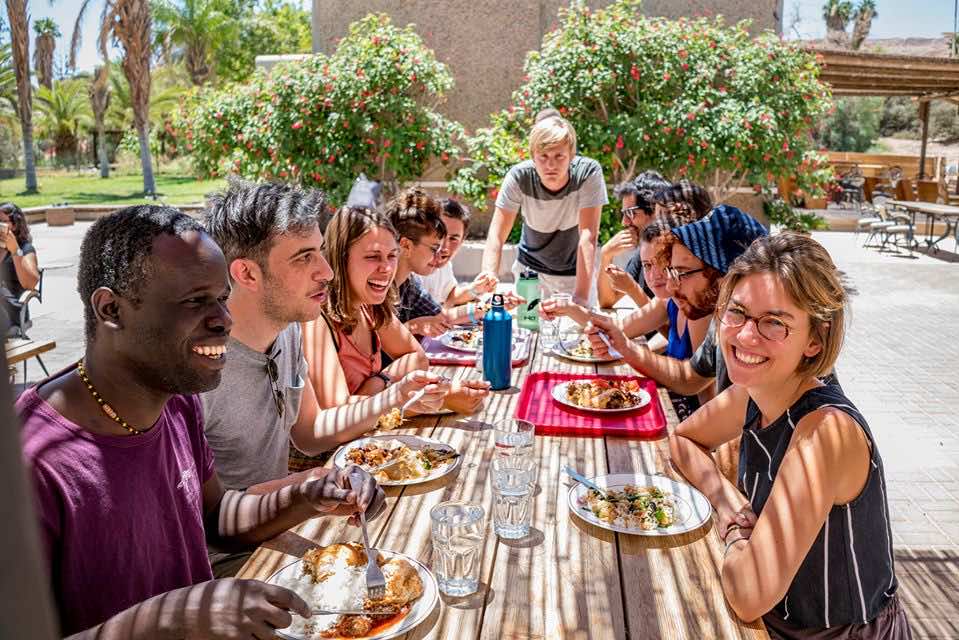
One of AIES’s primary goals is to bring Middle Eastern students across holistic borders while working together to protect the earth. Jewish-Israelis, Palestinians and Jordanians, and Europeans and North Americans make up three equal portions of the student body. No other research institution’s diversity in Israel matches AIES’s.
The institute does not have a political agenda but intends to create open and honest dialogue between young people of historically conflicting backgrounds.
Interestingly, the goal of daily academic discussion is not to make everybody agree. Instead, it is simply to offer a protected space where everyone’s voice can be heard. The environment of inclusivity and consideration at the Arava Institute and throughout the greater kibbutz finds its basis in the principle of necessary compromise.
Students with opposite backgrounds gather in the same desert classroom to practice value-based learning that expands their understanding of themselves as global citizens before national citizens.
Read also: The Climate Crisis Could Help Fuel Peace in the MENA Region
An even more uncommon social life
The institute is located within Kibbutz Ketura, an unexpected plot of luscious green in the middle of the Arava Valley’s 166 kilometer-long desert. In the region, Ketura is one of 10 similar kibbutzim, or communal agricultural and commercial societies of the 20th-century.
Traditional kibbutzim, of which Ketura is one of the remaining few, have members who share everything from their incomes to their clothes for the sake of the community’s collective growth.
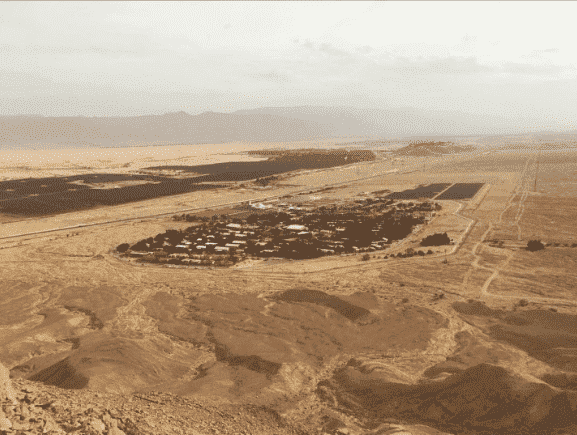
Today, the Arava Valley’s kibbutzim each have their own character and particular structure for reasons such as varying degrees of financial privatization to sheer difference of personalities. At Ketura, even though they are not technically members, the AIES students are incorporated into kibbutz life in such an inclusive way that they say they are growing as individuals as well as research scientists.
Students eat in the kibbutz dining hall, mingle in the kibbutz pub, enjoy Shabbat celebrations, and gather with kibbutzniks around starlit campfires every weekend. There is a strong atmosphere of comradery on the kibbutz. Students most often spend their free time playing sports in the sand, chatting over some Arabic coffee, or sharing ideas around a tobacco-filled hookah.
An important characteristic of the kibbutz that helps sustain the students’ sense of solidarity is the lack of emphasis on valuing material things. The spiritual atmosphere of the kibbutz in tandem with the omnipotence of the Arava Valley’s openness and towering mountains creates undeniable encouragement for students and kibbutzniks alike to deeply connect with the nature around them.

An emotional dissonance
The bonds that students of the Arava Institute create with one another are undeniable and withstanding. Their connections extend past the student realm into the Arava faculty. The program director of academics, Cathie Granit, said the alumni are the most rewarding aspect of her job. Their unrelenting support of the institute after their period of study is one of the organization’s strongest attributes.
Every year, past students come back to Israel’s desert to reconnect, guide new students, and simply dance.
Unfortunately for many, getting through the beginnings of being a student was not as cheerful. During one spontaneous campfire in Janurary 2019, young kibbutzniks and volunteers gathered with students from the West Bank, Gaza, Jordan, the US, Kenya, Germany, and Australia to talk freely about their experiences. The heaviest stories came from the Arabs in the circle as they spoke of the obstacles they overcome every day.
As the Palestinians and Jordanians spoke, all but one told of the societal shame they faced at home before entering Israel. Some families deemed it an inexcusable act, no matter how humanitarian the cause.
One couple heart-wrenchingly recalled having to physically throw themselves over a fenced border in the dead of night in order to make it to the institute unnoticed and uninhibited.
Some confided that they had never met or shared a real conversation with an Israeli before arriving for their studies. They told of the considerable cognitive effort needed to break down a negative perspective of Israelis. Even if that obstacle is overcome, one student mentioned, “It was exceptionally difficult to share my stories of lost loved ones with my new and close friends, then see them pick up a gun the next day and walk with the Israeli army.”
Read also: World Water Week: Crisis Drives Regional Cooperation
Accomplishments without borders
The Arava Institute continually builds its reputation as the heart of Israel’s renewable energy research as its students collaborate with kibbutzniks to find feasible and sustainable solutions to environmental issues of a particularly difficult climate: Extreme solar radiation paired with water scarcity.
In addition to the institute’s center for renewable energy and energy conservation; academics span centers for transboundary water management; sustainable agriculture; hyper-arid socio-ecology; as well as a Jordan-Israel center for community, environment, and research.

Ketura’s Arava Institute houses Israel’s first solar field and expanded its accomplishment by further developing the system to include the nation’s first self-cleaning panels. The institute is also a home for massive algae research, considerable desalination projects, and remarkable biogas technologies.
The greatest accomplishment of the institute may not be in physical technology, however. It is the relationships between the students and their stories that are making change on a deeper-rooted, more wide-ranging basis.
According to Cathie Granit, one of the most important aspects of the institute is that the alumni carry their legacies back to their home communities. The alumni travel back to America, Europe, South Africa, and more importantly, to Jordan, the West Bank, and Gaza while telling of the kindness they met in the Israeli desert.
They speak openly as they did around the institute’s campfires, about their constantly changing perspectives about the people unlike themselves. In this way, the Arava Institute for Environmental Studies trains students who are continually active members in an issue far larger than themselves: Building and spreading peace around one of today’s most historic global crises.
Read also: Environmental Innovation: A Shared Palestinian and Israeli Value