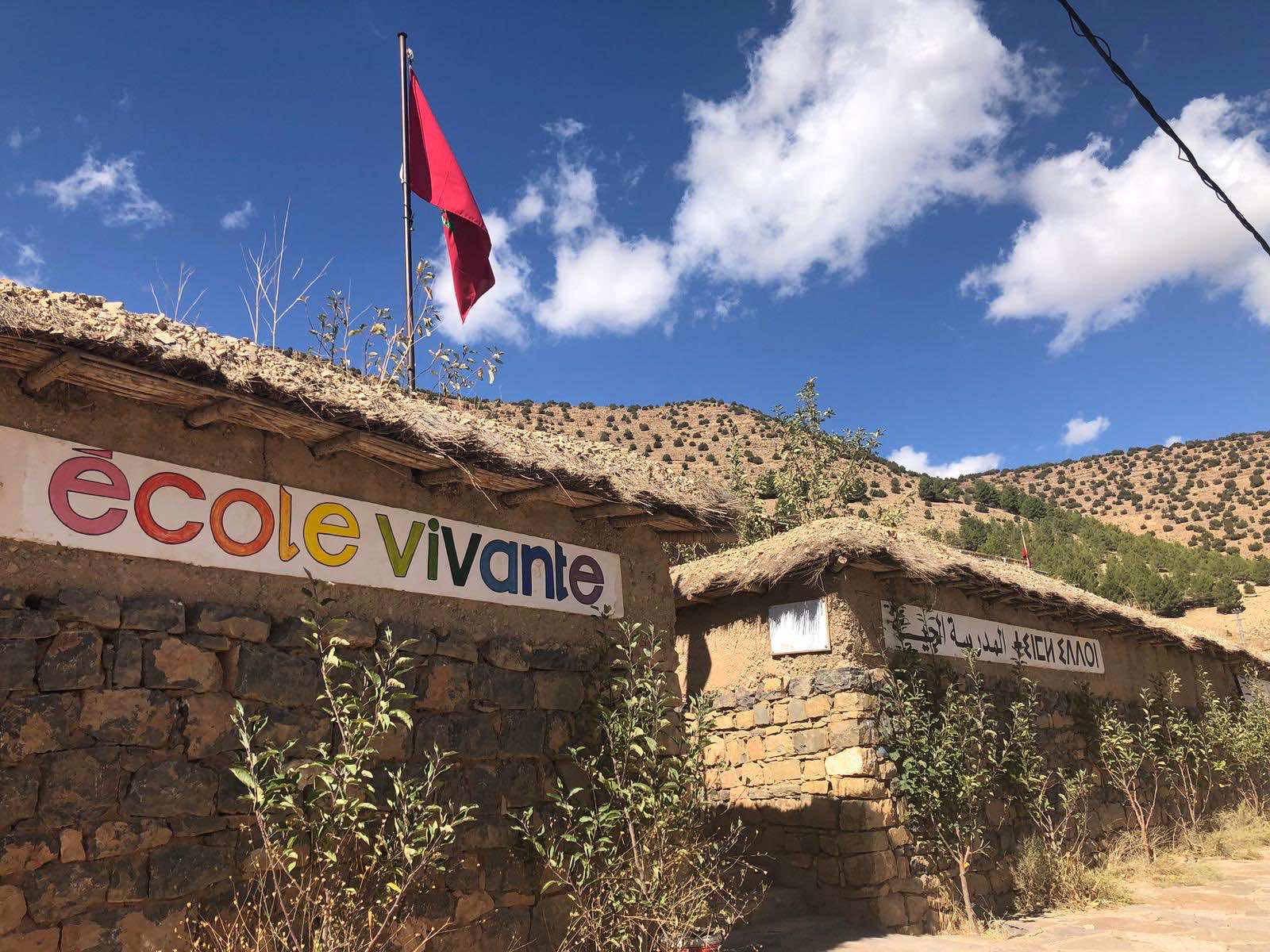
Rabat – Nestled deep in the High Atlas Mountains along the Ait Bouguemez valley, approximately 180 kilometers east of Marrakech, is a school in the small village of Timmit, offering a surprising curriculum — one that may inspire a more sustainable and inclusive future for coming generations.
There are a number of reasons why Ecole Vivant’e or the “Living School” is unique compared to other schools in Morocco, but what may set the school apart most from others is the surrounding garden, compost toilets, chicken coops, greenhouse, rain harvesting buckets, irrigation and drain water systems, and fenced-in land for reforestation. Another unique feature is the school’s deaf education program.
Joana Baumann, 31, and Lukas Muller, 30, first arrived in Morocco from Switzerland in 2009. Lukas, tasked with a university project to explore permaculture in different climates, originally planned to produce a small garden at his friend’s home. His plans evolved after the couple was coincidentally introduced to Itto Stefanie Tapal-Mouzoun, a German woman settled in the Ait Bouguemez valley, in the process of establishing a new school.
“We found out that our idea and their ideas harmonized very well. They wanted to have a garden for their school lessons, to teach outside. Because as the name says — ecole vivant’e. It says what it means,” explained Lukas, who stressed his support for students learning through active and experiential means.

The couple quickly immersed themselves in the collaborative development of the school. Lukas strives to build spaces and systems around the school that will lend themselves to a self-sustaining ecosystem and opportunities for students to build independent life-skills.
Joana, with her background in anthropology and teaching, took on the responsibility of working with local teachers and establishing a curriculum that supports the permaculture projects.
What is permaculture?
“What we are trying to do in a permaculture system is create a natural cycle. You want to produce as much energy as the system consumes. That is not something you can say about today’s agricultural systems — they are consuming much more energy than what they are producing,” explained Lukas. “And what is being produced now is mostly money. More than food, actually.”
The portmanteau “permaculture” originally derives from “permanent” and “agriculture” but has since taken on the entity of “permanent culture.”

Permaculture practitioners, Lukas and Joana included, conclude that the term itself is nebulous, as it encompasses a diverse set of ideas and various approaches. However, the overall practice is couched in three ethical principles: Earth care, people care, and fair share. Earth care and people care describe the effort to nurture natural environments and communities, while fair share refers to the concerted effort to share and equally distribute resources in a way that allows surplus energy to be returned to the earth and to those in need.
Experts in permaculture identify the process as an opportunity to build resilient and adaptable cultures and land by working with nature, rather than against it. Many suggest that the philosophy may be the solution to coping with climate change and bolstering the earth and our communities with more healthy and sustainable living solutions.
“It is shown by time why permaculture is needed and good”
Students at the school each have their own plants to grow and pieces of the project to which they must tend, work that is woven into the school’s hands-on curriculum. Still, the entirety of the system is immense and requires local commitment to manage and upkeep the systems.
Convincing the community that this project is a worthwhile investment has been a challenge, mostly due to the slow nature of the work and the time it takes to witness results. Additionally, Lukas and Joana have not felt comfortable directing the Amazigh (Berber) community to change without their own accords.
“I’m not trying to tell anyone how to do anything. It’s the idea of creating a demonstration site and they can convince themselves. I don’t want to be a ‘missionary,’ because I myself don’t know exactly what I am doing. I’m reading all the permaculture books. This is also my school to learn from.”
One of Lukas’ projects was to install a fence around the school’s property and plant trees. He said that in time, he hopes the reforestation will inspire new strategies to maximize the land’s use for animal grazing. Already, the land is proving to be more nutrient dense and favorable to shepherds.
“After one year of the fence being up, it will be a paradise for goats. This is showing how powerful nature is. It needs renewal. If you graze everything all the time, we see what is happening right now. A lot of erosion and no growth.
“The fence is not the forever solution, but it is demonstrating what is possible if there is better management of grazing.”


Lukas said that these projects are not necessarily new ideas within the community. However, with population growth and an increase in sheep and goats herded on the land, nature is struggling to keep pace. Most of the community has bought into industrial or less sustainable agricultural and animal husbandry practices.
Managing the water systems in the community has also been a challenge and although at first, the community did not understand the need for a water drainage system, locals eventually applauded Lukas and Joana for their efforts.
“We made a public presentation where we invited the whole valley and presented what we had done and why. In the end, we had to wait until there was a big rain [for people to understand the project]. All the roads were destroyed and land was taken down. But in the school’s place, no earth was taken down because of the system Lukas installed,” Joana recounted. “You saw the teachers looking at the slope and saying ‘nothing has happened here.’ This is when they saw permaculture is important.”
At times throughout the year, the region is extremely dry and the community struggles to access enough water for all of their needs. “They have a lot of problems with water management. Permaculture is giving a really good solution,” said Joana. “It [water scarcity] is something that the whole world will deal with. Water is rare on the planet.”
Thanks to the Joana and Lukas’ efforts, the school, with over 80 students enrolled and 25 teachers, no longer depends on the village’s water supply and harvests its own water through a number of installed rain water buckets.
“It’s all about the students – while they are growing up and learning – we hope that they will take this experience with them and might be inspired to think and live more independently”
Ecole Vivant’e is a public school, recognized by the government but independently financed. It enrolls students from kindergarten through high school and works to balance a government-issued curriculum and learning materials with a different institutional concept.

Overall, the community has taken interest in the non-traditional initiative. Many locals, inspired by the school’s compost piles, began to build their own composting systems at their homes. As the school slowly reaps what it has sown, the number of families interested in the alternative form of education has grown.
“The greatest thing the community has given us is their trust,” said Lukas. “By time it is going to show what it will bring.”
Lukas and Joana live simply in order to make projects like this one possible. When asked why they have dedicated so much time and energy to the remote valley, they respond with, “Why not? This is a good time and it is pure interest. We didn’t get paid for it and it was all our own investment, but for the past few years, there are people financing the school and also financing our ideas.”
Splitting their time between Switzerland and Morocco, they return to Ecole Vivant’e at least twice a year, spending a month or more collaborating with the local community to address issues of drought and erosion, while also discovering alternatives to today’s wasteful agricultural systems. Their goal is that the school will no longer need their support and the local community will sustain the permaculture system without them.
“We are hoping that one of the students will be interested in managing this project and bringing it into the next generation — a local person from Ait Bougamez who can bring this vibration into their Amazigh culture,” said Joana.
Parallel to the permaculture project, the school supports a growing number of Morocco’s deaf community. Morocco’s deaf and hard of hearing have long been left out of traditional education systems for lack of resources and programming dedicated to supporting their specific learning needs. Now, deaf students and teachers from across the country have made their way to the remote valley in pursuit of an education and new opportunity.