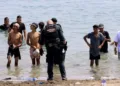
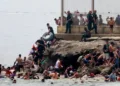
Since Mediterranean countries closed borders last March to fight the spread of Covid-19, undocumented migrants and refugees remained without shelter or sources of income. The consequence is that a large number of them have been facing precarious health situations and exacerbated dire economic conditions.
For many, income and livelihood depend on mobility. In my recent research, I explore how the majority work in the informal economy (street vendors, peddlers, and uncontracted work such as cleaners and maids). Now with border closures and lockdowns, many have lost their jobs and cannot qualify for any financial support by the government.
Stigmatization, misinformation, and segregation have led to further restrictions for migrants. Fake news and reports pretend that migrants carry the Coronavirus and spread it throughout communities. New restrictions on mobility will have longer-term negative impacts on migration and an increase in social exclusion, leading to issues like racism and xenophobia.
Limited mobility forces more migrants desperate for jobs to turn to smugglers, increasing vulnerability to human trafficking and abuses in the exploitation of migrants’ desolation. This includes additional probable restrictions on migrants and asylum seekers in search of refuge in third countries, like Spain or Italy.
Conventionally, an emigration country, Morocco is fast becoming a migration passageway into Europe, with land access to the border in the Spanish enclaves of Melilla and Ceuta, a habitually safer route as opposed to Libya where violent conflicts are unending. Although the number of illegal border crossings into Spain has halved since 2018, most migrants entering into mainland Spain last year came from North Africa (32%), and 68% coming from West Africa.
Last July, nearly 800 migrants tried to enter the Spanish enclave of Ceuta, according to the local authorities. About 100 were stopped by Moroccan police, others were intercepted by Spanish border officials and sent back to Morocco, and 602 eventually reached Spanish territory.
Morocco has a policy to crackdown on illegal border crossings into Europe. Arriving at the Spanish border, undocumented migrants are caught and transported back to Southern Moroccan cities far from smugglers who could offer them passage. As Moroccan and Spanish authorities continue to restrict movement on their borders, undocumented migrants and smugglers are forced to pursue new routes, such as by sea, which is often more hazardous.
Since 2014, the Moroccan government has given residency permits to nearly 50,000 migrants. However, the United Nations High Commissioner for Refugees (UNHCR) reports that “gaps in accessing documentation and employment persist.”
According to the Moroccan Red Cross, there are thousands of refugees and asylum seekers living in poverty, although the government says it provides support for those who need it. Access to education is limited, and socio-economic inclusion is inexistent in many countries.
With tighter migration restrictions on popular destination points, such as Spain and Italy, Morocco could see larger populations of undocumented migrants stuck indefinitely in migration sites such as Rabat, Casablanca, Fez, and Oujda. Civil society organizations like The High Atlas Foundation and Orient Occident Foundation provide them with basic foodstuffs such as rice, oil, sugar, and basic medicines.
The National Institute for Solidarity with Women in Distress distributed 40, 000 face masks and food supplies to 8, 500 sub-Saharan migrants in Rabat, in addition to hundreds of liters of bleach, 8,000 bars of soap, and 4,500 new packages of food.
However, as the Coronavirus crisis deepens, many associations and charities have had to cease operations, reducing support for large numbers of vulnerable people.
The National Council for Human Rights and the Moroccan Association for Human Rights have asked the authorities to speed up aid to these particularly vulnerable groups.
Last May, in partnership with the Moroccan government, the UNHCR and the National Council of the Medical Association jointly provided increased health care access and medicines for asylum seekers and refugees.
However, in Libya – the most dangerous sea crossing for migrants in the world – restrictions have prevented humanitarian boats from rescuing migrants stranded at sea – with migrants forced to return to a country mired in a dangerous conflict. Thirty undocumented migrants were killed last June by traffickers in Mizdah, southern Libya, whose victims came from African countries.
Thousands of refugees and migrants in Eastern and Western Africa die, while others face tormenting abuse in their attempts to reach the Mediterranean coast in search of a better life, according to a recent joint UN/Danish Refugee Council report. Testimonials published by the UN refugee agency, UNHCR, reveal random killings, torture, forced labor and beatings.
There is likely to be a sharp rise in attempts to migrate to Europe once travel restrictions are lifted – not least because lockdowns in African states have aggravated poverty and have caused more damage to already struggling economies.
As for European states, some have used the Covid-19 pandemic to once again politicize the issue of migration. For example, Malta has closed its ports and returned migrants at sea to Libya, while Italy said migrants would be quarantined on rescue boats. Austria, a country with a long track record of harsh anti-migration policies, has frozen the right to asylum using Covid-19 as justification.
There is a danger that Covid-19 will do long-term damage to migrant rights, as states continue to adopt inward-looking policies to try and keep out not only people seeking better economic opportunities in Europe, but also those fleeing war and political persecution. The phenomenon is complex and transnational; besides the northern side of the Mediterranean has also a big responsibility.
There is need for action and collaboration among countries to help vulnerable people on the move, prioritizing health support during the pandemic, and implementing internationally agreed measures to target businesses and individuals involved in people smuggling. There is also need for investment in the countries of origin, to provide desperate people with an alternative to having to put their lives in the hands of traffickers.
Moha Ennaji is President of the South North Center for Intercultural Dialogue and Migration Studies in Morocco. His most recent books include Muslim Moroccan Migrants in Europe and Managing Cultural Diversity in the Mediterranean .