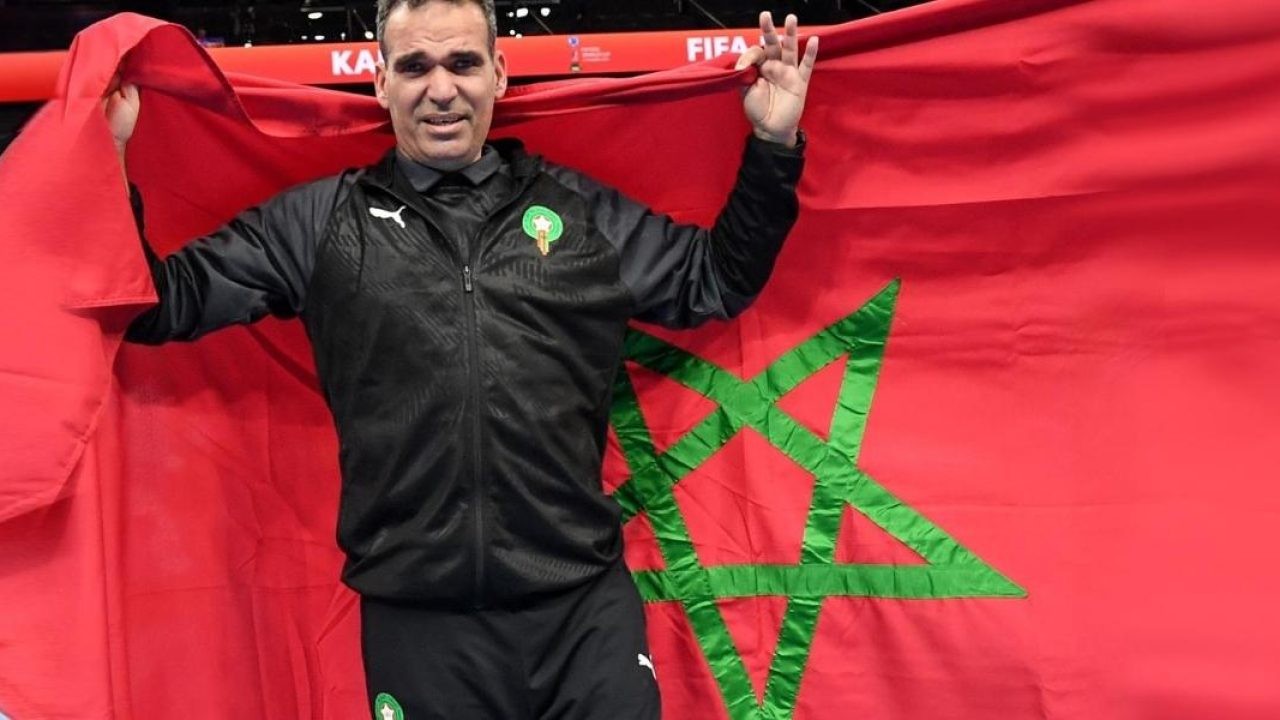
Rabat – After a resounding 13-0 victory over Zambia on Monday, all eyes are on the Atlas Lions as they are steadily working their way towards winning the Futsal Africa Cup of Nations for the third time in a row.
Behind their stellar run is Moroccan coach Hicham Dguig, who has led the Moroccan futsal team to continental and even global success since taking the reins of the national team in 2010.
Dguig has steered the team to unprecedented heights. Under his leadership, the Moroccan squad has clinched several prestigious titles, including the two latest editions of the Africa Cup of Nations in 2016 and 2020 and the Arab Cup for two consecutive years in 2021 and 2022.
Born in the northern Moroccan city of Tangier on March 31, 1973, Dguig’s journey from player to coach has been nothing short of remarkable.
He has successfully elevated the Moroccan futsal team to the global stage, securing an impressive 8th position in the world rankings, and surpassing both African and Arab competitors.
However, his path to success was not an easy one. Those close to Hicham Dguig remember the days when his ambitions for the national sport were dismissed by sports officials in Morocco, who are said to have repeatedly told him that he was punching above his weight.
Dguig credits Fouzi Lekjaa, president of the Moroccan Royal Football Federation (FRMF), for providing the necessary resources and opportunities for the team’s success. “This man has given us everything, believed in me and in this sports type, and all the credit goes to him,” he said at a recent press conference.
Even as his team continues to seal its dominance over the African and Arab futsal scenes, he has consistently shied away from taking all the credit for their dizzying success.
Read also: Morocco’s Futsal Team Secures Semi-final Spot in 2024 AFCON
Lekjaa’s personal involvement and the laudable work the Moroccan federation has been doing to make Morocco a footballing powerhouse have been the main drivers of the national futsal team’s achievements, the coach has constantly suggested.
“Before Fouzi Lekjaa’s arrival, I used to come at 8 in the morning and wait until 6 in the evening, just hoping to get a training camp, and I would hear in the corridors of the federation, ‘Is that person still here?’” he said in a recent interview as he reflected on his early struggles to gain institutional support.
His dedication to futsal extends beyond the pitch. He spends countless hours researching new developments in the sport, believing that with perseverance and determination, nothing is impossible.